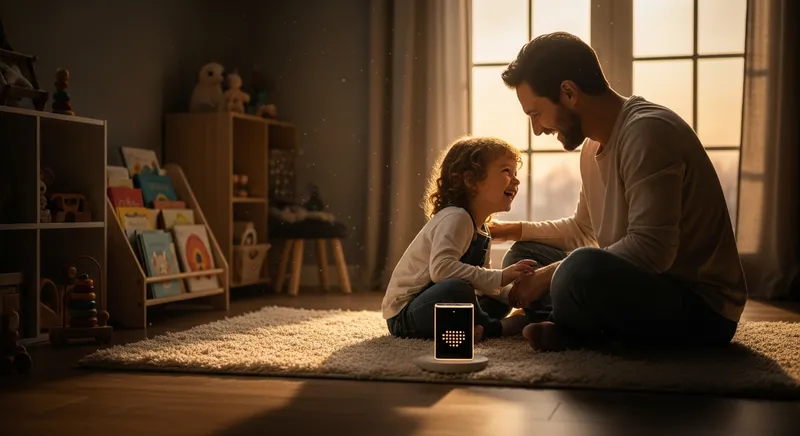
You've seen them all over social media and topping every "best kids' gift" list. You've heard the whispers in parent groups. You're trying to do the right thing by reducing screen time, and your research has led you here, to the two biggest names in screen-free audio: Yoto and Toniebox.
But maybe you also have a nagging feeling. Is buying a new plastic device-and committing to an endless stream of expensive plastic figurines or cards-really the only answer? If you're weighing the costs, the potential for lost pieces, and the growing pile of stuff in your playroom, you're not alone. We get it.
The search for quality, educational, and screen-free entertainment is real. Experts from the American Academy of Pediatrics (AAP) recommend limiting screen time for young children, and research highlighted by institutions like NewYork-Presbyterian Hospital shows that kids who spend less time on screens often perform better on thinking and language tests.
So yes, Yoto and Toniebox are popular for a reason. But what if the choice wasn't just between two different physical players? What if there was a third option that other reviews miss-one that is more creative, cost-effective, and doesn't involve buying more stuff? Let's break it down.
The Search for Screen-Free Magic: Why Yoto and Toniebox Are So Loved
First, let's be clear: both the Yoto Player and the Toniebox are fantastic tools for getting kids to listen to stories and music without staring at a screen. They have captured the hearts of families worldwide by offering a tangible way for kids to control their own audio adventures. One is a soft, squeezable box that plays stories when you place a character on top; the other is a minimalist cube that uses physical cards. Both are designed to give kids independence and parents a well-deserved break.
But as we move further into 2026, the conversation around kids' media is evolving. Parents are looking for more than just playback; they want interactive, creative experiences. The initial magic of these devices can sometimes give way to practical frustrations. We're here to give you the honest, head-to-head comparison you're looking for, and then introduce a different kind of story time magic.
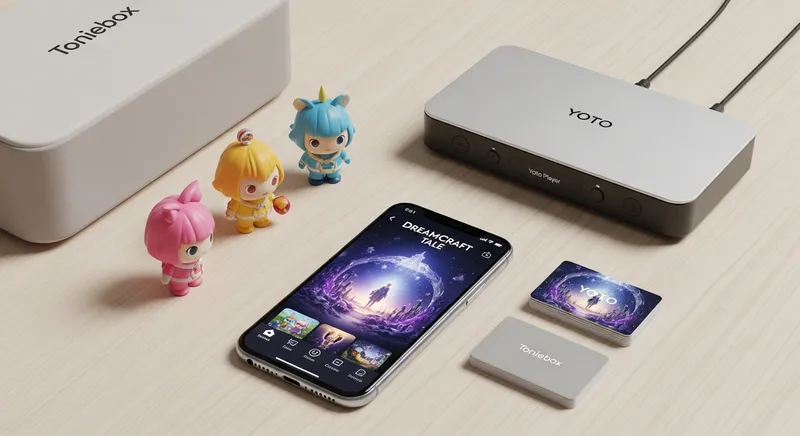
Yoto vs. Toniebox in 2026: An Honest Head-to-Head Comparison
Let's put these two audio giants side-by-side to see how they stack up on the factors that matter most to parents.
Design, Durability, and Portability: Yoto Player 3rd Gen vs. Toniebox
The Toniebox is famous for its design: a soft, padded cube with no sharp edges, built to withstand tumbles from the nightstand. It's undeniably durable and its simple "ears" for volume control are perfect for little hands. It's designed for parents who want a simple, robust device for kids under 10.
The Yoto Player has a more modern, minimalist aesthetic. It's a sturdy plastic cube with a simple pixel display that adds a bit of visual engagement without being a full-on screen. As noted by reviewers at The New York Times' Wirecutter, who called it a favorite gift, its design feels a bit more mature. For travel, the smaller Yoto Mini is a clear winner in portability.
Actionable Tip: Think about where your child will use their player most. If it's for a rough-and-tumble toddler in the playroom, the Toniebox's squishy design is a plus. If you need something for quiet time in bed or for long car rides, the Yoto Player or Yoto Mini might be a better fit.
Age Appropriateness: Yoto vs. Toniebox for Toddlers vs. 5-Year-Olds
This is one of the biggest differentiators.
- Toniebox (Ages 2-5): The physical, toy-like nature of the Tonie figurines is a massive draw for toddlers and preschoolers. They can easily grab their favorite character, place it on the box, and listen. It's intuitive and connects the story to a physical toy.
- Yoto Player (Ages 4-9): The card-based system requires a bit more dexterity and understanding, making it better suited for preschoolers and older kids. The content library also skews slightly older, featuring chapter books, podcasts, and activities that will keep a 5, 6, or 7-year-old engaged for far longer than a toddler.
Actionable Tip: Consider your child's developmental stage and your desire for longevity. The Toniebox is often a perfect first audio player, but kids might outgrow its toy-like feel. The Yoto Player has a longer runway, growing with your child as their interests mature.
The Real Cost of Yoto vs. Toniebox: A Total Ownership Breakdown
Here is the part most reviews gloss over: the true, long-term cost. The initial price of the player is just the beginning. The real expense lies in building a library of stories.
| Feature | Toniebox | Yoto Player |
|---|---|---|
| Starter Pack Price | ~$99 (Player + 1 character) | ~$119 (Player + 1 card) |
| Avg. Cost Per Story | $15 - $18 per Tonie | $7 - $13 per card |
| Cost for 20 Stories | ~$300 - $360 | ~$140 - $260 |
As you can see, the "parent tax" for content is significant. While Yoto is generally more affordable per story and offers the Yoto Club subscription to bring costs down, both models require you to keep buying more physical objects to get new content.
Actionable Tip: Before you buy, calculate the potential cost for one year. If your child loves stories and you anticipate buying just one new story a month, add that cost (~$180 for Tonies, ~$120 for Yoto cards) to the initial price of the player. This is your true first-year investment.
Beyond the Box: The Quest for Unlimited Creativity
Beyond the cost, there's a gentle limitation many parents discover a few months in. It's the moment your child asks for a story about a unicorn who is also an astronaut, but that specific story doesn't exist in the Yoto or Tonie library. What then?
Both companies have a smart feature to address this: "Creative Tonies" and "Make Your Own" Yoto cards, which allow you to upload your own MP3 audio files. It's a wonderful idea, but for busy parents, finding, recording, and editing audio can be a project in itself. It's a patch for creativity, not a built-in feature.
As parents ourselves, we loved our audio players but still found our kids dreaming up wonderfully weird stories that didn't exist on any card or figurine. This sparked an idea: what if you could say "yes" to every story idea?
A Different Approach: Limitless Creativity with Digital Stories
What if you could have the best of both worlds? The educational benefits of audio stories, the engagement of personalization, but with none of the physical clutter or ongoing content costs?
This is where Dreamcraft Tale comes in. It's a completely different approach. Instead of a closed library, Dreamcraft Tale is an AI-powered app that lets you and your child co-create unique, beautifully illustrated stories in minutes on a device you already own.
It's the ultimate "Make Your Own" tool, but without the hard work. Here's how it offers a different kind of story time magic:
- Unlimited Stories, One Price: A subscription gives you access to create an infinite number of stories. The cost-per-story is effectively zero.
- Infinite Personalization: Your child doesn't just listen to a story about a hero; they are the hero. Want a story about Raquel and the Shy Moonbeam? Or a thrilling tale about Pip's Gigantic Climb? You can create it instantly. This level of personalization is exactly what experts in child development endorse. The National Association for the Education of Young Children (NAEYC) encourages co-creating digital books with children.
- Zero Physical Clutter: Your entire library lives on your phone or tablet. No lost figurines, no bulky binders, no extra plastic.
- Fosters True Creativity: Instead of just consuming content, your child becomes a co-creator. The simple 3-step process (Imagine, Create, Read) turns their wildest ideas into a powerful bonding experience. It's a chance to build a world and characters for Rosie's Animal Show! together.
- Safety First: The app is a safe, ad-free environment with content filters designed to ensure every story is age-appropriate and positive.
Actionable Tip: Take a moment and think of the most specific, wonderfully weird story your child has ever asked for. Now, imagine watching their eyes light up as you say, "Yes, let's make that story right now!"
At a Glance: Yoto vs. Toniebox vs. Dreamcraft Tale
| Aspect | Toniebox | Yoto Player | Dreamcraft Tale |
|---|---|---|---|
| Best For | Tangible, toy-based play for toddlers (2-5) | Growing with kids who like variety (4-9) | Co-creating unique stories with your child (2-10) |
| Primary Interaction | Placing a physical character on a box | Inserting a card into a player | Creating a story together on an app |
| Content Library | Curated collection of popular characters | Broad library with books, music, & podcasts | Unlimited, user-generated stories |
| Investment Model | Player + one-time cost per figurine | Player + one-time cost per card | Subscription for unlimited creation |
| Storage Needs | High (Box + collection of figurines) | Medium (Player + collection of cards) | Zero (Your existing phone or tablet) |
Our Verdict: What's the Best Choice for Your Family in 2026?
Choosing the right tool for your family is a personal decision. Each of these options offers a unique kind of magic, and the best one depends on your family's needs and values.
Choose the Toniebox if... you have a toddler (ages 2-4) and your top priority is a simple, extremely durable, toy-like player with a curated library of popular characters.
Choose the Yoto Player if... you have a preschooler or young elementary-aged child (ages 4-9) and you want a device that feels more like a mini-radio, with a wider variety of content including podcasts and chapter books.
Choose Dreamcraft Tale if... you want to foster co-creation, eliminate clutter, and unlock your child's limitless imagination. It's for families who want to make their child the hero of every story and create truly unique adventures together, like a magical tale about Dania's Sparkly Adventure.
Ultimately, the goal is to create magical moments and foster a lifelong love of stories. Whether you choose a box, a card, or an app that turns imagination into adventure, you're giving your child a wonderful gift.
Frequently Asked Questions
Which is better for a 3-year-old, Yoto or Toniebox?
For most children around age three, the Toniebox is often the better choice. Its design is perfectly suited for toddlers. The toy-like character figures are easy for small hands to grasp, and placing one on the box to start a story is incredibly intuitive. The player's soft, durable body can also handle the inevitable tumbles. The Yoto Player's card system, while great for older kids, can be a bit challenging for a 3-year-old's developing fine motor skills.
Can you use Yoto cards on a Toniebox?
No, you cannot. Yoto and Toniebox are completely separate and incompatible systems. Yoto cards only work with Yoto Players, and Tonie characters only work with Tonieboxes. This is a crucial point to consider, as once you invest in one system, you are "locked in" to buying its specific content.
What is the real cost of owning a Toniebox or Yoto for a year?
To find the real cost, you have to look beyond the initial purchase. A realistic first-year budget includes the starter pack plus about one new story per month. For a Toniebox, that's roughly $99 for the player plus around $204 for 12 Tonies (at ~$17 each), totaling over $300. For a Yoto Player, it's about $119 for the player plus around $156 for 12 cards (at ~$13 each), totaling over $275. This highlights the significant ongoing investment required for both physical players.
Are there other audio players besides Yoto and Toniebox?
Yes, other screen-free audio players like Jooki and Voxblock exist. However, they generally operate on a similar model: you buy a physical player that is tied to a specific type of content you must also purchase. The more important distinction is between this entire category of physical players and a digital-first approach like Dreamcraft Tale, which removes the need for a dedicated device and offers an unlimited, creatable library for a single subscription.
How can I get personalized stories for my child?
For physical players, your main option is to use a "Creative Tonie" or "Make Your Own" Yoto card. This allows you to upload your own MP3 files, but you have to find or record the audio yourself. For truly effortless personalization, an AI-powered app like Dreamcraft Tale is a powerful solution. You can instantly create a brand-new, unique story where your child is the main character, complete with custom illustrations, simply by providing a few ideas. It transforms your child from a listener into the hero of their own adventure.