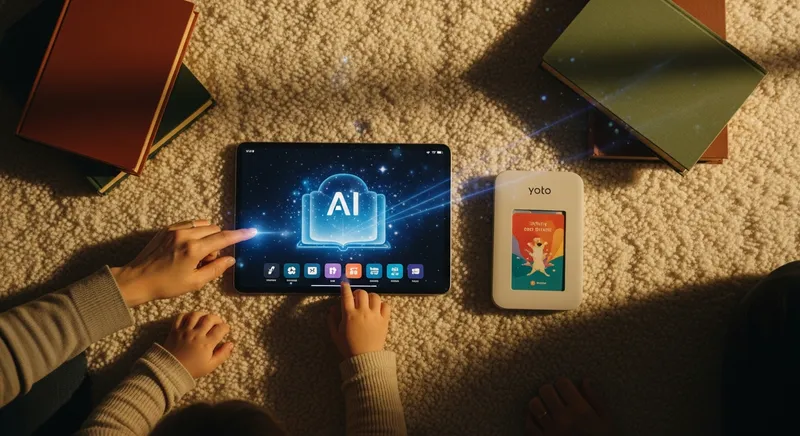
It's 8 p.m. and you're scrolling through your phone, feeling a familiar mix of exhaustion and guilt. Should you buy that Yoto player everyone is talking about for a screen-free bedtime? Or is a subscription to Epic! better for your little one's reading skills? Then you see an ad for an app that creates stories using AI, and the decision paralysis truly sets in. Welcome to parenting in 2026.
You are not alone. The landscape of children's media is exploding, leaving parents overwhelmed and unsure of how to invest their time and money. The core problem isn't a lack of options; it's the lack of a clear guide to navigate them. You're trying to choose between screen-free audio, massive digital libraries, and incredible new AI creation tools, all while balancing screen time rules and your child's unique needs.
This guide is the answer. Instead of declaring one winner, we're going to help you build a 'media toolkit' for your child. We'll break down the three main categories, explore their developmental benefits, and show you how each one can fit perfectly into your family's life. Think of it as finding the right tool for the right parenting moment.
The Modern Parent's Dilemma: Active vs. Passive Screen Time
Before we dive into the tools themselves, let's talk about a foundational concept: screen time quality. Not all screen time is created equal. The National Association for the Education of Young Children (NAEYC) emphasizes that for technology to be effective, it should be an "active, hands-on, engaging, and empowering" experience.
- Passive Screen Time: This is when a child mindlessly consumes content, like watching cartoons. It requires little to no interaction.
- Active Screen Time: This involves cognitive engagement, like following along with a read-aloud story, playing an educational game, or creating something new.
As you evaluate your options, ask yourself: Is my child actively participating or passively consuming? This simple question will help you make more intentional choices that align with your family's values.
Category 1: Screen-Free Audio Players (The Yoto Experience)
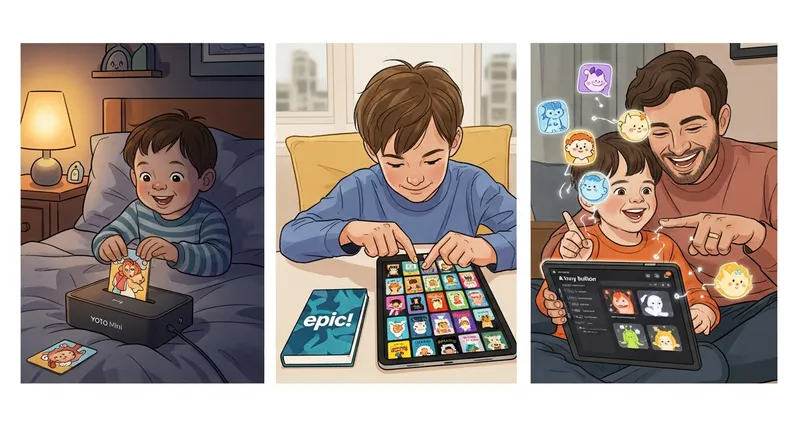
At the forefront of the screen-free movement is the Yoto Player, a small, durable audio box designed for kids. It's a modern take on the classic cassette player, built for independence and imagination.
What is a Yoto Player?
The Yoto Player works with physical cards. A child inserts a card into the slot, and the audio content-a story, music, podcast, or activity-begins to play. There are no cameras, no microphones, and no ads.
The simple pixelated display shows basic images related to the audio, but the core experience is auditory. It's designed to give control back to the child in a safe, walled-garden ecosystem.
Who is it Best For?
Yoto shines for children aged 3 to 8. It's perfect for:
- Independent Play: Empowering kids to choose their own entertainment without a screen.
- Bedtime Routines: A calming, screen-free way to wind down for sleep.
- Travel: A lifesaver on long car rides and flights.
- Quiet Time: An alternative to TV when you need a moment of peace.
The Developmental Benefits of Audio
Listening to stories has profound benefits. The Audio Publishers Association highlights that audiobooks can improve literacy skills, as a child's listening comprehension level is often years ahead of their reading level. Furthermore, research from the UK's National Literacy Trust shows that audiobooks can enhance mental wellbeing and make it easier for children to understand a book's content.
The Parent's Perspective: Pros & Cons
- Pros: Fosters independence and imagination, drastically reduces passive screen time, excellent for establishing calm routines, tangible and easy for small hands to use.
- Cons: The cost of content cards can add up over time, and some highly visual children may find it less engaging than screen-based media.
Actionable Tip: Make Bedtime Easier Use Yoto to give your child a sense of control over their bedtime routine, which experts at Alberta Health Services note can reduce conflict. Let them choose their bedtime story card just like they choose their pajamas. This simple choice empowers them and makes winding down a moment of calm connection, not a struggle.
Category 2: Digital Reading Libraries (The Epic! Experience)
Epic! is often called the "Netflix for kids' books." It's a massive digital library offering over 40,000 books, audiobooks, and learning videos for kids 12 and under through a monthly subscription.
What is Epic!?
Epic! provides an all-you-can-read buffet of content from major publishers. Children can browse a visually rich interface, choose books based on their interests, and use features like "Read-To-Me" where words are highlighted as they are read aloud. It's designed for discovery and volume.
Who is it Best For?
Epic! is a fantastic tool for children aged 5 to 9, especially:
- Voracious Readers: Kids who devour books faster than you can buy them.
- Reluctant Readers: The app's gamified elements (badges, progress tracking) can motivate them.
- Homework & School Support: Finding books on specific topics (e.g., rainforests, ancient Egypt) is easy.
- Families Wanting Variety: A single subscription provides endless options.
The Developmental Benefits of Digital Libraries
While this is screen time, it can be high-quality, active screen time. The American Academy of Pediatrics advises limiting screen use for young children but emphasizes the importance of 'high-quality programming.' When a child is actively following along with a story, sounding out words, and building their vocabulary, Epic! fits the bill. It's a powerful tool for building reading fluency and confidence.
The Parent's Perspective: Pros & Cons
- Pros: Incredible value for the price, huge variety of content, excellent for school-aligned reading, tracks reading progress.
- Cons: It is still screen time and can lead to eye strain, the sheer volume of choice can sometimes be overwhelming, and it lacks the tangible feeling of a physical book.
Actionable Tip: Use Epic! for Focused Learning Designate a specific "Active Reading Time." Set a timer for 20-30 minutes and give your child a mission: "Find three books about sharks" or "Let's read a book together about the solar system." This turns a potentially passive browsing session into an engaging, goal-oriented learning activity.
Category 3: AI Story Creators (The Co-Creation Experience)
The newest and perhaps most exciting category is AI-powered story generators. These tools empower parents and children to become co-creators, turning their wildest ideas into unique, personalized, and beautifully illustrated stories.
What are AI Story Creators?
While general AI tools exist, specialized apps like Dreamcraft Tale are built from the ground up for family safety and creative fun. They use carefully designed AI to bridge the gap between imagination and a finished storybook. The process is wonderfully simple: in just three steps (Imagine, Create, Read), you and your child provide prompts-a character, a setting, a moral-and the app generates a complete, age-appropriate story with vibrant, custom illustrations.
This allows you to make your child the hero of their own adventure, whether it's a tale of bravery like Pip's Gigantic Climb or a gentle story about feelings like Raquel and the Shy Moonbeam.
Who is it Best For?
AI story creators are magical for a wide range of kids (ages 3-9) and families, especially:
- Highly Creative Kids: Children with big imaginations who want to see their ideas come to life.
- Parents Seeking Bonding: The collaborative process is a powerful way to connect.
- Children with Niche Interests: You can create a story about anything, from a dinosaur who loves to bake to a girl who builds robots.
- Making Bedtime Magical: End the day by creating a brand-new adventure together.
The Developmental Benefits of Co-Creation
This is where technology becomes a tool for creative empowerment. Research from the University of Washington found that for AI to be most effective for kids' creativity, it often needs the support of an adult, making it a perfect bonding activity. This process isn't about replacing human creativity, but augmenting it.
As a recent study in Frontiers in Psychology notes, AI-based tools can significantly enhance creative expression when used thoughtfully. By making your child the author and hero, you build confidence and a deep, personal connection to storytelling. Purpose-built apps like Dreamcraft Tale ensure this happens in a completely ad-free and safe environment where your family's privacy is protected.
The Parent's Perspective: Pros & Cons
- Pros: Unlimited, unique story potential; highly engaging and personal; boosts confidence by making the child the hero; a powerful parent-child bonding tool.
- Cons: Requires a subscription; story quality can depend on prompt quality; younger children will need parental guidance to get the most out of the creation process.
Actionable Tip: Start a Weekly Story Ritual Dedicate one evening a week as your "Story Creation Night." To get started, browse the Dreamcraft Tale Story Library together for inspiration. See a story you like, such as the silly Rosie's Animal Show!? Use it as a jumping-off point to create your own tale about a talent show, but with your child's favorite animals and friends as the main characters!
Building Your Child's Media Toolkit: A 2026 Comparison Chart
To make the choice clearer, here's how the three categories stack up side-by-side:
| Feature | Yoto Player (Screen-Free Audio) | Epic! (Digital Library) | Dreamcraft Tale (AI Story Creator) |
|---|---|---|---|
| Best For (Age) | 3 - 8 years | 5 - 9 years | 3 - 9 years |
| Core Experience | Independent, screen-free listening | All-you-can-read digital books | Collaborative, personalized story creation |
| Main Benefit | Fosters independence, reduces screen time | Unmatched variety, builds reading skills | Sparks creativity, deepens parent-child bond |
| Screen Time | Zero | 100% Screen-Based (Active) | 100% Screen-Based (Creative & Collaborative) |
| Parent Involvement | Low (after setup) | Low to Medium | High (for best results) |
| Content Safety | Walled garden, curated content | Curated by editors | Walled garden, AI moderation, parent-led |
| Longevity & Cost | One-time hardware cost + per-card content | Low monthly subscription for all content | Low monthly subscription for unlimited creation |
Our Final Take: The Right Tool for the Right Moment
The debate over Yoto vs. Epic! vs. AI story creators isn't about finding a single winner. The best approach for 2026 and beyond is to build a balanced media toolkit for your child.
- Use the Yoto Player for the car ride to grandma's and to help your child drift off to sleep peacefully.
- Use Epic! on a rainy Saturday afternoon for an hour of focused reading practice on a topic they love.
- Use Dreamcraft Tale for a special weekly ritual where you and your child create a one-of-a-kind story together, making memories that will last far longer than any screen.
By understanding the unique strengths of each tool, you can move from feeling overwhelmed to feeling empowered. You can guide your child through the modern media landscape with intention, choosing the perfect experience for the right moment.
Ready to explore AI-powered storytelling? Discover how co-creation can become a cherished part of your family's routine and make your child the hero of their own adventure.
Frequently Asked Questions
What is the best screen-free alternative to the Epic! reading app?
The best screen-free alternative is an audio player like the Yoto Player combined with physical library books. The Yoto Player replaces the vast audio library of Epic! with a tangible, child-led listening experience that builds vocabulary and comprehension without a screen. Paired with regular trips to your local library for physical books, you can provide a rich, varied, and completely screen-free literary world for your child.
Can AI story generators replace reading published books?
No, they serve different, complementary purposes. Think of it like cooking: sometimes you follow a recipe from a master chef (reading a published book), and other times you create your own dish with ingredients you love (using an AI story creator). AI story creators like Dreamcraft Tale are excellent for sparking creativity, building confidence, and collaborative bonding. Published books are essential for exposing children to professional writing, diverse narrative structures, and the rich cultural heritage of literature.
Is a Yoto Player worth it for older kids (ages 8-9)?
It can be, depending on the child. While the sweet spot for Yoto is often cited as 3-7, its value for older kids lies in its growing library of chapter books, podcasts, and nonfiction content. For an 8 or 9-year-old who enjoys audiobooks and podcasts, it can be a fantastic, independent way to engage with longer-form content without the distractions of a phone or tablet. It's especially valuable for kids with reading challenges like dyslexia, as it allows them to access grade-level stories through listening.
How can I make bedtime easier and screen-free?
A consistent, calming, and screen-free routine is key. An audio player is a perfect tool for this. About 30 minutes before bed, dim the lights and let your child choose a Yoto card to listen to. This transitions them away from stimulating visual media and into a relaxed state. The act of giving them a choice, as recommended by health experts, empowers them and reduces bedtime struggles. The routine becomes a predictable comfort, signaling to their brain and body that it's time to wind down.
Which is better for a 7-year-old: Yoto or Epic!?
Neither is universally "better"; it depends on your goal. If your 7-year-old is a voracious reader and you want to support their school reading with a vast library, Epic! offers incredible value and variety. If your goal is to reduce screen time, encourage imaginative play, and provide an independent entertainment option for travel or quiet time, Yoto is the superior choice. Many families find value in using both: Epic! for active reading practice and Yoto for screen-free leisure and bedtime.