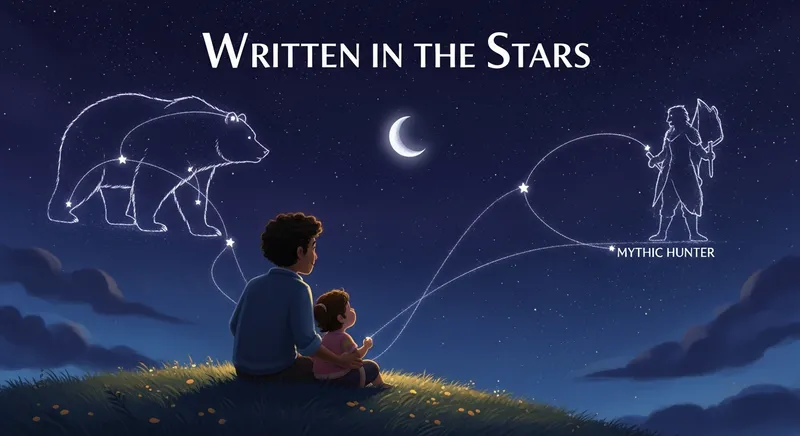
Written in the Stars: Magical Constellation Stories & Myths for Kids
You're snuggled up with your child under a blanket, looking up at the vast, dark sky. Whether it's a crisp autumn evening or a warm summer night, the moment feels perfect. Your child points a small finger at a cluster of stars and asks, "What's that one?"
You feel a surge of wonder, wanting to share the magic of the universe with them. But then, a familiar feeling creeps in. You remember bits and pieces of Greek myths filled with complicated names and grown-up drama, and you have no idea which dot of light is which.
We get it. You want to turn that starry sky into a canvas for imagination and bonding, but you feel overwhelmed. The myths seem too complex, the science feels too dry, and you're left feeling like you're missing out on a precious opportunity.
But what if you could become a storytelling stargazer for your family tonight? This simple, magical guide is for you. We've rewritten the most famous constellation stories to be whimsical and kid-friendly, and we'll show you exactly how to find them. Get ready to turn every clear night into an unforgettable storytelling event.
What is a Constellation, Anyway? A Simple Story for Kids
Before we dive into the stories, let's answer the first big question. For your little one, you can explain it like this: a constellation is like the sky's giant dot-to-dot puzzle! Thousands of years ago, people looked up at the stars and used their imaginations to connect the dots, seeing pictures of animals, heroes, and magical creatures. They then told stories about them, which have been passed down for generations.
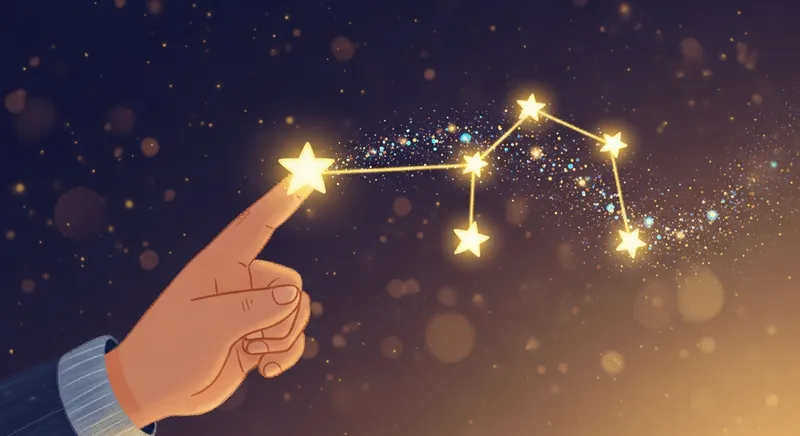
Parent's Corner: In a nutshell, NASA Space Place explains that a constellation is a group of stars that appears to form a pattern or picture. A fun fact to blow your child's mind: the stars in a constellation aren't actually neighbors in space! They can be very, very far apart from each other, but from our view on Earth, they line up to create a picture. It's all about perspective, just like in Luna's magical Moon Quest!
Easy Bedtime Stories from the Stars
Think of the night sky as a giant storybook waiting to be read. To make it easy and fun for the youngest listeners, we've simplified these ancient myths to focus on magic and adventure. Here are a few of our favorites to get you started.
Orion the Brave Hunter: A Winter Sky Story
Long ago, there was a brave and strong hunter named Orion. He was so proud of his skills that he had a special belt where he kept his tools, which shone as brightly as three stars. He loved exploring the world and wasn't afraid of anything. The gods were so impressed by his adventurous spirit that they gave him a special place in the winter sky to remind everyone to be brave and explore the world around them.
- How to Find Orion: This is one of the easiest to spot! On a clear winter night, tell your child to look for three bright stars in a short, straight line. That's Orion's famous belt. From there, you can try to spot the other stars that make up his body.
- Actionable Tip: After telling the story, go outside together and make it a game: "Who can be the first brave explorer to spot Orion's shiny belt?" It's a great way to start a Pip's Gigantic Climb up into the stars!
According to Britannica Kids, people have been telling stories about Orion for thousands of years, seeing him as a hero or a god in the night sky.
Ursa Major and Ursa Minor: The Great and Little Bear
This is a sweet story about a mother's love. Once, there was a beautiful nymph named Callisto who had a little boy she loved more than anything. To keep them safe from harm, a kind god turned them both into bears- a Great Bear (Ursa Major) and a Little Bear (Ursa Minor)- and placed them in the sky so they could be together forever, always watching over each other.
- How to Find the Bears: First, look for a pattern that looks like a big soup ladle or saucepan. This famous shape is the Big Dipper! National Geographic explains that the Big Dipper isn't a constellation itself, but an 'asterism'- a smaller picture within the Great Bear constellation.
- Actionable Tip: Once you find the Big Dipper, use the two stars at the end of its "cup" to draw an imaginary line straight up into the sky. The first bright star you run into is Polaris, the North Star! Polaris is special because it's the end of the handle on the Little Dipper, which is part of the Little Bear. It's like finding a whole family of bears, just like in Rosie's Animal Show!
Cassiopeia the Queen: A 'W' in the Sky
There once was a queen named Cassiopeia who was very beautiful, but she boasted about it a little too much. She learned a gentle lesson about being humble and kind. To remind people that kindness is true beauty, she was placed in the sky in her royal chair. Sometimes she sits upright, and sometimes her chair tips over, tracing a big letter in the stars!
- How to Find Cassiopeia: This is another super easy one for kids! Look for a group of five bright stars that form the shape of a big 'W' or 'M', depending on the time of year. The shape is meant to be her throne.
- Actionable Tip: Before you go outside, have your child practice making a 'W' and an 'M' with their fingers. Then, challenge them to find Queen Cassiopeia's throne in the sky. This simple action connects their learning to the real world, helping them find their own happy voice of discovery.
Stargazing Safety Tip: To keep your night vision sharp, use a flashlight with a red filter or cover a regular one with red paper. And always choose a familiar, safe spot for your stargazing, like your own backyard or a well-known local park. Safe adventures are the best adventures!
Bring the Stars Inside: 3 Magical Constellation Activities
Some nights it's too cloudy or cold to go outside. That's the perfect time to bring the magic of the stars right into your living room! These simple, screen-free activities are perfect for preschoolers and young children.
Flashlight Constellations: Inspired by great resources from PBS Kids, this is a classic for a reason. Take a paper cup, poke holes in the bottom in the shape of a constellation (like the Big Dipper), and turn off the lights. Shine a flashlight through the cup and project your very own stars onto the ceiling or a wall!
Marshmallow & Pretzel Stick Constellations: Get creative with a tasty snack! Use mini marshmallows as "stars" and pretzel sticks as the "lines" that connect them. Your child can recreate the shapes of Orion's belt or Cassiopeia's 'W' on a plate, learning the patterns in a fun, hands-on way.
Constellation Dot-to-Dot: Grab some dark construction paper and a white or yellow crayon. Draw dots for a simple constellation and lightly number them. Let your child connect the dots to reveal the hidden picture! It's the perfect quiet-time activity, just like using Justine and the Magical Paintbrush to create something beautiful.
From Stargazing to Storytelling: Create Your OWN Star Myth!
Now that you're an expert on finding star pictures, it's time to take the next step: becoming a storyteller! The most magical part of stargazing is that you can create your own stories.
Go outside with your family, look up, and find a random group of stars that makes a shape. Maybe it looks like a dog, a car, or a wiggly snake. Ask your child:
- What animal or object do you see?
- What should we name it?
- What grand adventure did it have to earn its place in the sky?
"My 6-year-old now asks to go stargazing every clear night. We created our own constellation called the Pizza Dragon, and she tells everyone about it!" — a Dreamcraft Tale parent
Once you have your hero and their adventure, you can bring your brand-new myth to life. Use your idea as a prompt in the Dreamcraft Tale app, and make your child the hero of the story by using their name. Watch their eyes light up as they star in a story that's truly written in the stars, complete with beautiful artwork to match their imagination.
Tired of the same old myths? Turn your child into the hero of a story written just for them.
Ready to turn your stargazing adventures into personalized storybooks? Download Dreamcraft Tale and create magical constellation tales your family will treasure forever. Start your first story tonight!
Frequently Asked Questions
What is the best age to start teaching kids about constellations?
It's never too early to share the wonder of the sky! You can start as early as 3-4 years old by keeping things very simple. At this age, it's all about the magic, not the science. Lie on a blanket, point out the twinkling lights, and trace the easy shapes like the Big Dipper. As they grow (ages 5-9), you can introduce the simplified myths and begin challenging them to find the constellations on their own. The goal is always to inspire curiosity, not to memorize facts.
Do we need a telescope to see constellations?
Absolutely not! This is one of the best parts of stargazing with kids- it's completely free and requires no special equipment. All the constellations in this guide are big and bright enough to be seen with just your eyes. Telescopes are fantastic for looking at details, like the rings of Saturn or craters on the Moon, but constellations are so large that they are actually best viewed with the wide, open perspective of the night sky.
How can we see stars if we live in a big city?
It's definitely more challenging, but not impossible! The key is to find the brightest stars that can punch through the city's glow. The Adler Planetarium and other experts recommend a few simple tricks:
- Find a dark spot: Get away from direct streetlights by visiting a local park, a sports field, or even just the darkest corner of your backyard.
- Let your eyes adjust: It takes about 15-20 minutes for your eyes to fully adapt to the dark. Put your phone away during this time to preserve your night vision.
- Aim for the brightest: Focus on finding the most obvious patterns first, like Orion's Belt or Cassiopeia's 'W', as their stars are often bright enough to be visible even with light pollution.
What's the difference between a constellation and an asterism?
This is a great question that confuses a lot of adults, too! The easiest way to think about it is with an analogy. A constellation is like a whole country, officially recognized with defined borders on the map of the sky. The International Astronomical Union recognizes 88 official constellations. An asterism, on the other hand, is a famous, easily recognizable pattern of stars within a constellation. The Big Dipper is the most famous asterism- it's a landmark inside the country, or constellation, of Ursa Major (the Great Bear).
Why do different constellations appear in different seasons?
Imagine you are on a carousel. As you spin around, your view of the world outside the carousel changes. The Earth is on a similar journey, making a year-long trip around the Sun. Because of this, our nighttime view of the universe is always changing. In the winter, our side of the Earth faces a different part of space at night than it does in the summer. This is why Orion is called a 'winter' constellation- it's the star pattern we see on winter nights- while other constellations like Scorpius are prominent in the summer. It's a constant, beautiful show happening above our heads!