
What is the Moral of a Story? A Parent's Guide to Teaching Life Lessons to Kids (Ages 3-9)
You finish reading a wonderful story about a little fox who learned to be honest. You close the book, feeling that warm, fuzzy feeling. But then a quiet, nagging thought creeps in. Did my child get it? You want to talk about the importance of telling the truth, but you're worried it will sound like a boring lecture and the magic of the moment will vanish.
If you've ever felt like you're failing to connect the dots between story time and real-life lessons, you are not alone. We all want to raise kind, honest, and thoughtful children, but translating the values from a story into a child's heart can feel like a mystery.
This guide is here to change that. We'll give you simple, age-appropriate, and genuinely fun ways to explain and discuss the moral of any story. Get ready to turn your reading time into one of the most powerful bonding and character-building moments of your day.
What You'll Learn in This Guide:
- The difference between a story's moral and its theme.
- Fun, age-specific ways to talk about morals with toddlers (3-5) and kids (6-9).
- Simple activities to reinforce life lessons without lecturing.
- How personalized stories can make learning values unforgettable.
Why Teaching Morals Through Stories is a Parenting Superpower
Stories are more than just entertainment; they are a safe playground for the heart and mind. Research shows that stories allow children to explore complex social situations and their consequences from a safe distance. This isn't just about learning to be 'good'- it's about developing empathy, critical thinking, and a strong moral compass.
In our busy world, kids often receive louder messages about achievement and success than about caring for others. Researchers at the Harvard Graduate School of Education identified this as a "rhetoric/reality gap." Stories are the perfect tool to close that gap. They provide a shared language for your family to talk about big values like honesty, kindness, and perseverance in a way that feels natural and loving.
First, What's the Difference Between a Moral and a Theme?
Before we dive in, let's clear up a common point of confusion. It helps to have a clear definition in your own mind first. According to resources like the Purdue University Online Writing Lab (OWL), the difference is simple:
- Theme is the big, underlying idea or topic of the story. Think of it as the general weather in the story's world, like 'friendship,' 'courage,' or 'family.'
- Moral is the specific, direct lesson the story is trying to teach about right and wrong. It's the actionable advice or the weather forecast for life, like 'always stand by your friends' or 'it's brave to try new things.'
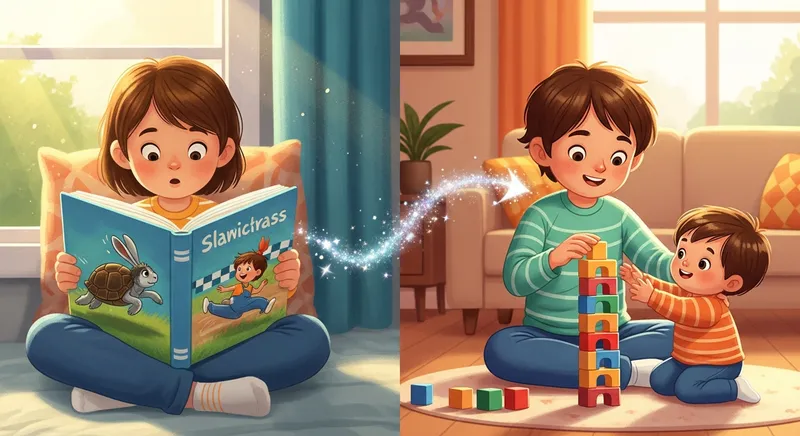
For example, in The Tortoise and the Hare, the theme is persistence, but the moral is the explicit lesson: "Slow and steady wins the race."
How to Explain the Moral of a Story: An Age-by-Age Guide
A 3-year-old's brain processes information very differently than a 9-year-old's. Tailoring your approach to their developmental stage is key. Interestingly, research suggests that while children may not be able to clearly articulate a story's moral until around age 9 or 10, their behavior can be positively influenced by a story's message at a much younger age.
For Toddlers & Preschoolers (Ages 3-5): Focus on Actions and Feelings
At this age, children are very concrete thinkers. The abstract idea of a 'moral' is too big, but they are experts in understanding actions and feelings. Your goal is to build the foundation of empathy.
Actionable Tip 1: Use 'Feeling Words.' According to the child development experts at ZERO TO THREE, building empathy starts early. Pause the story and ask, "How did that make the little bear feel?" or "Was the princess happy or sad when that happened?" Connect their feelings to their actions.
Actionable Tip 2: Point Out the 'Good Choice.' As Scholastic advises for this age group, keep it simple. Instead of explaining a complex moral, just narrate the positive action. Say, "Look, he shared his toy! That was a kind choice," or "She helped her friend. What a good helper!"
For Early Elementary Kids (Ages 6-9): Explore the 'Why' and Connect to Life
Kids in this age range are ready for more. They can start to think about cause and effect and, as Understood.org notes, they begin connecting what they read to their own personal experiences.
Actionable Tip 1: Ask the Magic Question. Research shows that asking a simple question can unlock deeper understanding. After the story, just ask, "Why do you think that happened?" This prompts them to think beyond the plot and consider the characters' motivations and the consequences of their actions.
Actionable Tip 2: Build a 'Life Bridge.' This is where you connect the story world to their real world. Ask questions like, "The character felt shy at the party. Have you ever felt shy like that? What helped you feel brave?" This makes the lesson personal and memorable.
Fun Activities to Teach the Moral of a Story (That Aren't Lectures!)
Reinforce the lesson with play. Here are a few ideas to move the conversation off the page and into your child's hands.
- Draw the Moral: Give your child some paper and crayons and ask them to draw the part of the story where the character learned their lesson or made a good choice. As they draw, they are cementing the idea in their mind.
- Role-Play the Right Way: Act out a different ending together. "What could the wolf have done instead of lying? Let's act it out!" This empowers your child by letting them 'fix' the character's mistake.
- Create Your Own Story: The best way to understand a moral is to build a story around it. Say, "Let's make up a story about a character who has to learn how to share."
Pro-Tip: Need a spark of inspiration? Browse the Shared Story Library in the Dreamcraft Tale app to see how thousands of other families have turned everyday lessons into magical adventures.
From Our Story Library: Morals in Action
Life lessons aren't just in old fables. A modern, personalized story can be the perfect starting point to talk about a value that matters to your family. Here are a few examples from the Dreamcraft Tale library that parents love:
- Pip's Gigantic Climb: Teaches the value of perseverance. Pip learns that even the biggest goals are achievable one small step at a time.
- Lily's Happy Voice: Focuses on kindness and respect. Lily discovers that using a kind tone of voice makes her friends (and herself) feel wonderful.
- Justine and the Magical Paintbrush: Explores creativity and purpose. Justine learns that her unique talents can bring joy to others.
Your Child Is the Hero Who Learns the Lesson
Imagine how much more powerful a lesson becomes when your child isn't just reading about it-they are living it as the hero of the story.
"We used to struggle explaining why sharing matters. Now we just create a story about it, and my daughter gets it immediately. She's the hero learning the lesson." - Parent of a 4-year-old
This is the magic of personalized stories. With an app like Dreamcraft Tale, you can turn a real-life situation into a fantastical adventure in three simple steps: Imagine, Create, and Read.
For example, when one parent's son kept interrupting at dinner, they created a story together about a little dragon who learned to wait his turn to speak. The next night, he reminded himself, "I'm like the patient dragon!" and practiced waiting. That's the power of personalized learning.
When your child is the main character, the moral of the story isn't just an abstract concept. It becomes a part of their own narrative, a lesson they helped discover in a safe, ad-free environment. This makes the moral personal, powerful, and truly unforgettable.
Frequently Asked Questions
What is a simple way to explain 'moral' to a child?
A great way to explain 'moral' is to call it the story's "big lesson." You can say something like, "Every story has a secret superpower, and it's the big lesson it teaches us about being a good person and a good friend." Keep it positive and tie it to action. For example: "The moral of this story is that being kind can help you make new friends!"
At what age can a child understand the moral of a story?
While children around ages 9-10 get much better at putting the moral into their own words, the learning starts much earlier. Toddlers and preschoolers (ages 3-5) are excellent at understanding the building blocks of morals-like fairness, kindness, and honesty-through a character's actions and the emotions that result. They absorb the lesson through behavior and feeling long before they can have a conversation about it.
What are some short stories with good morals for kids?
Classic fables are a great start! Think of 'The Lion and the Mouse' (moral: even small acts of kindness are important) or 'The Ant and the Grasshopper' (moral: it's wise to prepare for the future). However, the most powerful stories are often the ones that connect directly to your child's life. Creating a personalized story about being brave for a doctor's visit makes the moral incredibly relevant and memorable.
How do you find the moral in a children's movie or TV show?
It's a simple two-step process! First, ask your child, "What was the main character's biggest problem?" (e.g., They were afraid of the dark). Second, ask, "What did they learn at the end that helped them solve their problem?" (e.g., They learned that asking for help makes you brave). That lesson they learned is almost always the moral of the story!
How can I teach my child values without sounding preachy?
The secret is to shift from giving a lecture to starting a conversation. Instead of telling your child the lesson, help them discover it by asking curious questions. Try these open-ended prompts:
- "What do you think would have happened if the character made a different choice?"
- "How did that character's actions make everyone else feel?"
- "Have you ever felt like that character? What did you do?"
This approach makes your child an active participant, turning story time into a shared exploration of values rather than a one-sided lesson.
Ready to Write Their Next Chapter?
Turn your child's next life lesson into an unforgettable adventure. With Dreamcraft Tale, you can create personalized stories where your child learns about honesty, kindness, or any value that matters to your family-all while being the hero of their own tale.