
It's 8 PM. You know that teaching your child about honesty is vital, but how do you turn that big, abstract idea into a bedtime story that doesn't sound like a lecture? You want to nurture their moral compass, but you're tired, fresh out of creative ideas, and the thought of inventing a whole new tale from scratch feels overwhelming.
If this sounds familiar, you are not alone. You understand the importance of instilling good values, but you're struggling to translate concepts like integrity, empathy, and perseverance into engaging stories for your 3-to-9-year-old. You need a practical, grab-and-go resource that connects timeless morals to imaginative, ready-to-use story starters.
This guide is your answer. We've packed it with over 50 story starters categorized by moral value and, crucially, by age group. You'll also learn the secret to telling a moral story without preaching. And for those nights when you need a little extra magic, Dreamcraft Tale can help you create beautifully illustrated, personalized stories in minutes, turning your child into the hero of their very own adventure.
Why Moral Stories Are More Than Just Tales
Storytelling isn't just a way to get kids to sleep; it's one of the most powerful tools we have for shaping character. The human brain is uniquely wired to process information through narratives. According to experts at Scholastic, the brain is programmed to recognize plot patterns, storing them in long-term memory far more effectively than simple facts or rules. This makes stories a superhighway for conveying important life lessons.
This is especially true during the preschool and early elementary years. As pediatrician Dr. William Sears explains, a child's moral development hits a major turning point between ages 3 and 7, when they begin to internalize family values. What is important to you starts becoming important to them. And this moral foundation begins even earlier than we think. Research highlighted by ZERO TO THREE, a leading early childhood development organization, shows that infants as young as 6 months demonstrate a preference for "good" characters, suggesting we are born with a budding moral compass.
How to Tell a Moral Story Without Preaching (A Parent's Secret Weapon)
The goal is to spark a conversation, not deliver a sermon. When a story feels like a lecture, children disengage. But when they are invited into the moral dilemma, they become active participants in their own learning. Academic research published in the American Psychologist journal notes that narrative thinking is essential for developing empathy and caring.
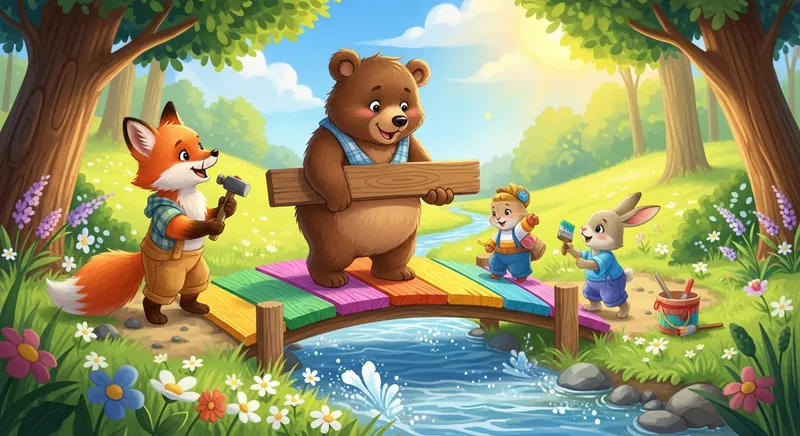
Here's how to do it:
- Focus on Feelings: Instead of saying, "Lying is wrong," explore the character's feelings. "When the little bear told a fib, his tummy felt all wobbly and his friends looked sad. How do you think he felt inside?"
- Ask Open-Ended Questions: Pause the story at the moment of choice. "The squirrel found a shiny acorn that wasn't his. What do you think he should do with it? What might happen if he keeps it?"
- Show Natural Consequences: Let the story world react realistically. If a character is selfish with their toys, other characters might not want to play with them. This is a more powerful lesson than an adult simply saying "You must share."
- Let Them Discover the Lesson: After the story, ask, "What was your favorite part?" or "What do you think the little fox learned today?" This allows them to articulate the moral in their own words, making it stick.
Want to see these techniques in action? Browse our collection of magical stories for inspiration.
The Story Starter Formula: Your 3-Step Method for Instant Ideas
Feeling stuck? Use this simple, repeatable formula to generate endless story ideas on the fly. One Dreamcraft Tale parent used this exact formula at 9 PM when her daughter asked for a story about a unicorn who was afraid of the dark. In 30 seconds, she had her starter!
Character + Setting + Moral Dilemma = Story Starter
Here's how it works:
- Character: A curious fox
- Setting: In a magical forest where lollipops grow on trees
- Moral Dilemma: The fox is told not to eat the lollipops until the annual festival, but he finds one that has already fallen on the ground.
Result: A story about patience and responsibility. Now, let's apply this to over 50 ideas you can use tonight!
50+ Moral Story Starters for Ages 3-9
Here are dozens of ideas, broken down by core moral values and tailored for two key developmental stages.
Honesty
Teaching the value of telling the truth, even when it's hard.
For Ages 3-5 (Simple & Concrete):
- A little bear cub accidentally breaks his mother's favorite honey pot. What does he do? (Try asking: How does his tummy feel? What does his face look like? What would make him feel better?)
- You find a shiny toy on the playground that belongs to your friend. Do you keep it or give it back?
- A magical crayon only draws true things. What happens when it draws something you did wrong?
- A character eats all the cookies from the cookie jar and tells his mom a monster did it. What happens next?
- In the story Leo and the Pet Pictures, a character learns the importance of being truthful about his abilities.
For Ages 6-9 (Deeper & More Complex): 6. A young wizard finds the answers to a big magic test. Does she use them to get a perfect score? 7. You promise a friend you'll keep a secret, but the secret could cause trouble. What do you do? 8. A character overhears friends saying something untrue about another person. Does he speak up? 9. You are given too much change at the store. The shopkeeper is very busy. Do you tell them about the mistake? 10. A girl running for class president is tempted to make promises she knows she can't keep.
Kindness & Empathy
Understanding and sharing the feelings of others.
For Ages 3-5 (Simple & Concrete): 11. A new animal comes to the farm and looks lonely. How can the other animals make him feel welcome? 12. A little cloud is sad because he can't make rainbows like the big clouds. What can you say to cheer him up? 13. You see a tiny snail trying to cross a busy sidewalk. What do you do to help? 14. In Lily's Happy Voice, a character discovers that using kind words can change everything. 15. A flower in the garden is drooping while all the others are standing tall. How can you show it kindness?
For Ages 6-9 (Deeper & More Complex): 16. A character sees someone being teased at school. It's scary to step in, but they know it's wrong. What do they do? 17. A grumpy gnome is mean to everyone. The main character discovers the gnome is grumpy because his home was washed away in a storm. 18. You have two tickets to a super fun event, but three friends who want to go. How do you handle it with kindness? 19. A story about helping someone without them knowing, like the character in Courtney and the Whispering Shell. 20. A character has to choose between winning a race and stopping to help a competitor who has fallen.
Bravery
Facing your fears and doing the right thing, even when it's scary.
For Ages 3-5 (Simple & Concrete): 21. A little kitten is afraid of the dark. One night, her favorite toy rolls under the bed. How does she find her courage? 22. It's your first day at swim class, and the water looks so big! What helps you dip your toes in? 23. A tiny mouse must speak up to a big cat who is taking everyone's cheese. How does he find his big voice? 24. A character is afraid to try a new food. What makes them brave enough to take one small bite? 25. A little hero shows immense courage in Pip's Gigantic Climb to achieve something amazing.
For Ages 6-9 (Deeper & More Complex): 26. A young knight must travel through a spooky forest to deliver a message. What gives them strength along the way? 27. A character has to give a presentation in front of the whole school. They practice and find the courage to share their ideas. 28. A girl stands up for her own unique idea, even when all her friends think it's silly, similar to the main character in Justine and the Magical Paintbrush. 29. A character admits they made a mistake, knowing they might get in trouble. That takes a special kind of bravery. 30. Bravery can be quiet, like being the first to befriend a shy new student, as explored in Raquel and the Shy Moonbeam.
Perseverance & Hard Work
Not giving up, even when things get tough.
For Ages 3-5 (Simple & Concrete): 31. A little squirrel is trying to carry a giant acorn up a tree. It keeps dropping it, but it doesn't give up. 32. You are learning to tie your shoes, and the laces keep getting tangled. What do you do? 33. A baby bird is learning to fly, but keeps tumbling to the ground. How does it finally soar? 34. A character wants to build the tallest block tower ever. It keeps falling down, but they try again and again. 35. The determined character in Luna's Moon Quest shows that persistence pays off.
For Ages 6-9 (Deeper & More Complex): 36. A young inventor is building a flying machine. It crashes 10 times. What does she learn from each crash to make the 11th try a success? 37. A character wants to learn a difficult song on the piano for a recital. The story focuses on the daily practice and small improvements. 38. A team of garden gnomes must work all season to grow a giant pumpkin for the fair, facing droughts and pests. 39. A girl dreams of being an artist, and her journey is filled with practice and dedication, much like the one in Dania's Sparkly Adventure. 40. A detective tries to solve a mystery, following many false clues before finally cracking the case through sheer persistence.
Responsibility & Teamwork
Taking care of your duties and working well with others.
For Ages 3-5 (Simple & Concrete): 41. You get a new pet puppy! What are all the things you need to do to take care of it? 42. A team of ants must work together to move a giant cookie crumb back to their anthill. 43. Your job is to water the plants, but one day you forget. What happens to the plants? 44. All the toys have to work together to clean up the playroom before their owner comes home. 45. The story of Rosie's Animal Show! shows how responsibility and care for others lead to wonderful outcomes.
For Ages 6-9 (Deeper & More Complex): 46. A group of friends is assigned a class project. One friend isn't doing their share of the work. How do they solve it as a team? 47. A character is made the "Guardian of the Magical Garden" for a week and must ensure all the fussy magical plants are cared for properly. 48. A community of forest creatures has to work together to rebuild their homes after a big storm. 49. A character borrows a special book from the library and is responsible for keeping it safe from their messy younger sibling. 50. The story of finding the right companion in Lily's Perfect Pet explores the responsibilities of friendship and care.
What If You're Too Tired to Create?
These story starters give you endless possibilities. But let's be honest- some nights, even with a great starter, you're just too exhausted to weave it into a full tale. That's exactly why we created Dreamcraft Tale.
The Problem: You're out of creative energy but want to share a meaningful story with your child.
The Solution: Dreamcraft Tale offers a magical, instant solution for tired parents.
- Instant, Personalized Stories: Simply input a few ideas (like "a story about a girl who learns to be brave at the dentist") and our AI story generation creates a complete, age-appropriate narrative in minutes.
- Your Child is the Hero: Boost your child's confidence by making them the main character. Imagine their delight when they read about their own adventures!
- A Library of Inspiration: On days when you're completely out of ideas, you can explore thousands of magical stories in our shared Story Library, all created by families just like yours.
- Safe and Sound: Most importantly, you can relax knowing every story is wholesome and appropriate. We use multiple content filters and provide a completely ad-free experience for peaceful, uninterrupted family time.
The Action: Try Dreamcraft Tale today and transform bedtime from a challenge into a cherished, magical ritual.
Parent Pro-Tip: "I was completely out of ideas for a bedtime story. I used Dreamcraft Tale to make my son the hero, and I even added our dog as his trusty sidekick. He was so excited, he asked to read it three times! It saved bedtime and made me feel like a super-parent." — A Dreamcraft Tale parent of a 5-year-old (name changed to protect privacy)
Ready to get started but still have a few questions? We've got you covered.
Frequently Asked Questions
Why are moral stories so important for child development?
Moral stories are crucial because they translate abstract values into concrete, memorable narratives. According to child development experts at PBS KIDS, watching characters navigate moral dilemmas helps children develop perspective-taking and empathy. Stories provide a safe space for kids to explore complex situations and consequences, building a foundation for their own real-life decisions.
How do you explain a complex moral like 'integrity' to a young child?
Don't use the big word; use a simple story. Integrity is about doing the right thing even when no one is watching. A perfect story starter would be: "A little squirrel finds a whole pile of nuts another family was saving for winter. No one else is around. What does he do?" The story isn't about the word 'integrity,' but about the choice and the feeling of being true to oneself. Let the child conclude that the squirrel felt good inside for leaving the nuts alone.
How long does it take to create a personalized story with the app?
It typically takes less than two minutes. You provide a simple prompt, choose a few options like art style and length, and our AI generates a complete, illustrated story ready for you to read and enjoy with your child. It's designed for busy parents who need a magical story in a hurry.
Do I need to be creative or good at storytelling to use the app?
Not at all! That's the beauty of Dreamcraft Tale. You don't need any creative skills. You can be as simple as, "a story about my daughter Maya learning to share her toys with her brother," and the app handles the rest, weaving a beautiful narrative for you.
What makes a good character-building story for a child?
A great character-building story has three elements: a relatable protagonist, a clear (but not easy) moral choice, and an emotionally resonant outcome. The child should see themselves in the character's struggle. The choice should feel meaningful, and the story should show how the character's decision affects their feelings and relationships. Making your child the hero of the story, a core feature of the Dreamcraft Tale app, is a powerful way to make these lessons even more personal and impactful.
Happy storytelling, and may tonight's bedtime be filled with wonder.