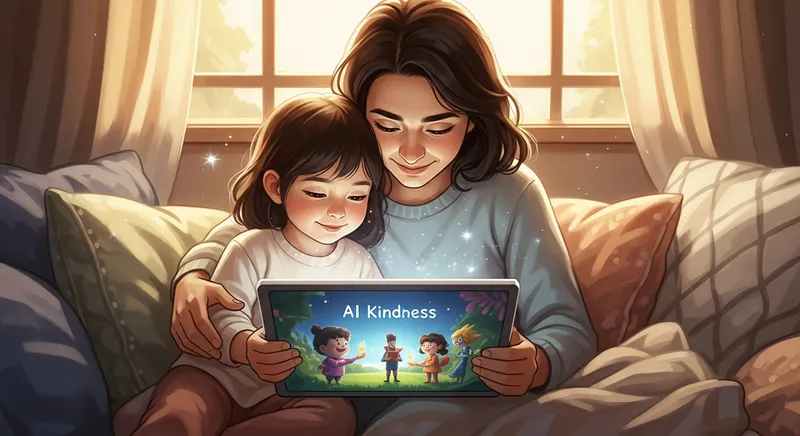
You want to raise a kind, empathetic, and resilient child. You know how important it is to teach them about sharing, managing frustration, and understanding others' feelings. But explaining these big concepts to a four-year-old can feel like trying to catch mist in a jar.
What if you had a secret key to unlock these complex lessons, turning them into adventures your child begs for every night? That key is the personalized story, supercharged by the magic of modern technology.
With AI story generators like Dreamcraft Tale, you can move beyond simply reading about characters and instead make your child the hero of their own learning journey. Our simple Imagine, Create, Read process makes it easy to craft a powerful, practical tool for modern parenting. Let's explore how.
The Hidden Superpower of Stories: Rewiring Your Child's Brain for Empathy
Have you ever noticed how your child is completely captivated by a good story? This isn't just passive listening; it's a deep, neurological experience. Stories don't just entertain—they can actually help build new neural pathways for empathy and perspective-taking.
According child psychologists, storytelling is one of the most powerful tools for social-emotional learning. An article on the neuroscience of storytelling from Mother Duck explains that when a child listens to a narrative, their brain doesn't just process words—it simulates the experiences. The emotional and sensory centers of their brain light up, creating a safe sandbox for them to explore big emotions from a distance.
They can feel the sadness in Raquel and the Shy Moonbeam or the courage in Pip's Gigantic Climb without being overwhelmed. This process is the foundation of Social-Emotional Learning (SEL), defined by the Collaborative for Academic, Social, and Emotional Learning (CASEL) as the way we develop healthy identities, manage emotions, and show empathy. Stories are a natural way to build these skills right from your living room.
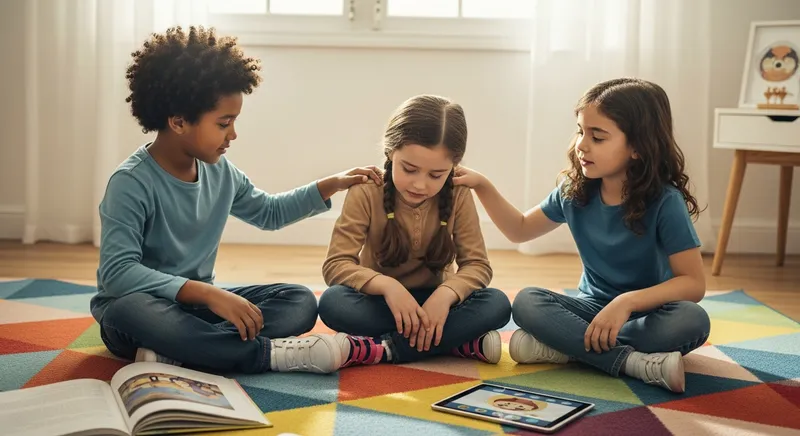
The Personalization Advantage: Why Your Child Should Be the Hero
Generic stories are good, but personalized stories are revolutionary. Does your child pay more attention when a story is about some random bear, or a story about them and their favorite stuffed animal?
This isn't just a hunch. A decade of research synthesized in Scientific American found that children showed far more smiles, laughs, and engagement with books where they were the main character. When your child is the hero, the story's lesson becomes a personal memory.
With an app like Dreamcraft Tale, they aren't just reading about a knight who learns to be brave; they are the brave knight. This boosts their confidence and builds a blueprint for success in real life.
The 'Story-Talk-Act' Framework: Turning Tales into Teachable Moments
Creating a story is just the beginning. The real magic happens when you connect the story to your child's world. Use this simple, three-step method to transform any personalized tale into a lasting life lesson.
Step 1: STORY (Craft the Perfect Tale)
This is where you use an AI tool to create a story targeting a specific skill. Using Dreamcraft Tale's Imagine, Create, Read process, you can be intentional with your prompt. Instead of just saying "a story about sharing," get specific. We'll provide a 'recipe book' of prompts below to get you started.
Step 2: TALK (Post-Story Discussion)
After the story, ask a few gentle, open-ended questions to help your child process the narrative. Avoid quiz-like questions and instead try:
- "I wonder how [Character Name] felt when their tower fell down?"
- "What do you think was the kindest thing [Character Name] did in the story?"
- "Have you ever felt shy, like the little moonbeam?"
Step 3: ACT (Bring the Lesson to Life)
The next day, find a low-stakes opportunity to practice the skill. If the story was about sharing, you could say, "Remember how you shared your sparkle stones in our story last night? Why don't we practice sharing your blocks with your brother today?" This step bridges the gap between fiction and reality.
Want to try this tonight? Browse stories like The Giggle-Glow Forest Adventure for instant inspiration →
Your AI Story Recipe Book: Prompts for Common Parenting Challenges
Here's the part that addresses the core challenge: knowing what to ask the AI. Think of these as starter recipes you can customize with your child's name, interests, and friends.
Pro Tip: As you create stories your child loves, save them to their personal library in the Dreamcraft Tale app. You can revisit their favorite adventures anytime to reinforce important lessons!
For Teaching Empathy & Kindness
Experts at Harvard's Making Caring Common project emphasize that giving children opportunities to practice empathy is crucial. Stories are the perfect training ground.
- Prompt Recipe: "Create a gentle story for a 5-year-old named Leo who loves dinosaurs. In the story, Leo finds a small, sad brachiosaurus who lost its fern. Leo must understand why the little dinosaur is sad and help it find its way back to its family."
- Dreamcraft Tale Inspiration: Explore stories about helping others, like Rosie's Animal Show!, to see kindness in action.
For Learning to Share
A 2024 review published by RSIS International confirmed that reading moral stories directly fosters prosocial behaviors like sharing in children aged 4-6.
- Prompt Recipe: "A story about two best friends, Maya and Chloe, playing at the park. They both want to play with the same magical, sparkling swing. The story should show them feeling frustrated, then finding a fun way to take turns, making the game even better together."
- Dreamcraft Tale Inspiration: Check out The Giggle-Glow Forest Adventure for themes of teamwork and friendship.
"I used the sharing prompt for my 4-year-old, Liam. The next day at the playground, he told his friend, 'We can take turns like in my story!' It was a small moment, but it felt like a huge win." – Jessica, Mom of Liam (4)
For Handling Frustration (Calm-Down Stories)
When your preschooler is overwhelmed, a calm-down story is a perfect co-regulation tool. As experts at ZERO TO THREE explain, helping a child manage emotions through supportive interaction is key.
- Prompt Recipe: "A short, calm-down story for Sam who is feeling frustrated. The story is about a friendly bear named Sam who is trying to build the tallest honey block tower. The tower keeps falling, and the bear feels wobbly and mad inside. A wise owl teaches the bear a simple breathing trick: 'breathe in the flower, blow out the candle.'"
For Welcoming a New Sibling
A personalized story can help a child envision their new, important role as a big brother or sister.
- Prompt Recipe: "An exciting story about Ava, who is about to become a super big sister! In the story, she gets a special 'Big Sister Cape' and learns about all the cool and helpful things she can teach her new baby, like singing songs and making silly faces."
Beyond Bedtime: Your Parenting "Emotional First-Aid Kit"
Think of your AI story generator as an "emotional first-aid kit" you can use anytime. The ability to create a story in minutes with Dreamcraft Tale's simple Imagine, Create, Read process means you can have a supportive tool ready anytime on your mobile device.
- Nervous about a doctor's visit? Create a story where Dr. [Child's Name] gives their stuffed animal a brave check-up.
- Scared of the first day of school? Generate an adventure about [Child's Name]'s first day in a magical forest school.
- Moving to a new house? Craft a tale about [Child's Name] discovering a friendly gnome in their new room.
This approach can be particularly transformative for neurodivergent children, who often thrive with social narratives that help them prepare for transitions.
Your Questions, Answered
Can personalized stories really change a child's behavior?
Yes, over time and with consistency. Think of it less as a magic wand and more as a powerful teaching tool. A single story won't instantly stop all tantrums, but consistently using them helps model positive behavior, build a child's internal identity as someone who is kind and capable, and open a gentle dialogue about feelings.
How long should an AI story be for a preschooler?
For preschoolers (ages 3-5), shorter is better. Aim for a story that takes 5-8 minutes to read aloud (400-700 words). The goal is to deliver a complete, engaging narrative before they get fidgety. With a tool like Dreamcraft Tale, you can easily create stories that are just the right length.
What if my child doesn't seem to understand the moral of the story?
That's perfectly okay! The primary goal is connection, not a test. If they don't grasp the moral, get curious. Use the 'Talk' step from our framework and focus on feelings: "How do you think the little fox felt when no one shared with him?" The lesson is often absorbed on a subconscious level.
What are some other social skills I can teach through stories?
The possibilities are endless! You can create stories that teach:
- Patience: Waiting for a seed to grow into a flower.
- Honesty: Telling the truth, like in The Mystery of the Missing Sparkle Stone.
- Resilience: Trying again after failing at something.
- Cooperation: Working together to solve a puzzle, like in The Great Green Quest.
- Managing Jealousy: Learning to celebrate a friend's happiness.
Are AI-generated stories safe and appropriate for kids?
This is a crucial question. A responsible, family-focused platform like Dreamcraft Tale prioritizes safety above all else. We use multiple layers of advanced content filtering and human moderation for our shared Story Library to ensure every story is wholesome and age-appropriate. Our platform is also completely ad-free, guaranteeing a private and secure bonding experience.
Ready to Turn Bedtime Battles into Bonding Time?
You have the tools, the framework, and the inspiration. Now it's time to create a little magic.