
It's 8:47 PM. You've brushed teeth, put on pajamas, tucked in the blankets, and read the same three books twice. Just as you're about to slip out of the room, you hear it: "Can you tell me a story? A made-up one?"
Your mind, already depleted from a long day of work, chores, and parenting, goes completely blank. A wave of guilt washes over you. You want to create that magical, bonding moment, but the pressure to be a creative genius on demand is overwhelming. You are not alone.
This is the core struggle for so many parents: we want to connect, but we're just plain tired. Here's the secret: telling a great bedtime story isn't about being a perfect author; it's about connection, not perfection. It's a skill that, according to researchers publishing in ResearchGate, is a portable, easy-to-learn strategy that creates powerful bonds.
What if you had a simple, low-energy framework you could rely on every single night? A method so easy you could do it with your eyes half-closed? You're in the right place. Welcome to the exhausted parent's guide to becoming a bedtime story hero.
Why Your Made-Up Stories Matter More Than Ever
In a world of endless screen time, the simple act of telling a story is a powerful act of connection. It's a dedicated time, free from distractions, where your child has your full attention. This ritual is foundational for their development. According to Reach Out and Read, a national nonprofit endorsed by the American Academy of Pediatrics, establishing a bedtime routine with stories promotes parent-child bonding and develops a child's literacy, language, and social-emotional skills.
Research from Duke University's Center for Child & Family Policy found that children develop stronger language and literacy skills when their parents use more engaging language during storytelling. Your made-up stories, with their unique twists and personal touches, are a perfect way to do this. Sadly, the UK's National Literacy Trust reports that daily reading to young children has seen a significant decline, making these moments of shared imagination more crucial than ever.
The 5-Step Framework for Making Up a Bedtime Story (Even When You're Tired)
Forget the pressure of crafting a literary masterpiece. This is your secret recipe for creating a simple, short, and satisfying story in minutes.
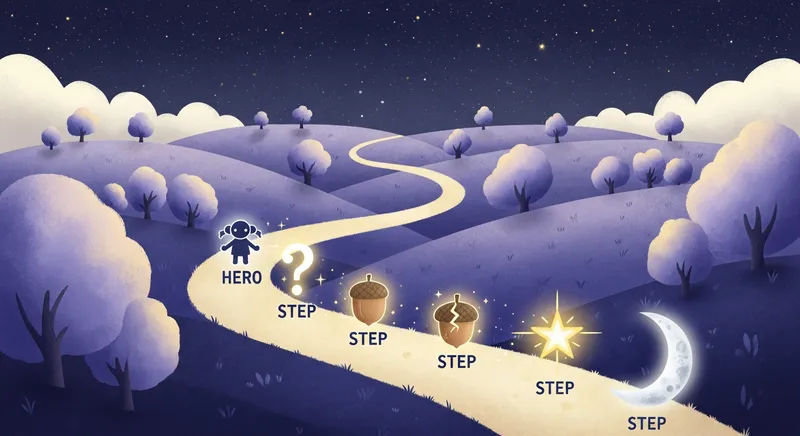
The 5-Step Framework at a Glance
- 👤 Step 1: The 'Who' - Make your child the hero.
- 📍 Step 2: The 'Where' & 'What' - Ask them where they are and what they see.
- ⚠️ Step 3: The 'Oops!' - Introduce a tiny, low-stakes problem.
- 🎉 Step 4: The 'Yay!' - Ask them how they solve it.
- 😴 Step 5: The 'Yawn' - Wind down to a sleepy, happy ending.
Step 1: The 'Who' - Find Your Hero (Hint: It's Your Child!)
This is the easiest and most important step. Make your child the hero of the story. Using their name, or a brave version of their name, instantly grabs their attention and makes them the center of the adventure. This simple act builds self-esteem and helps them feel seen.
Actionable Tip: Start with a simple sentence: "Once upon a time, there was a brave explorer named Leo…" or "In a magical kingdom lived a clever princess named Dania…" Watch their eyes light up. This personal connection is what makes stories like Leo and the Pet Pictures and Dania's Sparkly Adventure so engaging for kids.
Step 2: The 'Where' and 'What' - Ask Two Magic Questions
Your brain is tired. Don't try to invent everything yourself! Outsource the world-building to your co-creator: your child. This makes the story interactive and takes the creative burden off you. As PBS recommends, asking questions is a key way to keep children engaged.
Actionable Tip: Ask these two questions:
- "Where are you?" (Are you in a sparkly cave? A jungle made of candy? On the moon?)
- "What do you see?" (A talking squirrel? A river of chocolate milk? A shy moonbeam like the one in Raquel and the Shy Moonbeam?)
Their answers become the setting and the plot device. You're not inventing, you're just listening and narrating.
Step 3: The 'Oops!' - Introduce a Tiny, Low-Stakes Problem
A story needs a little bit of tension, but for bedtime, we want a tiny problem, not a terrifying one. The goal is to model problem-solving, not to induce nightmares. Think less "a fire-breathing dragon is attacking" and more "oh no, the friendly troll forgot the password to his bridge!"
Actionable Tip: Frame the problem as a simple 'oops' or a small challenge. Examples:
- The hero can't find their favorite shell, like in Courtney and the Whispering Shell.
- A magical creature, like the one in Rosie's Animal Show!, needs help finding its way home.
- The gigantic climb you thought was a mountain was just a small hill, like in Pip's Gigantic Climb.
Step 4: The 'Yay!' - Solve It Together
Just as you outsourced the world-building, you can outsource the solution. After presenting the tiny problem, ask another magic question: "What do you do next?"
This empowers your child and teaches them they are capable of solving problems. According to the Child Mind Institute, seeing characters navigate challenges helps children develop empathy and coping strategies. When they are the character navigating the challenge, the effect is even more powerful.
Actionable Tip: Guide them toward a kind, clever, or creative solution. If they're stuck, offer a gentle prompt: "Do you think the magical paintbrush from Justine and the Magical Paintbrush could help?" or "Maybe we can help the animal find its Lily's Happy Voice."
Step 5: The 'Yawn' - Wind Down to a Calming, Happy Ending
This is the most important step for a bedtime story. The adventure is over, the problem is solved, and now it's time to bring the energy down. The ending should be all about safety, comfort, and peace.
Actionable Tip: Describe the hero returning to a safe place. They get tucked into their bed, watch the stars come out, or listen to the quiet sounds of the forest at night. End the story with the hero feeling happy, safe, and ready for sleep. For example, after a long quest for Lily's Perfect Pet, the story ends with them cuddling together.
"I thought I had to be a creative genius to tell good stories. This framework showed me I just needed to listen to my kids and guide the adventure. Now it's our favorite part of the day."
- Sarah M., Mom of Two
Storytelling Techniques to Keep in Your Back Pocket
Once you have the 5-step framework down, you can add a little flair with these simple techniques:
- Use Silly Voices: You don't have to be a professional voice actor. A slightly higher voice for a squirrel or a lower voice for a bear is all it takes to create magic.
- Add Sounds: A whoosh for the wind, a plink for a raindrop, a boing for a bouncing bunny. It's fun and engaging.
- Borrow From Your Day: Did you go to the park? The story can be about a magical slide that goes to a new world. Did you bake cookies? The story can be about a gingerbread person's adventure.
- Use Your Hands: Show how big the giant was or how small the fairy was. Acting out parts of the story makes it more vivid.
Your Storytelling Co-Pilot: When Your Brain Says 'Not Tonight'
This framework works beautifully on its own. But let's be honest: some nights you won't even have the energy for five steps. That's where a little help comes in.
On those nights, you can turn to a co-pilot like Dreamcraft Tale. It's not about replacing you; it's about supporting you. The app follows a simple three-step process: Imagine your story idea, let the AI Create it with beautiful illustrations, then Read together.
- Feeling creatively blocked? Use the AI Story Generation to turn a one-sentence prompt (like "Lily finds a moon quest on her pillow") into a complete, calming adventure like Luna's Moon Quest.
- Want to make your child the hero? The app is built for it. You can personalize characters by inputting their name and unique traits so your child is always the star, complete with beautiful AI illustrations that bring their story to life.
- Too tired to even think of a prompt? Explore the Shared Story Library and find thousands of magical stories ready to read, created by other families.
Best of all, it provides a completely ad-free experience, ensuring that this precious time remains focused on peaceful, uninterrupted bonding.
Frequently Asked Questions
What makes a good 5-minute bedtime story?
A great 5-minute story is simple, personal, and calming. Make your child the hero, introduce a tiny problem they can solve quickly, and end with them feeling safe and cozy. The goal is connection, not an epic saga.
How can I come up with story ideas when I'm tired?
Lean on your child and your day. Ask them for an idea, or use something you did together as a prompt (e.g., a trip to the park becomes a magical slide adventure). The world around you is full of inspiration.
What if my child gets too excited during a bedtime story?
It's a great sign that they're engaged! To calm things down, consciously shift to Step 5: the 'Yawn'. Use a quieter, slower voice and narrate sleepy actions. You can also use the Dreamcraft Tale Story Library to find a pre-made calming story.
Is it bad to read the same story every night?
Absolutely not! Repetition is crucial for young children's learning and sense of security. Hearing the same story helps them master new words, understand story structure, and feel secure in a predictable routine. Sticking with a favorite is like visiting a comforting friend.
What are the key elements of a calming bedtime story?
A calming story has three main elements: a gentle tone, low stakes, and a peaceful resolution. Use a soft, soothing voice, ensure the problem is small and easily fixed, and always end the story with a return to safety and comfort.