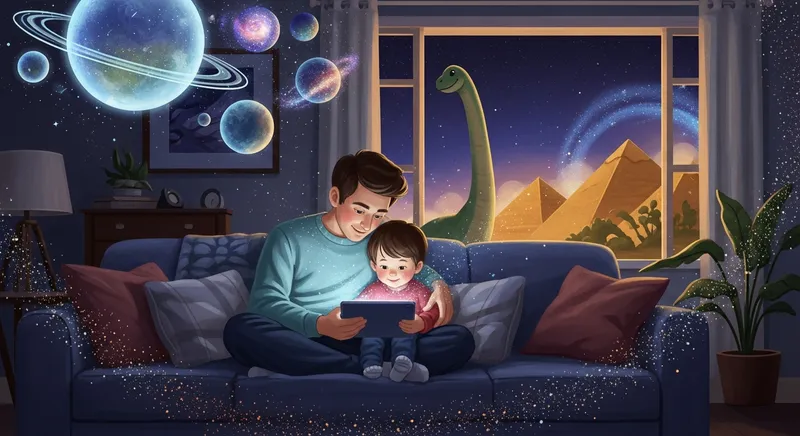
Story Time Science: 5 Ways to Teach Kids with Stories
Ever find yourself trying to explain what a fossil is, only to be met with a blank stare? Or maybe you've tried to make the solar system sound exciting, but your child is more interested in the lint on the carpet. We get it. You want to help your child learn and grow, but turning complex topics like science and history into something fun can feel like a full-time job you don't have time for.
You want to supplement their education in a way that feels like play, not a chore. You want to see their eyes light up with curiosity, not glaze over with boredom. What if you could do all that with something you already do every day?
It's time to rediscover the power of storytelling. Far from just a way to wind down for bed, telling stories is a brain-boosting, bond-building tool that can make any subject magical. We're sharing five simple, creative ways you can use stories to teach your kids about everything from planets to prehistoric life, with actionable prompts you can try tonight. Whether your child is three or nine, these techniques adapt to any age and interest.
Why Story-Based Learning is a Superpower for Young Minds
When you tell a story, you're doing more than just sharing information: you're creating an experience. According to education experts at Edutopia, a good story can cause the brain to release dopamine, making the listener more focused and motivated, as well as oxytocin, which promotes empathy and connection. This is why your child might remember every detail about a character in their favorite book but forget a science fact you told them five minutes ago.
In fact, some research suggests storytelling might be uniquely powerful. A study published in Frontiers in Psychology found that listening to a story told aloud can lead to more sustained brain activation than simply having a picture book read to them. It invites the child to become an active co-creator, building the world inside their own mind.
This is the heart of play-based learning, which the National Association for the Education of Young Children (NAEYC) highlights as a key way children develop problem-solving skills and build a genuine love of learning. By weaving educational concepts into a narrative, you empower them to learn without even realizing it.
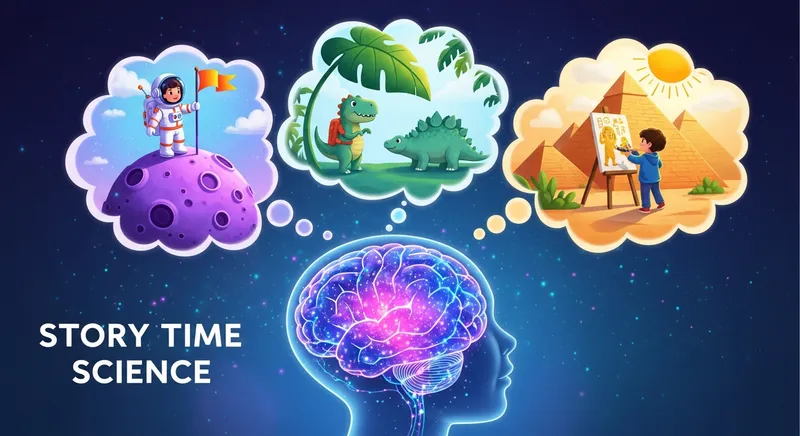
5 Educational Adventures You Can Create Tonight
Ready to become a master storyteller? Don't worry, it's easier than you think. These five adventures are designed to be starting points. Use them as-is, or adapt them to whatever your child is curious about this week. Frame them as exciting 'missions' you can go on together, and watch the magic happen.
Too Tired Tonight? Start Simple! Ask your child to pick their favorite animal and a place they want to visit. That's your story. A penguin in a candy store. A dinosaur at the beach. Done!
Age-Specific Story Tips
- Ages 3-5: Keep it simple. Focus on a single character, a clear emotion, and a fun adventure. Think: a story about a happy little star learning to twinkle.
- Ages 6-9: Introduce a problem. Add a simple mystery or challenge for the hero (your child!) to solve, and weave in a fun fact or two.
1. Blast Off into a Solar System Story
Space can feel overwhelmingly big. The key is to make it personal and give your child a mission. Instead of just listing the planets, turn it into an adventure.
- Actionable Tip: Create a story where your child is a brave astronaut who needs to visit each planet to collect a special item or deliver a message. This turns memorization into a fun quest. Need ideas? Check out tales like Luna's Moon Quest.
- Story Prompt You Can Use: "Create a story about a brave astronaut named [Child's Name] who flies a special spaceship to the Moon to help a friendly moonbeam find its way back home."
Quick Fact: As they travel, you can include real information from sources like NASA. For example: "When they landed on Mars, everything was covered in reddish dust. That's because Mars has a lot of iron in its soil, just like rust!"
2. Travel Back in Time with a Dinosaur Tale
Dinosaurs are a gateway to understanding natural history, extinction, and biology. Stories are the perfect way to explore these concepts in a gentle, non-scary way.
- Actionable Tip: Use a story to explain the difference between herbivores and carnivores. Instead of a scary T-Rex chasing other dinosaurs, what if the T-Rex was just misunderstood? This can also be a great way to introduce lessons on teamwork and celebrating differences, like in Pip's Gigantic Climb.
- Story Prompt You Can Use: "Tell a story about a friendly T-Rex named [Child's Name] who is a vegetarian and has to convince his dino friends that plants are delicious!"
Quick Fact: You can pull details from the American Museum of Natural History to build your world. For example: "The vegetarian T-Rex lived on a giant piece of land where you could find fossils from about 700 different kinds of dinosaurs!"
3. Uncover the Past with a History Story
History isn't just dates and events; it's about people. Storytelling makes the past feel alive and relevant.
- Actionable Tip: Place your child directly into a historical event. Instead of just talking about ancient Egypt, create a story about a child their age who gets to help build or decorate a pyramid. This makes the abstract tangible.
- Story Prompt You Can Use: "Create a story about a child named [Child's Name] living in ancient Egypt who gets to help paint beautiful stories on the inside of a pyramid."
Pro-Tip: According to the Historical Association, stories help children create a "mental map" of the past. By focusing on a character's experience, you help them understand the human situation, connecting the past to their own lives.
4. Explore a Miniature World of Ecosystems
'Ecosystem' is a big word, but the concept is simple: everything in nature is connected. A story can shrink this idea down to a world your child can understand, like a backyard or a tide pool.
- Actionable Tip: Turn your child into a 'nature detective' on a mission to discover how the creatures in a small area help each other. Who pollinates the flowers? Where do the worms go when it rains? This fosters curiosity about the world around them.
- Story Prompt You Can Use: "Tell a story about a curious snail named [Child's Name] who explores a tide pool and learns from a wise starfish how everything in the ocean is connected."
Quick Fact: You can use the story to simply explain a concept like a food chain. "The little snail learned that it ate tiny algae, and the seabirds sometimes ate the snails. It was all part of one big ocean family!"
5. Become a Problem-Solver with a 'Discovery' Plot
This is a fantastic technique for nurturing critical thinking. A 'discovery' plot, as described by the University of Pittsburgh's teaching center, is a narrative built around solving a puzzle or mystery. It naturally engages the listener because they want to know the answer, too!
- Actionable Tip: Frame any lesson as a mystery. A great starting point is "The Mystery of the Missing Teddy Bear," where your child follows clues to find it and learns prepositions like 'under,' 'behind,' and 'inside' along the way.
- Story Prompt You Can Use: "Create a mystery where Detective [Child's Name] has to solve 'The Case of the Missing Cookies' by following a trail of crumbs and other clues."
Pro-Tip: This method is the very essence of scientific inquiry: forming a hypothesis (guessing who took the cookies), gathering evidence (finding clues), and reaching a conclusion (solving the mystery!).
The Easiest Way to Create Your Educational Bedtime Story
These ideas are a great start, but let's be honest: after a long day, even thinking of a creative prompt can feel like too much. You're exhausted, and you might not feel like a natural-born storyteller.
That's exactly why we created Dreamcraft Tale. It was built by a parent, for parents, to solve this exact problem. Our app takes your simple ideas (even the ones on this list) and instantly transforms them into a complete, unique, and beautifully illustrated story that makes your child the hero.
You don't need to worry about plot points or character arcs. You just provide the spark of an idea, and our carefully designed AI helps bring it to life. It's the perfect way to put story-based learning into practice without the pressure. In just three simple steps (Imagine, Create, Read) you can have a brand-new educational adventure ready to go.
Frequently Asked Questions
Is story-based learning actually educational?
Absolutely. It's not just fun and games; it's backed by research. A long-term study highlighted by Duke University found that the quality of storytelling in early childhood has a lasting impact on language and literacy skills for years to come. It helps with memory, vocabulary, and critical thinking because it makes information personally meaningful and emotionally resonant.
How do I start if I'm not a creative person?
You don't have to be! The secret is to start with your child's natural curiosity. Ask them a simple "What if..." question related to what they're learning, like, "What if you were a dinosaur who could talk?" You can use the prompts in this article as a springboard, or let a tool like Dreamcraft Tale act as your creative partner. It does the heavy lifting so you can focus on the fun.
What's the difference between this and just reading a book?
Reading books together is fantastic and essential. Creating a personalized story adds a different, powerful layer. It makes your child an active participant in the story, not just a passive listener. When they see themselves as the hero solving problems and going on adventures, it boosts their engagement, self-confidence, and personal connection to the topic in a way that reading about someone else's adventure can't.
At what age can kids benefit from educational storytelling?
Storytelling is wonderfully adaptable. For younger children (ages 3-5), you can focus on simple concepts, characters, and emotions, like learning colors through a story about a magical rainbow. For older kids (ages 6-9), you can introduce more complex plots, interesting facts, and bigger moral questions, like creating a story about teamwork to build a Mars colony. The magic is in the participation, no matter the age.
Isn't using an app just more screen time?
That's a valid concern for every parent today. We think of Dreamcraft Tale as collaborative screen time. Unlike passively watching videos, using our app is an interactive activity you do together. It's a tool for creating, bonding, and sparking imagination, which then leads to the wonderful off-screen activity of cuddling up and reading the story you made as a family. And our platform is always 100% ad-free, so you can focus on what matters: creating and bonding together.
Ready to turn your child into a space explorer or a dinosaur detective? Download Dreamcraft Tale and create your first story for free today!