
It is a familiar scene in many households. Your child has spent months clicking through colorful animations, earning golden eggs, and mastering their basic letter sounds. But now, a new problem has emerged. When you hand them a physical book or ask them to read a few sentences on their own, they groan, look away, or complain that they are bored.
You feel stuck and frustrated. Your child has outgrown the gamified rewards in apps like Reading Eggs, yet they still lack the intrinsic motivation and reading comprehension skills to pick up traditional books independently. They have learned how to read, but they have not learned to love reading.
If this sounds familiar, you are experiencing the transition gap. Gamified phonics apps are excellent for teaching the mechanics of decoding words, but they often fail to inspire a genuine passion for storytelling. This is where personalized AI story apps come in. By making your child the hero of their very own adventure, these innovative tools offer the perfect Reading Eggs alternative, curing reading fatigue and bridging the gap between basic phonics and independent reading.
If you are worried about adding more screen time to their day, rest assured. Unlike passive videos or mindless tapping, personalized AI story apps offer active, creative engagement that turns screen time into a purposeful educational experience.
Why Reluctant Readers Get Bored with Traditional Phonics Apps
To understand why your child is suddenly bored with their reading app, we have to look at how these programs motivate children. Apps like Reading Eggs, ABCmouse, and Homer rely heavily on a concept called gamification. They use bright lights, funny sounds, and digital rewards to keep kids clicking.
While gamification uses extrinsic motivation (like badges and points) to drive short-term engagement, long-term reading success requires intrinsic motivation driven by personal interest and the joy of the activity itself. This psychological limitation is well documented. According to EducationalTechnology.net, extrinsic rewards eventually lose their appeal. Once your child realizes that collecting another digital sticker does not actually mean anything in the real world, the dopamine loop breaks. The app becomes a chore.
Furthermore, these apps often focus on passive screen consumption. The child is reacting to the screen rather than actively using their imagination. When they transition to a standard chapter book, the lack of flashing lights makes the text feel dull by comparison.
💡 Try This Tonight: Observe your child while they use a gamified reading app. Are they actually reading the words on the screen, or are they just rapidly clicking to get to the next reward animation? If it is the latter, it is time to transition their reading routine.
Reading Eggs vs. AI Story Apps: What is the Real Difference?
When searching for apps like Reading Eggs, many parents mistakenly look for another phonics-based game. However, if your child already knows their letters and basic sight words, more phonics drills will only increase their frustration.
Here is the real difference: Phonics apps teach a child how to decode text. AI story apps teach a child how to comprehend and enjoy text.
Dreamcraft Tale, for example, is an AI-powered mobile app that transforms children's ideas into beautifully illustrated personalized stories where they become the hero of their own adventure. Instead of asking a child to pop bubbles with the letter "B" inside them, an AI story app asks the child, "What kind of adventure do you want to go on today?"
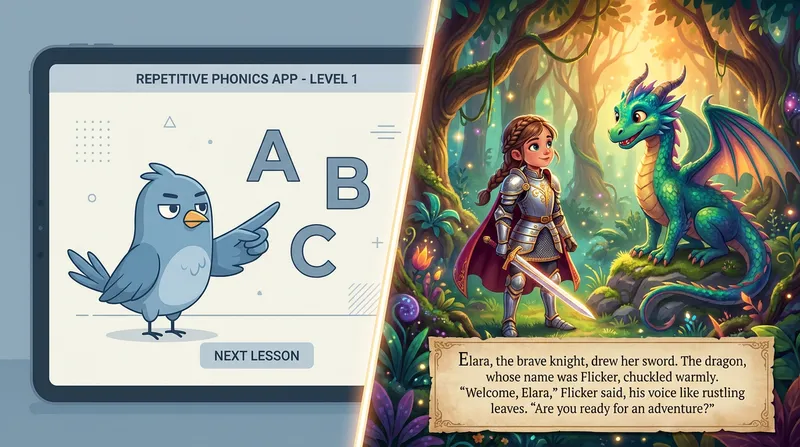
This shift from passive learning to active creation changes everything. When a child creates a story using Dreamcraft Tale's simple 3-step process (Imagine, Create, Read), they are highly invested in the outcome. They want to read the words because they want to know what happens to their character.
🦸♀️ Try This Tonight: Ask your child to invent a character based on themselves. Ask them what their character's special power would be and where they would live. Notice how their eyes light up when they are in control of the narrative.
Bridging the Gap: Transitioning from Phonics to Independent Reading
The leap from early phonics to reading chapter books is the most difficult phase of literacy development. Children often experience "reading fatigue" because sounding out words takes so much cognitive energy that they forget what the story is actually about.
Personalized AI reading apps act as the perfect bridge for children aged 2 to 10. Because the stories are highly tailored to the child's interests, their motivation to push through difficult words increases dramatically. Government-backed research supports this approach to early literacy. The Institute of Education Sciences funds initiatives to develop tools that generate personalized text and provide just-in-time literacy support to improve word recognition, fluency, and comprehension.
By using an app that generates fresh, customized content, you provide your child with a limitless library of reading material that sits right at their specific reading level. If they are struggling, you can generate a story with simpler vocabulary. If they are advancing, you can create a more complex narrative.
🦖 Try This Tonight: Take a topic your child is currently obsessed with at school (like space, dinosaurs, or bugs) and use an AI story generator to create a custom bedtime story about it. Watch how their willingness to read aloud improves when the subject matter matches their current passion.
How Personalized Stories Improve Reading Comprehension
Reading comprehension is the ultimate goal of literacy. It is the difference between "learning to read" and "reading to learn." Reluctant readers often score poorly on comprehension tests because they are simply decoding words mechanically without visualizing the story in their minds.
When you make your child the protagonist of the story, visualization happens automatically. A child who resists reading practice will often push through several pages on their own when the hero on the page shares their name, their hair, and their favourite pet.
This deepens their emotional connection to the text and forces their brain to process the meaning of the words. Consider the confidence boost a child gets from reading stories like Pip's Gigantic Climb or Luna's Moon Quest. When children see characters facing challenges, solving problems, and showing bravery, they internalize those traits.
🧠 Try This Tonight: After reading a personalized story together, ask your child three questions about how their character felt during the adventure. This simple exercise builds emotional intelligence and tests reading comprehension without feeling like a pop quiz.
What to Look for in an AI Story App - and Why Dreamcraft Tale Delivers
When looking for the best reading apps for reluctant readers, you will find several options on the market. However, not all interactive story apps for kids are created equal. Many lack the safety features, beautiful illustrations, and ad-free environments that young children need.
When evaluating an AI bedtime story app, look for these crucial features:
- Child-Centered Personalization: The app should allow you to customize character names, traits, and roles so your child is always the hero.
- High-Quality AI Illustrations: Visual storytelling is vital for kids. Vibrant, professional artwork keeps easily distracted kids engaged.
- Safety and Content Moderation: The internet can be unpredictable. You need an app with multiple content filters to ensure every story is safe, wholesome, and age-appropriate.
- Ad-Free Experience: Nothing ruins the magic of story time faster than a pop-up ad for a mobile game. Look for premium, ad-free platforms.
- Offline Reading: Take the magic anywhere. Stories should work offline once generated, making them perfect for travel, car rides, and screen-free camping nights.
Dreamcraft Tale checks all these boxes, providing a secure, distraction-free environment for families to bond over storytelling. If you are too tired to create a new story from scratch, you can even explore hundreds of magical stories in the shared Story Library.
📚 Try This Tonight: Browse a digital story library together with your child. Let them pick the theme for the night. Giving them autonomy over their reading material is a proven way to boost engagement.
The Limits of Gamified Reading Apps for Older Kids
Parents frequently search for comparisons like "Reading Eggs vs Homer" or "Reading Eggs vs ABCmouse." While these apps are fantastic for toddlers and preschoolers who are just learning their alphabet, they often fall flat for kids aged 6 to 9.
Older children quickly realize when they are being "taught." They crave agency, creativity, and maturity in their entertainment. Clicking a dancing cartoon animal feels babyish to a second grader who wants to read about epic quests, mysteries, and science fiction.
AI story apps respect your child's growing maturity. The narratives can scale in complexity. One day your child might want a simple story about finding a lost toy, like Courtney and the Whispering Shell or Dania's Sparkly Adventure. The next day, they might want a complex mystery to solve. Gamified apps simply cannot adapt to this rapid shift in a child's imagination.
🗣️ Try This Tonight: Have an honest conversation with your reluctant reader. Ask them, "If you could write a book about anything in the whole world, what would it be about?" Use their answer as the prompt for your next AI-generated story.
How to Use Custom Interests to Motivate a Bored Reader
One of the greatest advantages of AI story apps is the ability to leverage your child's incredibly specific, niche interests. Traditional publishing moves slowly. If your child is currently obsessed with underwater volcanoes, purple sparkly bats, or painting magical pictures, you will have a hard time finding a printed book that perfectly matches that interest at their exact reading level.
With a personalized reading app, you can generate that exact story in minutes. If your child loves animals, you can create stories that mirror the charm of Rosie's Animal Show! or Lily's Perfect Pet. If they are feeling shy and need a confidence boost, you can read them something akin to Raquel and the Shy Moonbeam or Lily's Happy Voice.
If they are highly creative, inspire them with tales like Justine and the Magical Paintbrush or Leo and the Pet Pictures.
By tailoring the reading material to their current hyper-fixation, you remove the friction of reading. They are no longer reading because they have to; they are reading because they are desperate to consume content about their favorite topic.
🏺 Try This Tonight: Create a "Story Jar." Have your child write down five crazy, imaginative ideas on slips of paper. Pull one out right before bedtime and use it to generate a unique story together.
Frequently Asked Questions (People Also Ask)
What is the best alternative to Reading Eggs for reluctant readers?
The most effective alternative for a child who has outgrown phonics drills is a personalized AI story app like Dreamcraft Tale. While traditional apps focus on decoding letters and earning digital badges, AI story apps focus on reading comprehension and intrinsic motivation by making your child the star of their own custom adventure.
Can AI story apps replace traditional phonics instruction?
No, they serve a different purpose. Phonics apps are excellent for teaching the foundational mechanics of reading (sounding out letters). AI story apps are the crucial next step. They bridge the gap between basic decoding and fluent reading comprehension by providing high-interest, personalized text that kids actually want to read.
Why do kids get bored with gamified reading apps?
Children get bored because gamified apps rely on extrinsic motivation (like collecting points or virtual stickers). Once the novelty of these digital rewards wears off, the repetitive nature of the educational games feels like a chore. Older kids crave engaging narratives and creative control over their reading material.
When is the right time to transition from phonics apps to reading apps?
The best time to transition is when your child has mastered basic sight words and letter sounds but still resists picking up physical books. If they are rapidly clicking through their educational app just to get the rewards without paying attention to the text, they are ready for narrative-driven AI stories.
Are AI-generated bedtime stories safe for young children?
Yes, as long as you choose a platform designed specifically for families. Apps like Dreamcraft Tale use strict, multi-layered content moderation to ensure every generated story is age-appropriate, wholesome, and completely free of advertisements or tracking.
What is the difference between learning to read and reading to learn?
"Learning to read" focuses on decoding: sounding out letters and recognizing sight words. "Reading to learn" happens when decoding becomes automatic, allowing the child's brain to focus entirely on understanding the story, visualizing the plot, and absorbing new information. Personalized stories accelerate this transition by making the content deeply relevant to the child.
Make Bedtime Magical Again
Transitioning from phonics apps to independent reading does not have to be a struggle filled with tears and frustration. When you replace repetitive digital games with boundless imagination, you give your child the greatest gift of all: a lifelong love of reading.
Remember that magical feeling when your child's face lights up during story time? Dreamcraft Tale brings that magic to every bedtime. Your little one becomes the brave explorer, the kind helper, the clever problem-solver, whatever hero they dream of being.
Ready to turn your child's imagination into beautifully illustrated stories? Download Dreamcraft Tale today and start creating memories that will last a lifetime.
Not ready to download yet? Explore our free Story Library and discover hundreds of magical adventures your child can enjoy tonight.