How to Create Magical Bedtime Stories: A Parent's Guide
It's 8:45 PM. You've read the same three books twice, your voice is getting hoarse, and your child is still pleading for "just one more story." You want to make bedtime magical, a moment of deep connection, but your creative well has run dry and you're just plain tired. The guilt creeps in. You're missing a chance to bond.
If this sounds familiar, you are not alone. So many of us feel this pressure. But what if the solution wasn't another book, but a different kind of story altogether? What if you could browse thousands of stories created by other families for instant inspiration, or craft a new one in minutes?
Welcome to the world of bespoke storytelling. It's the simple, powerful art of crafting a meaningful, tailored narrative just for your child. This guide is your handbook. It will give you a simple framework to become the master storyteller your child already thinks you are—no "natural creativity" required.
Why a Bespoke Story is More Than Just a Tale: The Science of Connection
A bespoke story isn't just a random tale; it's the art of weaving your child's unique world—their friends, their favorite blue boots, the funny thing that happened at the park—into a narrative created just for them. It's a story that says, "I see you. I hear you. Your world matters."
This is fundamentally different from just reading a book. While the science of reading confirms that books are essential, crafting a story with and for your child creates a unique bond. Leading early childhood development nonprofit ZERO TO THREE urges parents to prioritize this direct interaction, even suggesting you "Make up your own stories" instead of relying on technology. It's this human connection that makes the magic happen.
And science agrees. Researchers at the University of York found that this kind of "free storytelling" can be more captivating for children than simply reading a book, potentially boosting their learning. Furthermore, a fascinating study published by the National Institutes of Health (NIH) discovered that storytelling and book reading activate a child's brain in different ways, suggesting that making up a story is a uniquely powerful cognitive activity.
A bespoke story helps your child:
- Enhance their imagination and creativity.
- Develop language and communication skills.
- Build problem-solving abilities in a safe space.
- Feel seen, valued, and deeply connected to you.

The 5-Step Framework for a Personalized Bedtime Story Tonight
Feeling intimidated by the blank page? Don't be. This simple, 5-step framework will help you craft a wonderful story in minutes.
For example, if your daughter loves her blue rain boots, you might create a story about Mia the Brave Explorer whose magical blue boots help her discover a hidden garden in the park.
Quick Start Guide In a hurry? Here are the 5 steps at a glance:
- Find Your Spark: Base the story on a small, recent event from your child's day.
- Create a Hero: Make your child (or a character like them) the star of the story.
- Introduce a Quest: Add a simple, low-stakes problem, like finding a lost toy.
- The Journey: Let the hero try a few things to solve the problem. Ask your child for ideas!
- A Happy End: End on a warm, reassuring note that connects back to your child being safe in bed.
Step 1: Find Your 'Story Spark' (The Central Idea)
Every great story starts with a tiny spark. You don't need to invent a whole universe; just look at your child's day.
- Actionable Tip: Base the story on a small, recent event. Did they try a new food? See a ladybug on the sidewalk? Have a fun playdate? That's your spark!
According to the experts at PBS Kids for Parents, you can start with a simple prompt and build from there. Here are a few story starters:
- "Once upon a time, there was a brave little explorer who discovered a secret garden in the backyard…"
- "Remember when we went to the park today? Well, after we left, one of the squirrels decided to go on an adventure…"
- "There once was a magical paintbrush that could only paint things that were blue…"
Step 2: Create a Hero They Know and Love (Your Child!)
This is the heart of personalization. Your child gets to be the hero!
- Actionable Tip: Create a character who is a "superhero version" of your child. If your child is kind, make the character have the power of "Super-Kindness." If they are curious, give them "Mega-Curiosity." Use their name or a special nickname. This builds their self-esteem by celebrating their best qualities.
Imagine your little one as the star, bravely undertaking a mission like climbing a giant beanstalk or exploring the deep ocean.
Step 3: Introduce a Simple Quest or Problem
A story needs a little challenge to make it interesting. The key word here is simple.
- Actionable Tip: The problem can be very small and low-stakes. It doesn't need a villain! Maybe the hero needs to find a lost teddy bear, help a sad cloud learn to rain, or solve a silly riddle. The goal is a quest, not a scary conflict.
(Feeling stuck for a quest? Sometimes a little digital magic can help. Tools like Dreamcraft Tale can spark ideas while you're learning the ropes.)
Step 4: The Journey and the 'Aha!' Moment
This is the middle of your story. The hero tries to solve the problem, and it doesn't work at first. This is crucial for teaching resilience!
- Actionable Tip: Make it interactive! Ask your child, "Oh no, the squirrel can't reach the acorn. What should he do next?" This turns them from a passive listener into a co-creator. Literacy initiative Reading Rockets suggests that acting out the story can be a fantastic way to engage a child, letting them become part of the adventure.
The 'Aha!' moment is when the hero figures out the solution. For example:
- The lost teddy bear wasn't lost at all—it was hiding under the pillow, playing a game!
- The sad cloud just needed to hear a happy song to make gentle rain.
- The hero realizes they can use their "Super-Kindness" to ask a grumpy gnome for help.
Step 5: The Happy, Reassuring Resolution
Every bedtime story should end on a warm, safe, and comforting note. The hero succeeds, the problem is solved, and all is right in the world. This is a key part of creating a peaceful bedtime routine.
- Actionable Tip: End the story by connecting the hero's success back to your child. "And just like the brave hero, you are now all cozy and safe in your bed, ready for wonderful dreams." It's the perfect transition to sleep.
Pro-Tip: Using Stories to Help with Fears
One of the most powerful uses of a bespoke story is to help your child navigate big feelings. As explained in Psychology Today, this kind of "therapeutic storytelling" can give children a blueprint for coping.
Mini-Framework for Fear-Fighting Stories:
- Create a character similar to your child (e.g., a little squirrel or bear).
- Introduce the specific fear. The little squirrel is afraid of shadows in his nest.
- Show them using a coping strategy. The squirrel's mom teaches him a "brave song" or gives him a "magic acorn" that glows.
- Celebrate their bravery. The squirrel realizes he is brave and the shadows are just silly shapes.
This empowers your child by showing them they have the strength to overcome their fears.
From Tale to Treasure: Making a Custom Storybook at Home
Want to turn your beautiful tale into a physical keepsake? You don't need to be an artist!
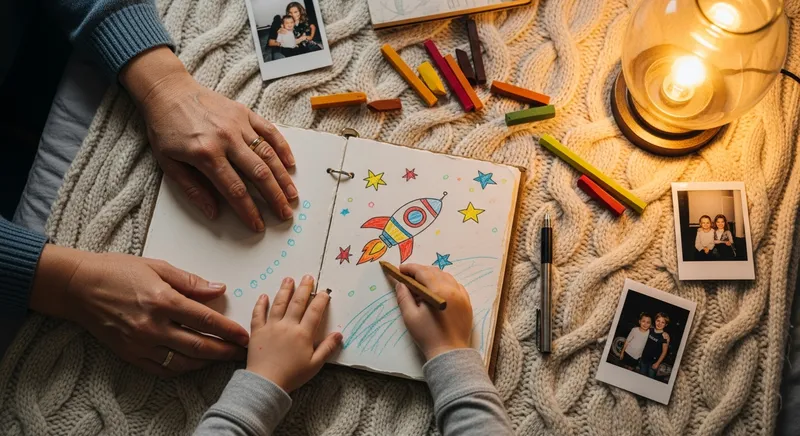
- Actionable Tip: Grab a few sheets of paper, fold them in half, and staple them down the middle. Voilà, you have a book! Write one sentence from your story on each page, and either have your child draw the pictures or print out family photos to glue in. For a more polished look, a guide from Canon Europe suggests printing your pictures on sticker paper for an easy, mess-free application.
This simple craft turns your story into a treasured object they can read again and again.
Need a Magical Assist? How Dreamcraft Tale Can Help
We know that even with the best intentions, there are nights when you're just too exhausted to create from scratch. That's okay! Think of Dreamcraft Tale as your creative partner for those moments.
"I used to dread the 'one more story' plea. Now, with Dreamcraft, I can create a story about my son and our dog going to space in about two minutes. It's our favorite part of the day. No ads, no distractions, just magic." - Sarah, Parent of a 5-year-old
Our app was built by a parent who gets it. For those nights when you need a little help, our simple 3-step process makes it easy:
- Imagine: Give our AI a simple prompt—like "a story about my daughter Lily and her teddy bear who go to the moon"—and add your child's name.
- Create: Our carefully designed AI generates a complete, beautifully illustrated story in minutes, making your child the hero.
- Read: Enjoy a magical story together. Our app is 100% ad-free for a distraction-free bonding experience. Plus, it's mobile-first, so you can save stories for offline reading on planes, in cars, or anywhere your family's adventures take you.
Or, if you're too tired to even think of an idea, you can explore the Story Library and browse thousands of magical stories shared by our community of families for instant inspiration.
Start your first magical adventure for free tonight.
Frequently Asked Questions
What if I'm not creative at all?
That feeling is completely normal! Storytelling is a skill you can learn, not a magical gift. Start with the 5-step framework in this guide. Your child's real life is the only prompt you need. You're not inventing from thin air; you're just adding a little magic to their world. You can do this!
How long should a personalized bedtime story be?
For toddlers and preschoolers (ages 3-5), a 3-5 minute story is perfect. For early elementary kids (ages 6-9), you can stretch it to 5-10 minutes. The goal is connection and a peaceful transition to sleep, not writing an epic novel. Focus on quality, not length.
How can I make up a story when I'm tired?
This is a real challenge. On low-energy nights, use a simple template and let your child co-create. Try this: "Once upon a time, there was a [child's favorite animal] named [child's name] who had to find a magical [color] [object]…" Let your child fill in the blanks. It takes the pressure off you and makes them feel even more involved.
What are the main benefits of telling stories instead of just reading books?
While reading books is incredibly important, telling a bespoke story offers unique advantages. It deepens the parent-child bond, allows you to tailor lessons and address specific fears directly, and boosts your child's imagination by making their world the foundation of the adventure. As studies from the NIH and the University of York show, it's a distinct and powerful activity for a child's brain development.
Can I tell a story about a 'bad guy'?
For young children (ages 3-9), it's generally better to focus on challenges and obstacles rather than outright villains. A scary 'bad guy' can sometimes create more anxiety around bedtime. Instead of a villain, the conflict could be a tall mountain to climb, a tricky puzzle to solve, or a grumpy troll who just needs a friend. This keeps the story feeling safe, positive, and empowering.