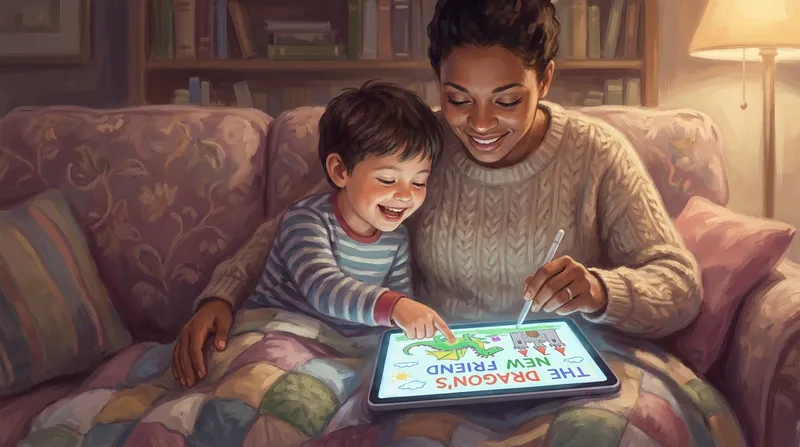
It's 8 PM. You've read the same three books twice, and your kindergartener is still buzzing with energy, asking for "just one more story." As a parent myself, I know this moment well. You love their passion for stories, but you're also wondering how to channel that love into the building blocks of reading and writing. What if the answer wasn't just reading one more story, but creating one together?
Welcome to the magic of story creation, one of the most powerful—and fun—core literacy activities for kindergarten. It's a playful journey that takes your child's spoken words and brilliant ideas and transforms them into written text, building a bridge to literacy without the pressure of drills or worksheets.
This guide will walk you through a simple, step-by-step process called "From Talk to Text," showing you how to turn your child's imagination into a foundation for reading success.
Why Story Creation is a Literacy Superpower
Before a child can read or write a story, they need to understand what a story is. This is where narrative skills come in. According to research on early literacy development, developing narrative skills—the ability to describe things and events and tell stories—is one of the six fundamental pre-reading skills. It's the soil from which all other literacy skills grow.
While reading books is fantastic, co-creating stories offers unique benefits:
- It Builds Comprehension: When children create a story, they have to think about a beginning, a middle, and an end. This "story grammar" is a key part of reading comprehension.
- It Connects Spoken and Written Language: It shows children that their own thoughts and words can be captured on paper, giving them a powerful motivation to learn to write.
- It Boosts Confidence: Your child is the creator, the inventor, the boss of the story. When they see their idea become a 'real' story, their confidence soars. We've heard from parents whose children, after co-creating a story about a brave astronaut puppy, volunteered to read aloud in class for the very first time.
Research has confirmed that strong oral narrative skills are a powerful predictor of future reading success. By making up stories, your child is actively practicing a skill that will help them for years to come.
Understanding Narrative Skills at This Age
For a kindergartener, "narrative skills" don't mean writing a novel. They are much simpler, foundational abilities. According to guidelines from education departments like Australia's Raising Children Network, making up and sharing stories helps children learn to put ideas in order.
Based on developmental milestones outlined by experts like those at the Victoria Department of Education, a child around age 5 is typically learning to:
- Tell a simple story with a clear sequence (beginning, middle, end).
- Use descriptive words to talk about characters and settings.
- Connect events using words like "and then" or "because."
- Retell a familiar story or a personal experience.
Your role isn't to be a teacher, but a joyful collaborator. You can find many 12 Fun & Simple Ways to Boost Your Child's Imagination just by playing together.
Your "From Talk to Text" Toolkit: A Step-by-Step Guide
This four-step process gently guides your child from oral storytelling to the first steps of writing. There's no pressure—move at your child's pace and focus on the fun.
Step 1: Start with Oral Storytelling (The "Talk")
Everything begins with a conversation. Co-create a story out loud, taking turns adding sentences. Don't worry about it being perfect; the goal is collaboration and fun. Research from Penn State Extension notes that oral storytelling helps children develop abstract thinking.
Actionable Tips:
- Ask Open-Ended Questions: Instead of "Was the dragon scary?" try "What did the dragon do next?"
- Use Silly Voices: Different voices for different characters make it more engaging.
- Capture the Magic: Use your phone's voice recorder to record your story. Listening to it later reinforces the narrative structure and makes your child feel like a real author!
For more ideas on this, check out these 11 Imaginative Storytelling Activities for Preschoolers (Beyond Just Reading Books).
Step 2: Draw the Story (The Visual Bridge)
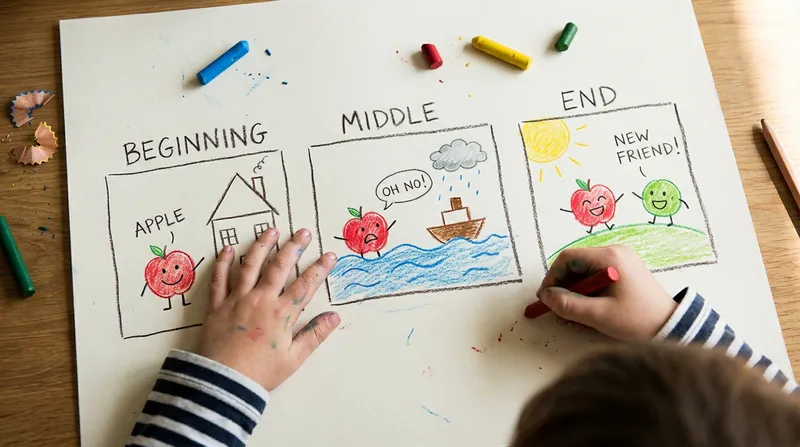
For young children, drawing is writing. It's their first and most natural way to represent ideas visually. Get a big piece of paper and draw three large boxes for the beginning, middle, and end. Ask your child to draw the most important part of each section of the story you created together.
Step 3: Become a Scribe (Dictation)
This step is where the magic connection happens. As your child points to their drawings and retells the story, write their exact words underneath each picture. Don't correct their grammar or change their words. This act shows them, in real-time, that their spoken words can become permanent text. They see their voice has power on the page. (P.S. If you ever need a little help sparking that initial story, creative tools can be a great starting point!)
Step 4: Encourage "Kid Writing" (The "Text")
Once your child is comfortable with dictation, they may start showing interest in writing themselves. This is the time to celebrate "invented spelling." If they write "DGN" for dragon, that's a huge win! It shows they are connecting sounds to letters. Academic studies, like one published in Reading & Writing Quarterly, have shown that this kind of oral-to-written narrative instruction significantly improves kindergarteners' writing skills. Encourage them to write just one word, the character's name, or a sound effect—every mark is a victory.
Fun Activities and Prompts to Get Started
Staring at a blank page can be intimidating for anyone. The key is to make it a game!
Story Starter Ideas:
- "Once upon a time, there was a squirrel who was afraid of..."
- "The spaceship landed in our backyard, and the door opened. Inside was..."
- "What if our dog could talk for a day? What would he say?"
Need more inspiration? Check out our lists of 50+ Creative Story Starters for Kids and The Ultimate Guide to Creative Writing Prompts for Kids.
Build Empathy and Other Skills Storytelling isn't just for literacy; it's a powerful tool for social-emotional learning. You can explore complex feelings in a safe, fictional space. Creating stories is one of the best Social-Emotional Learning (SEL) Activities You Can Do Through Storytelling and a great way to introduce ideas from 10 Modern Moral Stories for Kids.
Making Story Creation Even Easier with a Little Magic
These four steps work beautifully, and we've seen thousands of families build amazing literacy skills this way. But let's be honest: some nights, you just don't have the creative energy.
That's where technology can be a helpful, magical assistant. At Dreamcraft Tale, our mission is to help you transform bedtime into a truly special bonding experience. We've designed an app to do the heavy lifting so you can focus on the fun part: imagining with your child.
With Dreamcraft Tale, you can create a unique, personalized story in three simple steps:
- Imagine: You and your child share a simple idea. Maybe it's making them the brave knight who saves a kingdom of candy.
- Create: Our AI helps bring that idea to life, crafting an age-appropriate narrative and generating beautiful, professional illustrations to match.
- Read: In minutes, you have a brand-new, beautifully illustrated storybook on your device, starring your child as the hero—with offline access so you can read it anywhere.
For those nights when you're out of ideas, you can explore thousands of adventures in our shared Story Library. Most importantly, it's a completely ad-free and safe environment, built with multiple content filters to ensure every story is wholesome and free from any inappropriate themes or language. Ready to give it a try? You can Download Dreamcraft Tale and start your first adventure tonight.
The Story Never Really Ends
Story creation is more than just a pre-reading activity; it's a way to connect, to understand your child's inner world, and to build a treasure chest of shared memories.
Not ready to download? Join our newsletter for weekly story prompts and creative parenting tips delivered right to your inbox!
By following the journey from talk to text, you are not just teaching your child how to read and write; you are teaching them that their voice matters, their ideas have value, and their imagination can change the world.
And that's a story worth telling again and again.