
It's 6 PM. Dinner is over, the kitchen is clean, and you have a precious hour before the bedtime routine begins. Then you hear it: "Can I watch my show?"
Your heart sinks a little. You know screen time isn't ideal, but you're tired, and the thought of another argument is exhausting. The parental guilt sets in.
If this sounds familiar, you are not alone. We, as parents, feel a constant pressure to manage screen time, often seeing it as a necessary evil to get through the day. The numbers can seem daunting; a 2020 report from Common Sense Media found that for children aged 0-8, the vast majority of screen use is passive video consumption. Initial data from a large-scale National Institutes of Health (NIH) study even showed that children with more than two hours of daily screen time scored lower on some language and thinking tests.
But what if we're looking at it all wrong? What if the conversation wasn't about how much time our kids spend on screens, but how they spend it?
Welcome to the shift from passive viewing to active creating. This is your guide to transforming screen time from a source of guilt into a powerful tool for creativity, learning, and most importantly, family bonding. We'll give you 8 simple, actionable ways to make screen time a positive part of your family's life.
What is Active vs. Passive Screen Time?
Before we dive in, let's get clear on the two main types of screen time. Understanding the difference is the first step toward guilt-free digital wellness for your family.
Passive Screen Time is when a child is simply consuming content without any interaction. Think of it as the digital equivalent of staring out a window. This includes activities like:
- Binge-watching cartoons or YouTube videos
- Scrolling through video feeds
- Watching a movie without discussion
While not all passive viewing is bad, excessive amounts can be concerning. It's the "zoning out" that worries parents, where the screen becomes a digital pacifier rather than a tool for engagement.
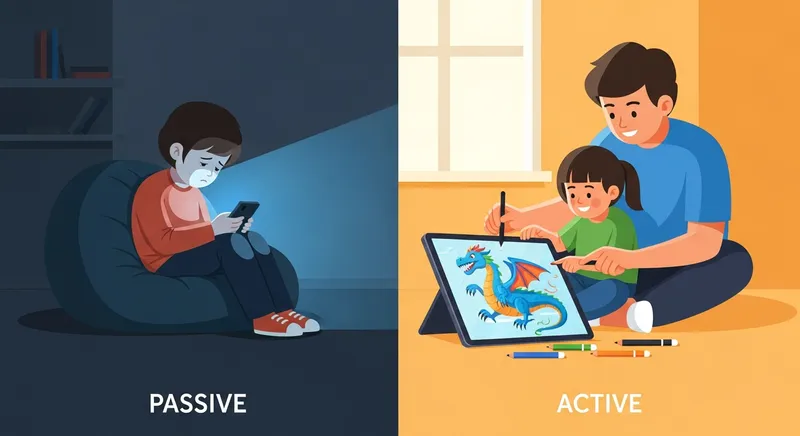
Active Screen Time, on the other hand, involves mental engagement, interaction, and creation. It requires kids to be participants, not just observers. According to research highlighted by EdSurge, how children use their devices is the strongest predictor of emotional and social well-being connected to screen use. Active screen time includes:
- Drawing on a tablet
- Playing an educational game that involves problem-solving
- Coding a simple animation
- Creating a digital storybook
- Video-chatting with grandparents
When screen time is active, it encourages critical thinking, creativity, and skill development.
Why It's About Connection, Not Just Content
The secret to positive screen time isn't just swapping a mindless video for an educational app. The real magic happens when you do it together. This is a concept called "co-viewing," and it's a cornerstone of modern media guidelines.
The American Academy of Pediatrics (AAP) recommends that for children ages 2 to 5, parents should co-view media to help them understand what they're seeing and apply it to the world around them.
It's not just about supervision; it's about participation. A study from the University of Portsmouth even suggests that discussing TV shows with your child can help develop their conversation skills. When you engage with digital media alongside your child, you transform isolating screen time into connecting "we time."
"We used to fight about screen time. Now my kids ask if we can 'make a story together.' It's become our favorite bonding time." — Sarah, mother of two (name changed to protect privacy)
8 Ways to Turn Passive Viewers into Active Creators
Ready to make the change? Here are eight practical strategies to help your family move from passive consumption to active, collaborative creation.
1. Start with Co-Viewing Conversations
This is the simplest first step. The next time your child is watching their favorite show, sit with them for 10 minutes. But instead of just watching, start a conversation. Experts at the Harvard Graduate School of Education point out that even non-educational content can become a learning opportunity through dialogue.
Actionable Tip: Ask "what if" questions. "What do you think will happen next?" "If you were that character, what would you do differently?" This simple act pulls them out of a passive state and into active thought. (Looking for more ideas? Here are our favourite story starters for kids.)
2. Bridge the Gap with "Story Extenders"
Does your child love a show about animals? Or a movie about magical creatures? Use that passion as a launchpad for creation. A "story extender" is an activity that takes the world they just watched and expands on it.
Actionable Tip: When the show ends, say, "That was a great adventure! What if we made our own story about it?" Use a creative tool to build a new narrative together. You could even explore a story inspired by their favorite characters, like in Rosie's Animal Show!, which bridges the gap between what they love to watch and what you can create together.
3. Create a Family Digital "Creation Station"
Designate a tablet, laptop, or even just a folder on your phone as the family's "Creation Station." Curate it with apps that foster creativity and collaboration, not just consumption.
Actionable Tip: Organize your apps by the type of interaction they encourage:
- For Collaborative Storytelling: Apps like Dreamcraft Tale allow you to create completely new, personalized stories with your child as the hero. See how it works.
- For Digital Art: Tools like Toca Boca apps, Procreate (for older kids), or even the basic markup tool on your phone's photo editor can be used to draw together.
- For Simple Coding: ScratchJr is a fantastic, free app for ages 5-7 to learn the basics of coding by creating their own interactive stories and games.
- For Movie Making: Apps like Stop Motion Studio let you create amazing films with LEGOs, clay, or toys. It's a perfect weekend project.
4. Build Confidence by Making Them the Hero
One of the most powerful ways to engage a child is to put them at the center of the story. When they see themselves as the brave knight or clever scientist, their investment soars, and it can build real-world confidence.
Actionable Tip: Personalized storytelling apps make this easy. Is your child nervous about a new experience? Create a story where they bravely face it, like in Pip's Gigantic Climb. Do they dream of space? Send them on an epic journey like Luna's Moon Quest. This doesn't just make screen time active; it helps them practice courage in a safe, imaginative space.
5. Host a Family "Creative Challenge"
Turn active screen time into a fun family ritual. A weekly creative challenge gives structure and excitement to the idea of making things together.
Actionable Tip: At the start of each week, announce a theme. For example: "This week's challenge is to create a story about an unlikely friendship!" Spend a few sessions brainstorming, and then use a tool that facilitates collaboration. In Dreamcraft Tale, for instance, the whole family can contribute ideas for the hero, setting, and plot, then watch the app bring your shared vision to life, complete with beautiful AI illustrations, like the one in Dania's Sparkly Adventure.
6. Make a Movie Together
This is a project-based activity that combines storytelling, art, and technology. It's the ultimate active screen time project.
Actionable Tip: Grab some toys and a smartphone. Start by planning a simple story with a beginning, middle, and end. Use an app like Stop Motion Studio to take a series of photos, moving the toys slightly in each frame. Record your family members' voices for the characters. The final product will be a cherished memory you all made together.
7. Explore the World From Your Couch
Active screen time can also be about exploration and discovery. Use technology to travel the world, visit museums, and see nature up close.
Actionable Tip: Go on a virtual scavenger hunt with Google Earth. Challenge your kids: "Can you find the Eiffel Tower? How about the pyramids in Egypt?" Explore the world-class collection of the British Museum or watch live nature cams from the San Diego Zoo and talk about what the animals are doing.
8. Collaborate on a Story from Scratch
This is the pinnacle of active, creative screen time. It combines imagination, teamwork, and technology into one seamless, bonding activity.
Actionable Tip: Sit down with your child and a blank slate. Ask them: "Who is our story about? Where do they live? What big problem do they need to solve?" Brainstorm together. Then, use a simple creation process, like Dreamcraft Tale's three steps: Imagine, Create, Read. Input your shared ideas, and watch as a complete, unique story with vibrant illustrations is generated, like the tale of Justine and the Magical Paintbrush. You're not just reading a story; you're making a memory together.
Key Takeaways for Busy Parents
- Quality over Quantity: Focus on how your child uses screens, not just for how long.
- Connect Through Co-viewing: Watching and creating together transforms screen time into bonding time.
- Start with Their Interests: Use their favorite shows as a launchpad for creative activities.
- Create, Don't Just Consume: Prioritize apps and activities that involve building, designing, and storytelling.
From Guilt to Connection
Shifting from passive viewing to active creating isn't about adding another task to your already-full plate. It's about changing your mindset. The goal isn't to perfectly manage every second of screen time, but to see those moments as opportunities for connection, creativity, and fun.
By co-viewing, asking questions, and using digital tools to build, design, and tell stories together, you transform the screen from a divider into a uniter. You replace parental guilt with shared laughter and turn mindless minutes into magical memories.
Ready to turn screen time into magical story time? Create your first personalized adventure where your child is the hero. The journey starts with a single story.
Frequently Asked Questions
Is all passive screen time bad for my child?
Not necessarily. It's all about balance and context. A quiet, relaxing movie night as a family can be a wonderful bonding experience. The issue arises when passive consumption becomes the default mode of screen use, replacing interaction, play, and creative thought. The goal isn't to eliminate passive screen time entirely but to ensure it's a small part of a balanced digital diet that heavily favors active, creative, and connective activities.
How can I make screen time more educational without a fight?
Start with their interests. If your child loves watching videos about monster trucks, don't force them into a math app. Instead, sit with them and ask questions: "How do you think they build those trucks? What makes them so strong?" Then, suggest a creative next step: "Let's try to draw the wildest monster truck we can imagine!" or "What if we created a story about a friendly monster truck who helps people?" By starting with what they love and gently guiding them toward a creative activity, you make learning a natural and fun extension of their passion, not a chore.
What are the best creative apps for a 5-year-old?
For this age, look for apps that are intuitive, open-ended, and encourage creativity without complex rules. Great options include:
- Dreamcraft Tale: Perfect for collaborative storytelling and making your child the hero of their own illustrated book.
- Toca Boca apps (e.g., Toca Kitchen, Toca Nature): These are digital sandboxes that let kids explore and experiment freely.
- PBS Kids Games: Offers a wide variety of games based on beloved characters that focus on learning and problem-solving.
- ScratchJr: A fantastic introduction to coding basics through creating interactive animations and stories.
How do I set boundaries around even positive screen time?
Boundaries are crucial for a healthy digital life, even with creative apps. The American Academy of Pediatrics (AAP) recommends creating a Family Media Plan. This is a great way to work with your child to establish clear, consistent rules. Your plan should include:
- Screen-Free Times: Such as during meals and the hour before bed.
- Screen-Free Zones: Such as bedrooms and the dinner table.
- Clear Timers: Use a visual timer so your child knows when screen time will end. Giving a five-minute warning helps ease the transition.
Are creative apps better than strict screen time limits?
They work best together. Focusing on the quality of screen time (choosing creative, active apps) is more impactful than focusing only on the quantity. However, that doesn't mean limits aren't necessary. Even creative activities on a screen can be overstimulating. The best approach is to prioritize high-quality, active content within a structured and limited timeframe that your family agrees on.
What's your biggest screen time challenge? Share your thoughts in the comments below, we're all in this together!