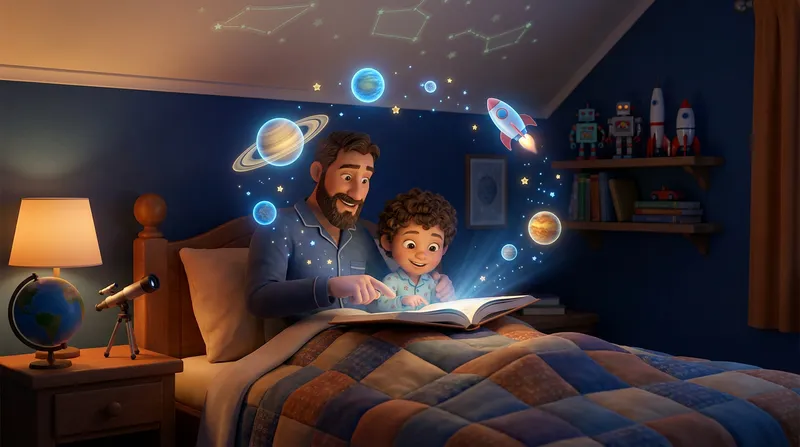
It's 8:45 PM. You've read the same book about a talking truck twice, and your child is still asking for just one more story. You want to make bedtime special and educational, but you're running on empty. Sound familiar? Every parent has been there.
You've tried the science books from the library. Some are great, but your child has already memorized them. And the ones with real facts? They often read like dry textbooks, putting children to sleep out of sheer boredom rather than comfort. On the other hand, many fun science stories rely so heavily on fantasy that they completely abandon real scientific facts, replacing physics and biology with inexplicable magic. Parents need engaging narratives that actually teach real STEM concepts without losing the wonder of a great bedtime tale.
What if your 2 to 10-year-old actually looked forward to bedtime because they were the hero of a thrilling, fact-based adventure? With Dreamcraft Tale, an AI-powered storytelling app available on iOS and Android, you can create personalized science bedtime stories that perfectly balance imagination with real-world facts. Let's explore how you can turn bedtime battles into magical moments of discovery, fostering a lifelong love for science, technology, engineering, and math (STEM).
Fact-Checked Fiction: Blending Storytelling with Real Science
One of the biggest missing pieces in children's literature today is the seamless integration of accurate scientific explanations into a fictional plot. Too often, a character flying to the moon simply flaps their arms, ignoring gravity and aerospace engineering. While imagination is wonderful, we miss a massive opportunity to teach young minds how the world actually works.
According to the National Science Teaching Association, at an early age, all children have the capacity and propensity to observe, explore, and discover the world around them, laying the foundation for K-12 science learning. When we weave real facts into our stories, we nurture this natural curiosity.
To make the most of your story time, create clear distinctions between science fiction and real science. As you read, pause and ask your child, "Do you think this part is pretend, or is this how it works in real life?"
Actionable Tip: Create an age-appropriate vocabulary glossary. Before you begin your kids' science adventures, pick three "big words" from the story (like "gravity," "habitat," or "evaporation"). Explain them simply, and have your child listen for those words as you read. When they hear the word, they can clap their hands or ring a small bell. This turns passive listening into active early science education.
Personalized Science Stories for Kids: Making Your Child the Hero
Children learn best when they are emotionally invested in the material. When your child is the main character of their own STEM stories for children, their engagement skyrockets. They aren't just hearing about a scientist. They are the scientist.
Research from the Early Childhood STEM Working Group shows that a child's grasp of spatial reasoning and foundational STEM concepts during preschool often correlates directly with literacy and math success in middle school. By placing your child at the center of the narrative, you build their confidence in tackling complex subjects early on. Imagine your daughter asking brilliant follow-up questions about the water cycle the next morning just because she was the hero who rode a raindrop in last night's story!
With Dreamcraft Tale, you can customize character names, traits, and roles. Watch your child become a brave marine biologist exploring the Mariana Trench, or a clever botanist discovering a new plant species. You can even read about characters like Justine and the Magical Paintbrush to see how creativity and discovery go hand in hand, or explore biology with Leo and the Pet Pictures.
Actionable Tip: Let your child choose their scientific profession each night. Ask them, "Do you want to study the stars, the bugs in the dirt, or the fish in the sea tonight?" Use their choice as the prompt for your Dreamcraft Tale AI story generation.
Space Adventures for Bedtime: Exploring the Cosmos
Space stories for kids are a classic bedtime favorite. The vastness of the universe naturally inspires wonder, making it the perfect setting for science bedtime stories. However, instead of just visiting a moon made of cheese, why not visit a moon with real craters caused by meteorites?
You can generate stories where your child builds a rocket using actual principles of thrust and aerodynamics, or where they learn about the different temperatures of stars based on their colors. These narratives make abstract concepts tangible for young minds.
For inspiration on celestial journeys, check out Luna's Moon Quest or the gentle nighttime tale of Raquel and the Shy Moonbeam.
Actionable Tip: After reading a space adventure, take your child to the window or step outside to look at the night sky. Try to find the moon or a bright star, and ask them to recall a fact they just learned in their story. Connecting the story to their immediate environment solidifies the learning experience.
Join the Conversation: What science topic is your child obsessed with right now? Drop it in the comments below. We'd love to hear what adventures your family is dreaming up!
Nature and Animal Stories: Discovering the World Outside
If the cosmos feels too far away, nature stories for kids bring the science right to your backyard. Biology, ecology, and environmental science are incredibly accessible for preschoolers because they can physically interact with nature every day.
The National Association for the Education of Young Children explains that STEM learning doesn't begin with worksheets or formal lessons. It begins with play when children build, test ideas, and make sense of the world through hands-on experiences. A great story acts as a catalyst for this play.
Imagine a story where your child shrinks down to the size of an ant to learn how colonies work together, or where they follow a drop of water through the entire water cycle. You can explore the animal kingdom with tales like Rosie's Animal Show! or Lily's Perfect Pet. You can also dive into earth science with Pip's Gigantic Climb or discover ocean wonders in Courtney and the Whispering Shell.
Actionable Tip: Collect items from nature (leaves, rocks, pinecones) during the day. At bedtime, generate a story that features the exact items you found, explaining their biological purpose.
Interactive Science Mysteries for Curious Minds
Science is ultimately about asking questions and seeking answers. The best science books for preschoolers frame the plot as a mystery that needs solving. Interactive science stories encourage readers to use the scientific method: make an observation, form a hypothesis, test it, and draw a conclusion.
The American Library Association highlights that when used in the classroom or at home, science read-alouds can increase science vocabulary, lower the abstract nature of science principles, and enrich children's science experiences.
Instead of the narrator simply giving the answer, a good STEM story allows the child to figure it out alongside the main character. Why is the shadow getting longer? Why did the ice cube melt?
Actionable Tip: Pause the story right before the scientific mystery is solved. Ask your child, "What do you think is going to happen next?" or "How can we fix this problem?" Validate their hypothesis, even if it's incorrect, by praising their critical thinking before reading the real solution.
Parent-Child Experiment Guides: Bring the Story to Life
One of the biggest gaps in modern children's storytelling is the lack of follow-up. A story shouldn't end when you close the book (or turn off the app). To truly cement early STEM foundations, pair your reading with real-world activities.
While Dreamcraft Tale provides the digital narrative, you can easily create offline resources to accompany them. For example, if you read Dania's Sparkly Adventure, you can talk about how light reflects off different surfaces. If you read Lily's Happy Voice, you can discuss soundwaves and vibrations.
Actionable Tip: Plan a "Story Extension Experiment" for the next morning. If your bedtime story was about buoyancy (why boats float), fill the sink with water the next day and test different household objects (a penny, a plastic toy, a wooden spoon) to see which ones sink and which ones float. This bridges the gap between digital storytelling and tactile learning.
Create Your Own STEM Story: A Simple 3-Step Process
Creating high-quality, customized educational content might sound intimidating, but AI technology has made it effortless. The National Academies of Sciences, Engineering, and Medicine notes that most children don't get enough opportunities to learn science in the early grades, and early exposure is critical to prevent interest from waning by middle school.
You can provide this crucial early exposure right from your phone. Imagine it's 8:30 PM. Your daughter tells you she wants to be a marine biologist who discovers a glowing fish. Instead of scrambling for a book you don't have, you simply open Dreamcraft Tale (available on iOS and Android) and follow an easy three-step process:
- Imagine: Type in her exact request. A simple prompt like, "A story about a 6-year-old girl named Maya who explores the deep ocean and discovers bioluminescent fish, learning about marine biology along the way."
- Create: Within minutes, the AI weaves her idea into a complete, age-appropriate narrative, generating beautiful illustrations that bring her glowing fish to life.
- Read: Snuggle up and enjoy your unique storybook together, completely ad-free and without interruptions.
Actionable Tip: Let your child press the "Create" button on the app. The anticipation of waiting a few moments for their very own story to generate builds incredible excitement for reading time.
Early STEM Foundations: Vocabulary and Comprehension
Reading a story is only the first half of the educational journey. Comprehension is the second half. Many apps provide quick stories but fail to offer educational reading guides for parents.
To maximize the educational value of short science stories for kids, you need post-story discussion questions. This doesn't mean giving your child a pop quiz before they go to sleep. Instead, frame it as a casual conversation about the adventure they just went on.
Actionable Tip: Keep three standard questions in your parenting toolkit for every science story:
- What was the coolest thing you learned today?
- If you were the scientist in the story, what would you have done differently?
- Where else in the real world have we seen something like this?
Why Choose AI Bedtime Stories for Science Education?
You might wonder how an AI story generator fits in with traditional printed books. Traditional books are a treasure, and Dreamcraft Tale is designed to expand your family's story world beyond what any single shelf could hold. It adapts to your child's rapidly changing interests. If your child loves caterpillars on Tuesday but is obsessed with bulldozers by Friday, you have instant access to stories that match their curiosity.
Dreamcraft Tale offers a Shared Story Library where you can access thousands of stories created by families worldwide. If you're too tired to create a new prompt, simply browse the library for instant inspiration.
Furthermore, Dreamcraft Tale guarantees a safe, wholesome environment. With multiple content filters and strict moderation, every story is age-appropriate. The ad-free experience ensures that your family bonding time remains private, peaceful, and focused entirely on storytelling and learning.
Start Your Scientific Adventure Tonight
Bedtime doesn't have to be a struggle, and science education doesn't have to be boring. By combining the magic of personalized storytelling with the wonder of real-world STEM concepts, you can create nights filled with curiosity, bonding, and joy.
What will your little scientist discover tonight? Whether it's the rings of Saturn or the secret life of ants, Dreamcraft Tale turns their curiosity into a story they'll never forget. Create your first adventure free on iOS or Android. It takes less than three minutes. Download Dreamcraft Tale today and let their imagination lead the way to discovery!
Frequently Asked Questions
What are good science stories for 5 year olds?
Good science stories for 5-year-olds focus on observable phenomena in their immediate environment. Topics like the weather, plant growth, animal habitats, and simple physics (like gravity and friction) are excellent choices. The best stories make the child the hero and use simple, relatable language rather than complex jargon.
How can I teach my child STEM concepts through bedtime stories?
The secret is to weave facts into a narrative. Instead of reciting facts about the solar system, read a story about your child traveling to Mars and experiencing lower gravity. Pause during the story to ask open-ended questions, and follow up with a simple hands-on activity the next day to reinforce the learning.
Are there short stories about space for kindergarteners?
Yes! Space is highly engaging for kindergarteners. Stories that focus on the phases of the moon, the concept of planets orbiting the sun, or what astronauts wear in space are perfect for this age group. Apps like Dreamcraft Tale allow you to generate unlimited space stories tailored exactly to your kindergartener's reading level.
What makes a good educational science story for kids?
A great educational story balances accurate facts with an engaging plot. It shouldn't feel like a textbook. It needs a clear conflict or mystery, relatable characters, age-appropriate vocabulary, and vibrant illustrations to help visualize abstract concepts without relying entirely on magic to explain away the science.
How do I explain nature and physics to preschoolers?
Use analogies related to their everyday life. Explain gravity as the earth giving everything a big hug to keep it from floating away. Explain plant growth by comparing roots to drinking straws. Use stories to illustrate these concepts visually, and always encourage them to ask "why" when they observe the world around them.