
Is it bedtime, and you're already feeling a sense of dread? Do you find yourself searching for a way to bridge the gap and understand what's happening in your child's wonderful, unique mind, especially when big feelings take over? If you're a parent of a neurodivergent child with ADHD or on the autism spectrum, you know that connection is everything. You're seeking a way to connect heart-to-heart, calm the storms, and build their confidence.
You are not alone in this, and there is a powerful, loving tool that can help: storytelling. This guide is about using the magic of stories-from time-tested methods to incredible new tools-to build a world of understanding, safety, and connection for your child.
Key Takeaways for Busy Parents
- Embrace a Neuro-Affirming Lens: Focus on connection and understanding, not correction. Validate your child's experience.
- Use the Right Tool for the Job: Learn the difference between Social Stories™, Sensory Stories, and Personalized Adventures to meet your child's specific needs.
- Leverage Special Interests: Weave your child's passions into stories to build their confidence and make learning feel like play.
- Co-Create Together: Use tools like an AI story generator to empower your child, showing them their ideas have value and turning story time into a team activity.
- Anchor Your Routines: Use predictable, calming stories to ease difficult transitions, especially the bedtime routine.
Beyond Words: Why Storytelling is a Superpower for Neurodivergent Families
For neurodivergent children, the world can often feel loud and unpredictable. A simple story can be a quiet harbor in a stormy sea. It provides structure, predictability, and a safe space to explore complex emotions and social situations. This isn't just a feeling; it's backed by science. Stories help organize the brain, making sense of events and emotions in a linear, manageable way.
For many neurodivergent kids, anxiety is a constant companion. In fact, research published by the National Center for Biotechnology Information found that nearly 40% of young people with Autism Spectrum Disorder (ASD) also struggle with a clinical anxiety disorder. Stories can be a powerful tool for anxiety relief by offering gentle repetition and predictable outcomes.
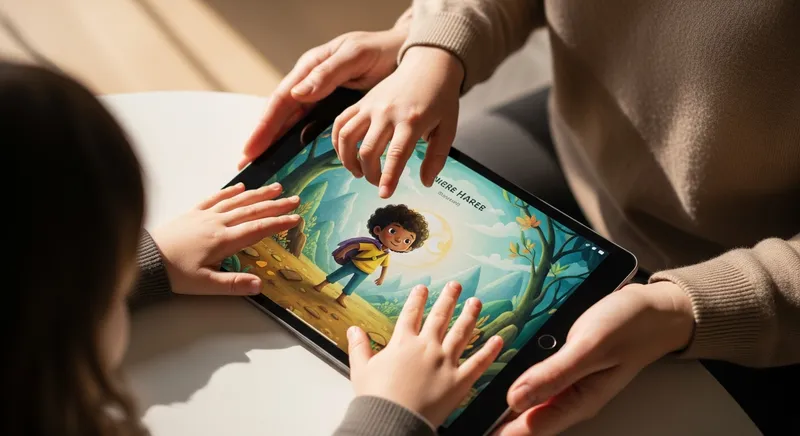
For a child with ADHD, a calming story can help focus a racing mind. For an autistic child, a story can provide a clear script for a confusing social interaction, making the world feel more understandable. Modern tools can make creating these stories easier than ever, allowing you to focus on the connection, not just the creation.
Adopting a Neurodiversity-Affirming Approach
Before we dive into the 'how,' let's talk about the 'why.' The most powerful storytelling is done through a neurodiversity-affirming lens. This means we shift our goal from 'fixing' a behavior to 'connecting' and 'understanding.' It's about celebrating your child for who they are.
A neurodiversity-affirming story:
- Validates Feelings: "It's okay to feel overwhelmed. In our story, Raquel and the Shy Moonbeam also felt a little shy, and that was okay."
- Explains the Neurotypical World: "Sometimes, people like to look at each other's eyes when they talk. It helps them know you're listening. It's just one way people talk."
- Builds Self-Advocacy: "When my ears feel full, I can ask for my headphones. I know what my body needs."
Actionable Tip: Before creating a story, ask yourself: "Does this story help my child feel seen and understood, or does it tell them they need to change to be accepted?" The answer will guide you toward true connection.
The Storytelling Toolkit: Methods for Every Need
Your storytelling toolkit can be as simple as your own voice or as advanced as an AI-powered app. The key is knowing which tool to use and when. Tools like Dreamcraft Tale become invaluable here, using a simple 3-step process (Imagine, Create, Read) to generate therapeutic stories in minutes.
Social Stories™: Sharing Information Respectfully
Developed by Carol Gray, the official purpose of Social Stories™ is to share social information in a respectful way, not to control behavior. A Social Story™ accurately describes a situation to help an autistic person better understand it.
According to the Vanderbilt Kennedy Center, these stories are written from the child's perspective using positive language. For example, instead of "Don't run," try "At the library, I use my walking feet."
- How the App Helps: Writing a Social Story™ from scratch can be tricky. With an app like Dreamcraft Tale, you can generate a story about 'going to the dentist' or 'taking turns' with your child as the main character, making the lesson personal and engaging.
Sensory Stories: Engaging the Whole Child
Sensory Stories, championed by experts like Joanna Grace of The Sensory Projects, are short narratives made meaningful with accompanying sensory experiences. They are a fantastic way to introduce sensory triggers in a safe, predictable way.
Actionable Tip: Create a sensory story about a walk in the woods.
- "I am walking on a bumpy path." (Let your child walk over a bumpy cushion.)
- "I can smell the pine trees." (Hold a pinecone under their nose.)
- "A cool breeze blows." (Gently blow on their arm.)
- How the App Helps: While the sensory items are physical, you can use a tool like Dreamcraft Tale to quickly generate the simple, repetitive narrative that forms the backbone of your story, saving you time and creative energy.
Personalized Adventures: Building Confidence and Joy
This is where the magic really ignites. When your child becomes the hero of their own story, it does wonders for their self-esteem. Your child's deep, passionate interests are not a distraction; they are a doorway into their world.
Does your child love dinosaurs? They can be the paleontologist who discovers a new species! Are they obsessed with sparkles? Let them be the hero of a story like Dania's Sparkly Adventure! This approach transforms their interest into a source of confidence.
Explore our Story Library for inspiration and see how other families are using special interests in their tales!
Practical Magic: Storytelling for Common Challenges
Calming Bedtime Routines for Kids with ADHD
Bedtime can be tough for kids with ADHD. As the Child Mind Institute notes, a consistent routine is crucial. A predictable story can be the anchor of that routine.
Actionable Tip: Create a recurring bedtime adventure with a character you and your child invent. Every night, they can go on a short, calming journey, like exploring the quiet stars in Luna's Moon Quest. The familiarity is soothing and signals that it's time for sleep.
Navigating Big Emotions and Building Regulation
Neurodivergent kids often feel emotions in a big, overwhelming way. Stories give them a language for these feelings and a script for how to navigate them. You can create a story about a character who feels 'fizzy' inside and finds a strategy that helps, like taking deep breaths or finding a quiet corner. It's about giving them tools, not punishments.
You Are the Magic Ingredient
An AI app can generate a story, but it can't cuddle your child close. It can create an illustration, but it can't wipe away a tear. Tools like Dreamcraft Tale are designed to be your partner, to take the pressure off so you can focus on being a present parent. You bring the love, the intuition, and the deep knowledge of your child. You are the magic that turns a story into a bridge for connection.
Ready to create therapeutic stories that truly see your child? Download Dreamcraft Tale today for a safe, ad-free experience where you control the narrative and your child becomes the hero. Transform story time into connection time.
Frequently Asked Questions
What is therapeutic storytelling? It's using stories to help children process emotions and understand social situations. It provides a structured, safe way to explore confusing topics like managing anxiety or making friends.
How can a story calm a child with ADHD at bedtime? A story provides a single point of focus for a racing mind. A familiar, calming narrative signals to the brain that it's time to rest, easing the transition to sleep.
What is the difference between a sensory story and a Social Story™? A Social Story™ uses words and pictures to explain a social situation. A sensory story is a short narrative paired with physical sensory experiences (smell, touch, sound) to engage the whole child.
How long should a therapeutic story be? It depends on your child's attention span. For toddlers and preschoolers, 5-10 sentences is great. The key is to end the story while they are still engaged and happy.
Can I really use my child's special interests in these stories? Absolutely! It's one of the most effective ways to connect. Using your child's passion (whether it's trains or planets) shows you value what they love and makes the story instantly engaging.