
Beyond Books: A Parent's Guide to Teaching Financial Literacy (Ages 4-9) With Personalized Stories
You want to raise a financially savvy child. You know it's important. But when you try to explain what a 'savings account' is to your five-year-old, you're met with a blank stare. You feel overwhelmed trying to teach abstract concepts to a very concrete thinker, and you worry that the piggy bank on their dresser just isn't cutting it in our increasingly digital world.
If this sounds familiar, you're not alone. The pressure is real, especially when groundbreaking research from the University of Cambridge reveals that our core money habits are largely formed by the age of seven. That's a tiny window to build a huge foundation.
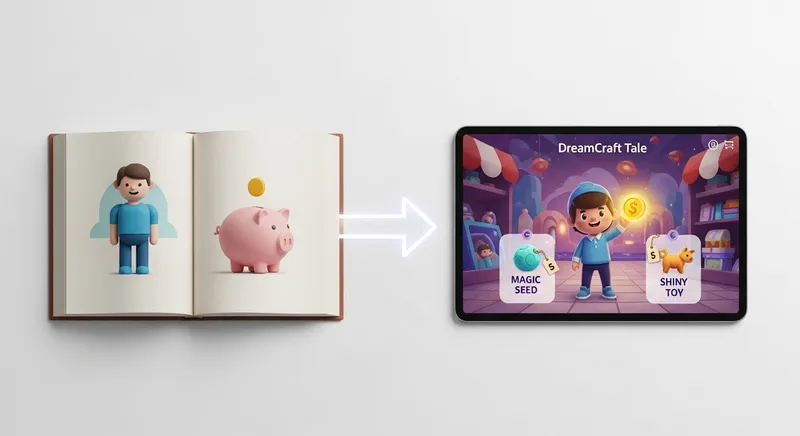
So, how do we make lessons about earning, saving, and spending stick? The answer isn't in another boring lecture or a static picture book. It's by making the lesson an adventure, and making your child the hero.
This guide will show you how to move beyond traditional books and use the magic of dynamic, personalized stories to teach financial literacy in a way that is fun, engaging, and deeply memorable.
Why Traditional Money Lessons Often Miss the Mark for Young Kids
For a young child, money is a confusing topic. We try our best with jars and piggy banks, but often, the core concepts don't quite land. Here's why:
- Money is Abstract: Concepts like 'saving for the future' or 'interest' are invisible and abstract. A five-year-old lives in the here and now; 'later' can feel like an eternity.
- Traditional Books are Static: While wonderful, most books feature fixed characters in fixed scenarios. They might not resonate with your child's unique world or answer their specific questions.
- The World is Increasingly Cashless: It's hard to teach the value of a dollar when your child rarely sees you use physical cash. They see you tap a card or a phone, and magically, you get groceries. This makes money seem like an unlimited, invisible resource.
These challenges can make parents feel like they're failing before they even start. But what if you could make these abstract ideas feel as real and exciting as their favorite cartoon?
The Magic of Storytelling: A Powerful Tool for Financial Education
Storytelling isn't just for entertainment; it's one of the oldest and most effective teaching tools in human history. As Edutopia, an initiative of the George Lucas Educational Foundation, highlights, stories are powerful because they make abstract ideas accessible and improve listening skills.
When you frame a lesson within a story, you're not just giving information; you're creating an experience. And when your child is the main character of that story, the magic is amplified tenfold. The lesson becomes:
- Personal: It's not about a random character; it's about them. Their choices, their adventure.
- Memorable: We remember feelings and experiences far better than dry facts. The excitement of their character saving up for a magical castle is a feeling they will remember.
- Engaging: They are no longer a passive listener but an active participant in their own learning journey.
How to Teach Core Money Concepts with Personalized Stories
Ready to become a financial storyteller? Here's how you can use personalized stories to teach the three pillars of financial literacy. We'll provide actionable prompts you can use right away.
Lesson 1: Earning Money (From Allowance to Entrepreneurship)
The first step is helping children understand that money is earned through work and effort. This aligns with the national standards from organizations like the Jump$tart Coalition for Personal Financial Literacy, which include 'Employment and Income' even for early grades. Instead of just handing over an allowance, create a story that illustrates the connection.
Actionable Story Prompt: "Let's create a story about a great detective named [Child's Name]! Their mission is to find all the lost socks in the house. For every pair they find and match, the King and Queen (that's us!) will reward them with a shiny hero coin for their bravery and hard work."
For older kids, introduce entrepreneurship:
"Let's tell a story about an amazing artist named [Child's Name] who loves drawing animals. They decide to start a small business, just like in the story of Leo and the Pet Pictures, and offer to draw beautiful pictures of their friends' pets for one gold coin each!"
These stories transform chores or small jobs from mundane tasks into epic quests, directly linking effort to reward.
Lesson 2: The Power of Saving (Delayed Gratification)
This is often the hardest concept to explain to a 5-year-old. A story is the perfect way to help them visualize the benefit of waiting for a bigger reward.
Actionable Story Prompt: "Let's create an adventure for [Child's Name], a brave mountain explorer! They have one coin and could buy a small, yummy trail mix bar right now. But, if they save their coin each day for three days, they'll have enough to buy a ticket for the giant super-slide at the top of the mountain, just like in Pip's Gigantic Climb! What adventure will they choose?"
This narrative allows your child to experience the choice of delayed gratification in a fun, low-stakes environment. You can celebrate their character's patience and the amazing reward they get at the end.
Lesson 3: Smart Spending (Needs vs. Wants)
Understanding the difference between needs and wants is a foundational budgeting skill. A story can make this tricky distinction crystal clear.
Actionable Story Prompt: "Imagine [Child's Name] is a magical gardener who has three shiny coins. They go to the Sparkle Market. They need to buy a bag of sunbeam seeds to make their food-plants grow. But they also want a beautiful, but unnecessary, singing crystal. They only have enough coins for one. What should they do?"
This kind of story, similar to the quest in Dania's Sparkly Adventure, creates a safe space to explore consequences. What happens if the gardener buys the crystal instead of the seeds? You can explore that outcome together, solidifying the lesson without any real-world tears.
Want to see these prompts in action? Explore our Story Library for instant inspiration →
Age-Appropriate Money Lessons: A Timeline for Parents
While stories make the concepts stick, it helps to know which concepts to introduce and when. It's crucial to match the lesson to your child's developmental stage. The U.S. Consumer Financial Protection Bureau (CFPB) provides excellent milestones that we can use to guide our financial stories.
Ages 4-6: The Basics
At this stage, children are concrete thinkers. Your stories should focus on:
- What money is: A tool we use to buy things we need and want.
- Earning: You have to work to earn money.
- Saving: The concept of putting money away in a visible place (a clear jar is great!).
Ages 7-9: Making Choices
Children can now understand more complex ideas. Your stories can introduce:
- Goal Setting: Saving up for a specific, desired item.
- Choice & Cost: Things have different prices, and we have to make choices because money is limited.
- Needs vs. Wants: The ability to distinguish and prioritize.
From Story to Reality: Opening Your Child's First Savings Account
After your child has become the hero of countless saving adventures in their stories, you can create the ultimate sequel: their real-life savings journey. This is the perfect time to open their first savings account. Bridge the gap with one last adventure.
Actionable Story Prompt: "Let's create a story where [Child's Name], the hero of Glimmerwood, needs to keep their treasure safe from the Sleepy Dragon. They journey to the Great Vault of Glimmer (the bank!) where friendly goblins (the tellers!) help them lock their hero coins away where they can stay safe and even grow!"
Don't be intimidated by the real-world process; it's simple:
- Talk about it: Frame it as a 'grown-up' piggy bank where their money is kept extra safe and can even grow, just like in their story.
- Visit the bank: Make a special trip to the bank or credit union. Let your child help hand the initial deposit to the teller.
- Celebrate the milestone: This is a big step! Make it feel as important as it is.
Research from the University of Wisconsin-Madison's Center for Financial Security shows that by age 9, children can understand the idea of keeping money in a bank. By introducing it through story first, you're giving them the confidence and context to embrace this real-world step.
Making Financial Storytelling Effortless (Yes, Really!)
Feeling inspired but wondering how to create these adventures without staying up until midnight? That's exactly why we created Dreamcraft Tale.
Join thousands of families who are already turning money lessons into magical memories. Our app is the perfect tool to put all this advice into action, effortlessly. In just a few minutes, you can use the prompts in this article to create a complete, beautifully illustrated story where your child is the star. You can create a tale about a magical paintbrush that brings creations to life, just like in Justine and the Magical Paintbrush, and tie it to the value of creating things.
Dreamcraft Tale's AI story generation helps you turn these important lessons into the magical, personalized, and ad-free bonding moments you'll both cherish.
Ready to raise a money-smart kid while creating magical memories? Turn your first financial lesson into an adventure tonight.
Download Dreamcraft Tale from the App Store →
Frequently Asked Questions
At what age should I start teaching my child about money?
You can begin introducing very basic financial concepts as early as age three or four. According to the Consumer Financial Protection Bureau, preschoolers can grasp that money is exchanged for things. The goal at this age isn't to create a financial wizard but to build a foundation of awareness, especially since critical money habits are formed by age seven.
Should I give my 6-year-old an allowance?
An allowance can be a fantastic, hands-on tool for teaching financial literacy. Think of it less as a payment and more as a learning aid. For a 6-year-old, tying a small allowance to completing 'Hero Helper' tasks (like those in our story prompts) creates a clear link between work and earning. A common starting point is the 'dollar-per-age' rule, so a 6-year-old might receive $6 per week, giving them just enough to start making simple saving and spending decisions.
What is the best way to explain 'needs vs. wants' to a young child?
Keep the definitions simple and use relatable examples. You can say, "'Needs' are things our bodies and families must have to be safe and healthy, like food to eat, water to drink, and a cozy home to sleep in. 'Wants' are extra things that are fun to have but we don't require to live, like a new toy or a special ice cream treat." Reinforce this concept during a grocery store trip by pointing out what's a 'need' (vegetables, milk) versus a 'want' (candy at the checkout aisle).
What are some fun financial literacy activities for kids besides stories?
Personalized stories are a powerful starting point, and you can boost their impact with other hands-on activities. Here are a few favorites:
- The Three-Jar System: Label three clear jars: Save, Spend, and Share. When your child receives money, have them divide it among the jars. This visually teaches them that money has different jobs.
- Play Store: Set up a pretend store with items from around the house, each with a price tag. Give your child play money and let them shop, make change, and decide what they can afford.
- Goal Chart: If they're saving for a specific toy, create a visual chart. They can color in a section for every dollar they save, making their progress tangible and exciting.
How can I teach my child the value of money if we barely use cash?
This is a crucial question in today's digital world. The key is to make the invisible, visible. When you use a credit card or your phone to pay, don't let it be a silent, magical transaction. Narrate the process: "Okay, I'm tapping the card to pay the grocery store $50 for all of our food." For their own money, use a visual tracker. This could be a simple chart on the fridge or a kid-friendly allowance app. When they 'spend' some of their money on a want, physically update the chart with them so they see their balance decrease.