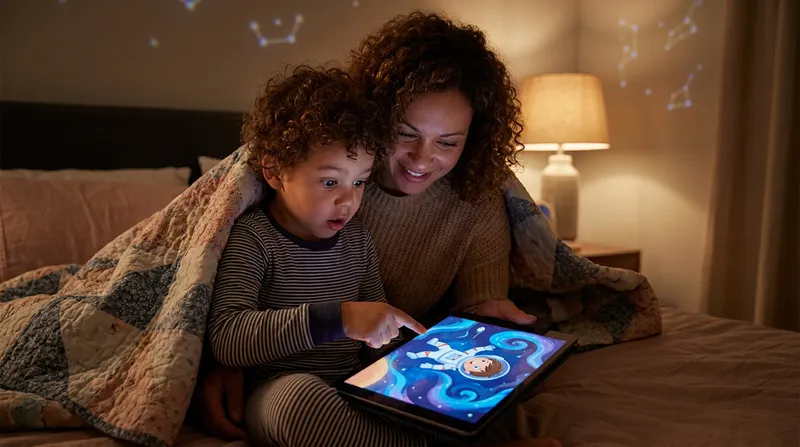
The clock says it is time for sleep, but your little one's eyes are wide open, brimming with questions about dinosaurs and spaceships. You have already read their favorite printed books cover to cover, and you are running out of steam. Bedtime suddenly feels like a hurdle rather than a peaceful winding down.
Every parent and caregiver knows this feeling. In our search for rest, many of us turn to passive audio apps to help our little ones drift off to sleep. While these apps can be soothing for the final transition to sleep, they offer limited opportunities for active reading skill development. On the flip side, traditional printed books are wonderful, foundational tools for literacy. Yet, on nights when a child's attention is scattered, they might need an extra layer of personalization to pull them in.
This leaves families looking for a middle ground between passive listening and traditional reading. What if you could turn bedtime into a magical bonding experience that actually boosts your child's literacy? Today, we are exploring a new kind of bedtime experience that goes beyond what standard audio apps offer. We will look at why AI picture books are transforming early education, the science behind visual learning, and why making your child the hero of their own custom illustrated stories is the secret to building lifelong confidence.
The Bedtime Routine: Finding the Right Balance
For years, caregivers have searched for the best bedtime story apps for kids. Audio-only apps have become incredibly popular because they offer a hands-off approach. You press play, a narrator speaks in a calm voice, and eventually, your child falls asleep.
But there is a hidden downside to relying solely on this routine. Audio-only apps are entirely passive. They ask nothing of the child other than to lie still and listen. While this is helpful for the final five minutes of winding down, it is a missed opportunity for cognitive development during the core storytime hour.
Early childhood is a critical window for building literacy. When a child passively listens to an audio track without visuals, they are not connecting words to images, and they are not following a narrative arc with visual cues. Children today are visual creatures who thrive on color and expression. When we remove the visual element entirely, we often see their attention wander.
Actionable Tip for Parents:
- Audit your bedtime routine. Try replacing 15 minutes of passive audio listening with 15 minutes of active, shared reading. Use audio apps only for the final lights-out transition.
What is an AI Picture Book?
If you are looking to add an exciting new dimension to your traditional reading routine, the AI picture book is a perfect complement.
An AI picture book is a modern approach to bedtime reading that combines the magic of traditional storytelling with the power of modern technology. Using an AI story generator for kids, parents and children can co-create personalized children's books with pictures in a matter of minutes.
Instead of reading about a generic character, your child becomes the main character. You input their name, their interests, and a lesson you want them to learn. The AI then weaves these elements together, generating a completely unique, beautifully illustrated story where your child is the star.
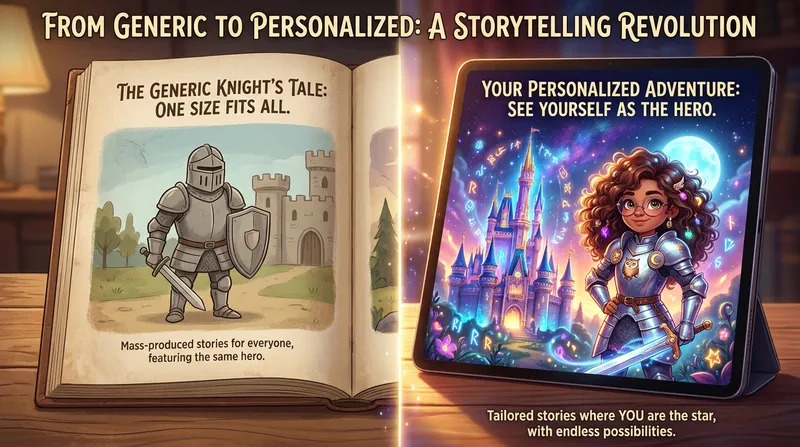
With apps like Dreamcraft Tale, you are getting a personalized adventure. Do they want to explore Mars with a friendly robot? Done. Do they want to shrink down to the size of a bug to explore the backyard? You can create that in seconds.
Actionable Tip for Parents:
- Next time your child asks a random, imaginative question (like "Where do the stars go during the day?"), use that exact question as a prompt to generate a custom illustrated story together.
Audio vs Visual Learning for Kids: The Science of Storytime
When we compare audio story apps to AI picture books, we have to look at how children actually learn. The debate surrounding audio vs visual learning in early childhood has been studied extensively by educators.
Research clearly points to the power of visual learning. According to the National Institutes of Health, students with a visual learning style perform significantly better on comprehension tests compared to strictly auditory learners.
This is because visual storytelling benefits a child's developing brain by providing essential context. When a child hears the word "gigantic" and simultaneously sees a picture of a massive mountain, the vocabulary word is cemented in their mind. This dual-coding of information is crucial for reading comprehension.
Furthermore, research published in Taylor and Francis Online validates that visual cues provide context that helps children actively process spoken language. Without these visual cues, young children often struggle to follow complex narratives.
AI picture books provide the perfect balance. Caregivers can read the text aloud while the child engages with the vibrant, custom illustrations.
Actionable Tip for Parents:
- While reading an AI picture book, pause and ask your child to point to specific objects in the illustration. Ask questions like, "How do you think the character is feeling based on their face?" to build emotional intelligence.
The Hero Effect: Why Kids Need to See Themselves in the Story
One of the most profound benefits of AI bedtime stories is the ability to create personalized story books with avatars that look like your child. This is a powerful psychological tool known as "The Hero Effect."
For decades, educators have understood the importance of representation in literature. Explaining this concept, Scholastic notes that identifying with characters in a story allows for a deeper comprehension of the text because kids make personal self connections.
When a child sees themselves as the protagonist, they often show significantly greater focus and engagement. They are no longer just observing a story. They are living it.
This builds incredible self-esteem. The U.S. Department of Education confirms that when texts serve as mirrors reflecting the reader, children gain confidence in their abilities and build self-efficacy. When your child sees their personalized character acting bravely in a story, they begin to believe they can act bravely in real life, too.
Take a look at Courtney and the Whispering Shell, where a young girl uses her listening skills to solve an ocean mystery, or Justine and the Magical Paintbrush, which shows how creativity can save the day. When your child is the hero of a similar story, they learn that their own unique traits are superpowers.
Actionable Tip for Parents:
- When creating a story in Dreamcraft Tale, give your child's character a challenge they are currently facing in real life (like being afraid of the dark). Let them see their avatar overcome this exact fear.
Active vs. Passive Engagement: Purposeful Screen Time
Many caregivers feel guilty about screen time. However, it is vital to distinguish between passive screen time (like watching endless video clips) and active screen time (like co-reading an interactive AI picture book). The American Academy of Pediatrics emphasizes the importance of co-viewing and interactive media for young children, noting that engaged, shared screen time can be highly beneficial.
Passive audio apps and videos ask little of the brain. AI picture books require active participation. Your child has to look at the images, listen to your voice, process the narrative, and turn the digital page.
This active engagement is the perfect bridge for reluctant readers. Children who typically struggle to focus will suddenly show intense interest when the book is about them. Stories with high stakes and big visuals, like Pip's Gigantic Climb (featuring a tiny character conquering a massive mountain) or Luna's Moon Quest (a visually stunning space adventure), naturally encourage kids to ask questions about the plot.
Actionable Tip for Parents:
- Turn story creation into a game. Before generating the story, ask your child to pick three random things (e.g., a purple frog, a spaceship, and a piece of broccoli) and challenge the AI to make a story including all three.
How to Create Custom Children's Books with Dreamcraft Tale
If you are ready to experience the magic of AI picture books, Dreamcraft Tale makes the process incredibly simple. You do not need to be a writer or an artist to create breathtaking stories.
Created by a parent for parents, Dreamcraft Tale is a premium, ad-free mobile app that uses a simple 3-step process:
- Imagine: Open the app and type in a brief prompt. You can include your child's name, their favorite activities, and the setting. You can even dictate the moral of the story.
- Create: Within minutes, the AI story generator for kids crafts a beautiful, age-appropriate narrative paired with stunning, professional-quality illustrations.
- Read: Snuggle up and read the story together. Watch your child's face light up as they realize they are the hero of the book.
Safety is Dreamcraft Tale's top priority. The platform features multiple layers of content filtering to ensure every story is wholesome and age-appropriate. Plus, the app is completely ad-free, ensuring your peaceful bedtime routine is never interrupted.
If you are too tired to create a new story, you can always explore the Shared Story Library to find thousands of magical stories created by other families.
Actionable Tip for Parents:
- Download Dreamcraft Tale and try creating your first story tonight. Keep the prompt simple for your first try: "[Child's Name] discovers a secret door in their bedroom that leads to a magical forest of friendly animals."
[CTA Button: Start Your Free Trial - Make Your Child the Hero Tonight]
(Developer Note: Please format the following FAQ section as collapsible accordion dropdowns for optimal mobile UX.)
Frequently Asked Questions
Are AI picture books better than audio stories for toddlers?
For the vast majority of toddlers, AI picture books offer a highly engaging learning experience. Toddlers are visual learners who need to connect words with images to build their vocabulary. While audio stories can be calming, custom illustrated stories hold a toddler's attention much longer and help them actively process the narrative.
How do personalized children's books improve reading comprehension?
Personalized books improve reading comprehension through increased engagement and self-relevance. When a child sees their own name and likeness in a story, they are intrinsically motivated to understand what happens next. This heightened focus means they pay closer attention to sentence structure, plot sequencing, and vocabulary.
What is a good Moshi kids app alternative for visual learners?
For families looking for a Moshi kids app alternative that focuses on visual engagement, Dreamcraft Tale is a premier choice. While audio-based apps focus solely on soundscapes to induce sleep, Dreamcraft Tale engages a child's imagination through vibrant, personalized artwork and active storytelling.
Can custom illustrated stories help kids with short attention spans focus at bedtime?
Absolutely. Children with short attention spans often struggle to focus when they cannot relate to generic characters or when there is nothing to look at. Custom illustrated stories solve both problems. By making the child the hero and providing rich visuals, the brain receives the exact stimulation it needs to stay focused.
Are AI story generators for kids safe to use?
Yes, premium platforms like Dreamcraft Tale prioritize safety above all else. They use multiple layers of strict content filtering and moderation to ensure every generated story is wholesome and age-appropriate. Furthermore, a secure, ad-free environment means your child will never accidentally click on inappropriate external links.
How long does it take to create a personalized children's book with pictures?
With modern AI apps, creating a custom story takes just a few minutes. You simply type in a short prompt with your child's name and interests, and the AI story generator instantly crafts a complete narrative with beautiful illustrations.