
Talking about consent with your three-year-old. It can feel awkward, right? You know it's important, but the words feel too big, the concepts too complex. How do you explain body autonomy to a toddler who just wants to climb on everyone, or teach a first-grader to say no to a well-meaning relative's hug without causing a scene?
If you've ever felt this uncertainty, you are not alone. This is the core challenge for so many parents: we want to raise respectful, confident children who understand their own boundaries, but we lack the simple tools and scripts to start the conversation.
What if you had a gentle, magical way to introduce these ideas? A tool that bypasses the awkward lectures and instead uses wonder and imagination to build a lifelong foundation of respect?
That tool is storytelling. And with personalized stories, you can make these lessons unforgettable.
What is Consent for a Child? (Hint: It's Simpler Than You Think)
For adults, the word "consent" carries a lot of weight. For young children, the concept is much simpler. It's about learning two foundational ideas: your body belongs to you, and you must respect that other people's bodies belong to them.
Experts at the Harvard Graduate School of Education suggest that for young children, the goal isn't to teach the complex word 'consent' but to build a shared vocabulary with simple words like 'body,' 'space,' and 'touch.' It's about giving them the language to say, 'This is my body,' and be understood.
This is often called body autonomy- the right to control your own body. For a child, this means:
- Deciding who touches them and when.
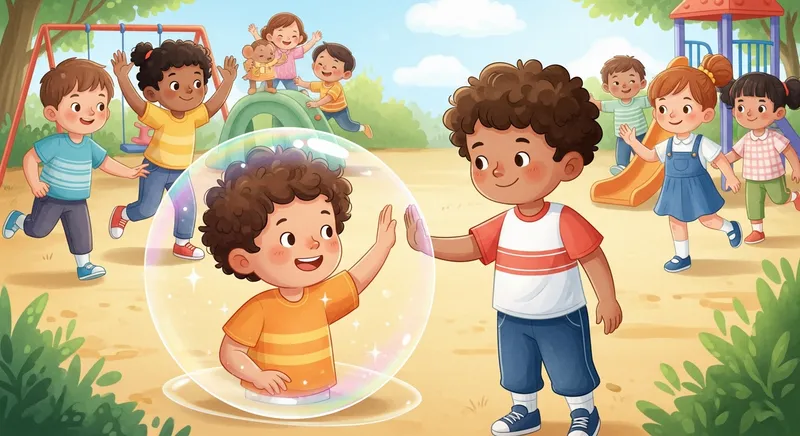
- Understanding they have a "personal space bubble."
- Knowing they have the power to say "yes," "no," or "stop."
Why Start So Young? The Power of Early Conversations
Starting these conversations in the preschool years isn't about scaring children; it's about empowering them. A study published in the Pacific Rim International Journal of Nursing Research found that a structured body safety training program significantly increased self-prevention skills in preschoolers. Early lessons build a strong foundation for a lifetime of healthy relationships and self-advocacy.
Children who learn consent early develop stronger self-advocacy skills and healthier relationships throughout life.
Think of it like this:
- It Normalizes the Conversation: Talking about bodies and boundaries from a young age makes it a normal, natural topic, not a scary or taboo one. The anti-sexual violence organization RAINN emphasizes that fostering this open communication makes children more likely to speak up if something feels wrong.
- It's Proactive Safety: The NSPCC's 'Talk PANTS' campaign is a brilliant, child-friendly framework for this. It teaches kids a simple acronym to remember key body safety rules, making protection a matter of empowerment, not fear.
- It Builds Empathy: Understanding their own boundaries helps children recognize and respect the boundaries of others, a cornerstone of empathy and building respectful relationships.
The Magic of Storytelling: Your Secret Tool for Teaching Consent
So, how do you actually have these conversations? You let a story do the talking. Stories provide a safe distance for children to explore big feelings and complex situations.
While traditional books are wonderful, a 2024 study from Washington State University found that many children's books on consent fall short. They often place the burden of saying "no" entirely on the child without showing adults as helpful resources.
This gap is precisely where personalized storytelling becomes your secret weapon.
With an app like Dreamcraft Tale, your child isn't just listening to a story about a character learning to use their voice; they become the hero who finds their voice. When your child is the protagonist who bravely sets a boundary, the lesson isn't just heard- it's felt and internalized. This is the power of making them the hero of their own adventure.
An Age-by-Age Guide to Teaching Consent with Stories
Consent education is not a one-time talk. It's a conversation that evolves as your child grows. Here's how you can use stories to tailor the message for each stage.
Ages 3-5: The "My Body, My Bubble" Years
At this age, the concepts need to be simple, concrete, and repeated often.
- Core Concepts: "My body is mine." "I am the boss of my body." "I can say stop, and my friends should listen."
- Actionable Tip: Practice offering alternatives to unwanted physical affection. The Child Mind Institute suggests that instead of forcing a hug, you can help your child offer a high-five, a wave, or a fist bump. This respects their choice while still being polite.
- Dreamcraft Tale Story Prompt: Here's where a story can make the lesson stick. Use our AI story generation to create a story about "[Your Child's Name] and the Tickle Monster." In the story, your child learns that they can say "Stop, please!" when the tickles become too much, and the friendly monster listens right away. This teaches them their voice has power in a fun, low-stakes way.
Ages 6-9: The "Asking and Respecting" Years
Older children can grasp more nuance. The focus shifts from only their own body to understanding the boundaries of others, both in person and online.
- Core Concepts: Asking for permission before touching someone or their things. Understanding that "no" from a friend must be respected. Recognizing that friendship means making others feel safe and comfortable.
- Actionable Tip: Role-play! Use dolls or stuffed animals to act out scenarios. "Bunny wants to read Fox's book. What should Bunny do first?" Guide them to the answer: "Ask!"
- Introducing Digital Consent: This is also the perfect age to talk about digital boundaries. Explain that just like we ask before a hug, we should ask before taking a picture or video of a friend. A good rule is: "Always ask before you snap or share." This sets a foundation for respectful online behavior later on.
- Dreamcraft Tale Story Prompt: To bring this to life, generate a personalized adventure. For example: "Create a story where [Your Child's Name] goes on a magical quest. To enter a secret garden, they must first ask the talking flowers for permission. The flowers are happy to let them in because they asked so respectfully." This beautifully illustrates the concept of asking first.
Your "Consent Story Starter" Pack with Dreamcraft Tale
Feeling inspired but need a little help? Here are three story prompts you can use right now in the Dreamcraft Tale app. Creating magical stories is as easy as 1-2-3: Imagine the idea, let our AI Create the story and illustrations, and Read it together!
"The Personal Space Adventure story was a game-changer for us. My 4-year-old now proudly tells his little brother, 'My bubble needs some space!' It's amazing." - Sarah, Mom of Two
- The Personal Space Adventure: Create a story about "[Your Child's Name] who discovers they have a magical, invisible 'personal space bubble' that glows softly whenever they need a little room. They learn how to tell friends, 'My bubble needs some space right now, please!'"
- Parent Tip: This story externalizes the abstract idea of a boundary, making it a fun, visual concept your child can easily understand and own.
- The Power of 'No': Generate a story about "[Your Child's Name] who learns that 'No' is a powerful and good word. They practice saying no to things they don't want (like a yucky-flavored jellybean from a wizard) and 'yes' to things they do (like playing a fun game)."
- Parent Tip: This helps detach 'no' from negativity. It frames saying 'no' as a healthy choice, just as important as saying 'yes.'
- The Respectful Friend: Imagine a story about "[Your Child's Name] and their best friend who are building the most amazing fort ever. They make a 'Fort Rule' that they must always ask before borrowing each other's special pillows or blankets."
- Parent Tip: This connects the big idea of consent to everyday situations like sharing, teaching that respect is part of all our interactions.
Beyond Stories: Fun Games and Activities to Practice Consent
Reinforce the lessons from your stories with these playful, hands-on activities.
- Stop and Go: A simple game where you give your child a gentle hug, a tickle, or hold their hand. They get to yell "Stop!" and you must freeze immediately, without question. Then they can say "Go!" when they are ready for more. This gives them a powerful feeling of control. For example, during playtime, you can say, "I'm the tickle robot! Beep boop!" and start tickling, then freeze instantly when they say stop, saying "Robot powering down!" before asking if the robot can power back on.
- The "High-Five or Hug?" Choice: When greeting family or friends, quietly ask your child, "Do you want to give a hug or a high-five?" By empowering them to choose, you are modeling that their comfort is a priority.
- Draw Your Bubble: Get out some paper and crayons. Ask your child to draw themselves and then draw their "personal space bubble" around them. They can decorate it however they want! As Action for Healthy Kids recommends, this helps them own the concept by making it visible and fun.
The Story Never Ends
Teaching consent isn't a single lecture; it's thousands of small, ongoing conversations woven into the fabric of your family life. It's in the way you ask, "May I have a hug?" and respect their "no." It's in the way you praise them for asking a friend to borrow a toy.
And most powerfully, it's in the stories you share. By making your child the hero who is brave, respectful, and in charge of their own body, you are giving them the greatest gift: a deep, unshakable sense of self-worth and safety.
Ready to turn these lessons into magical stories your child will remember?
Create your first personalized story about boundaries and respect tonight. Your child can be the hero who learns to use their voice, building confidence one adventure at a time.
➡️ Download Dreamcraft Tale and Start Your Free Trial
Frequently Asked Questions
At what age should you teach a child about consent?
You can start teaching the foundational concepts of consent as early as age two or three. Research, including work from the University of South Florida, shows that toddlers are capable of learning basic boundary skills. At this age, it's not about using the word "consent," but about teaching simple ideas like "your body is yours" and using concrete terms like "personal space bubble."
What's a simple way to explain consent to a 5-year-old?
Use a simple, empowering definition. You can say: "Consent is being in charge of your own body. You get to decide who gives you a hug or a high-five. It also means we need to ask our friends before we touch their bodies, because they are in charge of theirs."
How do I teach my child to say no to an adult, like a relative who wants a hug?
This is a common and tricky situation. The key is to empower your child while providing them with polite alternatives. First, privately reassure your child that they never have to show physical affection if they don't want to. Then, role-play what to do. You can be your child's advocate in the moment by saying to the relative, "She isn't feeling like hugs today, but she'd love to give you a special wave!" This validates your child's feelings and models how to set a boundary kindly, a strategy supported by experts at the Child Mind Institute.
What are some good examples of body boundaries for kids?
Body boundaries are rules a child can understand for their personal space and body. Great examples for young children include:
- The Bubble Rule: "Everyone has an invisible bubble around them. We don't pop anyone's bubble without asking."
- The Knock-Knock Rule: "Just like we knock on a bedroom door, we can 'knock' by asking before we enter someone's space with a hug."
- The Underwear Rule: A concept from the NSPCC, it teaches that the parts of your body covered by underwear are private.
- The "My Body, My Say" Rule: A simple mantra that reinforces they are the boss of their body.
Can children's books or stories really teach these lessons effectively?
Yes, but the type of story matters. Stories provide a safe way for kids to explore scenarios they haven't faced yet. However, as research from Washington State University points out, not all stories are created equal. The most effective stories are ones that don't just show a child saying no, but also model adults being helpful and respectful of that 'no.' Personalized stories, where your child is the hero who successfully navigates these situations, are especially powerful for internalizing these lessons.