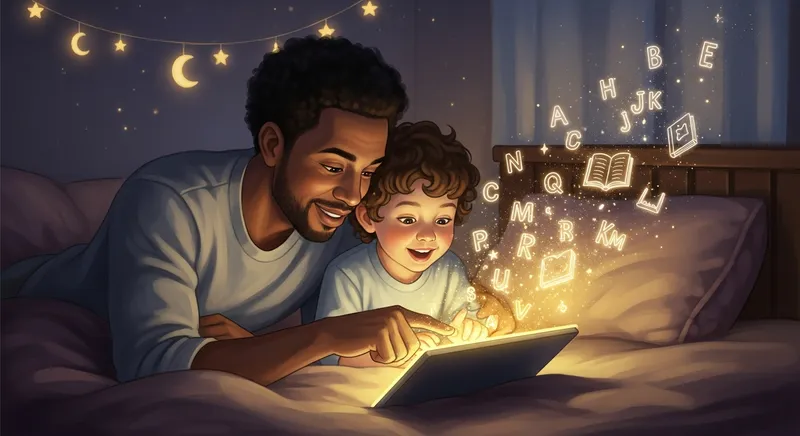
Introduction: From Bedtime Battles to Magical Moments
It's that time of night. You find yourself scrolling through your phone, searching for "how to improve my child's language skills," while a little voice in the back of your head wonders if they're keeping up. You feel a mix of anxiety and pressure, wanting to do the best for them but feeling overwhelmed by the thought of adding another "educational activity" to an already packed day.
We get it. Every parent has been there. But what if the most powerful tool for boosting your child's vocabulary and language skills wasn't a flashcard or a worksheet, but something you can do together, filled with joy and connection?
It's storytelling. And it's not another chore on your to-do list; it's a magical key that unlocks your child's imagination and language abilities. In this guide, we'll share 7 proven, expert-backed ways storytelling can transform your child's development and turn learning into the best part of your day.
Why Storytelling is a Superpower for Your Child's Developing Brain
Before we dive into the "how," let's talk about the "why." When you tell a story with your child, you're not just passing the time; you're literally building their brain. Every plot twist, new character, and silly sound effect creates and strengthens neural pathways for language. Experts at Reading Rockets have found a direct link between strong oral narrative skills in preschool and later success in reading and academics.

Storytelling is so effective that it's even used as a tool in professional speech therapy. The American Speech-Language-Hearing Association (ASHA) notes its power in enhancing both receptive language (listening and understanding) and expressive language (speaking and sharing ideas). It's a complete workout for your child's communication skills, all wrapped up in a fun, engaging package.
Here are seven proven ways it works.
1. It Explodes Their Vocabulary in Context
Children are word collectors, but words stick best when they have a story attached. Hearing a new word in a thrilling adventure is far more memorable than seeing it on a flashcard. The context of the story provides a rich, emotional hook for the new vocabulary.
Actionable Tip: The next time you tell a story, intentionally swap a simple word for a more exciting one. Instead of "big," try using "gigantic" or "enormous." Pause and say, "Gigantic means super-duper big, like a giant's shoe!" Then, challenge them to use the new word. Research has confirmed that storytelling techniques are a significant predictor of vocabulary acquisition in young children. For example, a story like Pip's Gigantic Climb naturally introduces concepts of size and scale in a way that's exciting and easy to remember.
2. It Develops Sophisticated Listening Skills
In a world of constant distractions, the ability to listen actively is a true superpower. Following a story from beginning to end requires a child to pay attention, track characters, remember plot points, and anticipate what's next. This active listening is a foundational skill for success in the classroom and beyond.
Actionable Tip: Practice "active recall" during and after a story. Pause before a big reveal and ask, "What do you think is going to happen next?" After the story, ask open-ended questions that require more than a "yes" or "no" answer, such as, "Why do you think the shy moonbeam was hiding?" Tools with engaging illustrations can make this even easier by giving you lots of visual cues to talk about.
3. It Teaches Narrative Structure (First, Next, Last)
Every story has a beginning, a middle, and an end. Understanding this sequence is a critical pre-reading and writing skill. Research has shown that internalizing this narrative structure helps bridge the gap between spoken and written language. It teaches children how to organize their thoughts in a logical way.
Actionable Tip: Use your hands to create a "story mountain." Start with your hand low for the beginning, raise it up for the exciting climax, and bring it back down for the resolution. Ask your child to retell a simple event from their day using this structure. This helps them organize their own thoughts and stories, just like they might in an exciting adventure like Luna's Moon Quest.
- Beginning: Who is our story about and where are they?
- Climax: What is the most exciting part or the big problem?
- Resolution: How does the story end and how is the problem solved?
4. It Encourages Expressive Language and Creativity
One of the most powerful aspects of storytelling is when the child shifts from being a listener to a creator. When children generate their own stories, they are practicing expressive language, building confidence, and learning that their ideas have value. Experts at ZERO TO THREE highlight that these skills begin developing as early as age two, often through co-telling stories with parents.
Actionable Tip: Start a "chain story." You begin with a classic opening like, "Once upon a time, there was a brave squirrel who…" and then turn to your child and say, "Your turn!" Take turns adding one sentence at a time. The results are often hilarious and always unique, empowering your child as a co-creator of their own magical tale, perhaps one as creative as Justine and the Magical Paintbrush.
"My shy daughter now asks to create stories every night. It's given her a voice." — A Dreamcraft Tale parent (name changed to protect privacy)
5. It Develops Phonological and Print Awareness
Before children can read words, they need to hear the sounds within them. This is called phonological awareness. Storytelling, especially with rhymes, alliteration, and silly sounds, is a playful way to build this essential pre-reading skill. When a story is written down, it also builds print awareness-the understanding that those squiggles on a page represent spoken words.
Actionable Tip: If you're reading a book, run your finger under the words as you say them. If you're creating a story together, grab a piece of paper and write down a key phrase or the title your child comes up with. Then, ask them to be the illustrator. The National Association for the Education of Young Children (NAEYC) says this act of "publishing" their story powerfully connects their spoken words to written language, helping them find their own 'happy voice' just like Lily did.
6. It Strengthens Abstract Thinking and Empathy
Stories are empathy-building machines. They allow children to walk in someone else's shoes, explore complex emotions from a safe distance, and understand different perspectives. This helps them develop emotional intelligence and the vocabulary to talk about their own feelings.
Actionable Tip: After a story, ask questions that encourage perspective-taking. "How do you think Rosie felt when her animal show was a success?" or "What would you have done if you were in Leo's shoes?" This helps them connect a character's actions to their feelings, a skill they can practice with stories like Rosie's Animal Show!.
7. It Supercharges Dialogic Reading
Dialogic reading is an evidence-based technique that transforms reading to a child into a conversation with a child. It's a powerful way to build language skills, and storytelling is its perfect partner. Instead of just listening passively, the child becomes an active participant.
Actionable Tip: Use the simple PEER sequence recommended by language experts like Reading Rockets. When you see something in a story, like the one in Dania's Sparkly Adventure where she finds a sparkly dress, try this:
- Prompt your child: "What is that?"
- Evaluate their response: They might say, "Dress."
- Expand on it: "Yes, it's a beautiful, sparkly dress!"
- Repeat the expansion: "Can you say, 'sparkly dress'?"
This simple back-and-forth turns story time into a rich, interactive language lesson.
But What If I'm Not a 'Creative' Storyteller?
After reading all this, you might be thinking, "This is great, but I'm just not creative enough to make up stories on the spot." This is a feeling almost every parent has. The pressure to perform can feel daunting, especially at the end of a long day.
But here's a secret: your child doesn't need a perfectly polished, award-winning story. They just need you. It's about the connection, the shared laughter, and the feeling of creating something together.
And what if you had a magical tool to help you co-create those stories, making your child the hero every single time, without any of the pressure?
Dreamcraft Tale: Your Creative Partner for Language Building
This is where Dreamcraft Tale comes in. Think of it not as a replacement for you, but as your creative partner. It's an AI-powered app designed by a parent, for parents, to help you and your child build incredible stories together, effortlessly.
Dreamcraft Tale directly supports the language-building skills we've talked about:
- Encourage Expressive Language (Point #4): The app makes your child the hero of every story. They can be a brave knight, a clever scientist, or a kind friend. This empowers them as the creator of their own narrative, just like in the story of Leo and the Pet Pictures.
- Explode Their Vocabulary (Point #1): By creating stories based on your child's interests-whether it's dinosaurs, space, or fairies-you can naturally introduce new and exciting words in a context they already love.
- Supercharge Dialogic Reading (Point #7): Each story comes to life with beautiful, personalized illustrations. These vibrant images are perfect conversation starters, making it easy to have a rich dialogue about the characters, settings, and plot.
With Dreamcraft Tale, you can create unlimited unique stories in just three simple steps: Imagine, Create, and Read. It removes the pressure and lets you focus on the magic of connection, turning bedtime from a battle into a cherished bonding moment.
Ready to Make Story Time Magical?
Stop worrying and start creating. Turn tonight's bedtime into a core memory and give your child a language-building boost they'll love.
Start creating magical stories with your child today!
Frequently Asked Questions
At what age should I start storytelling with my child?
You can and should start from birth! The approach simply changes as they grow. For infants, storytelling is about the soothing rhythm and tone of your voice. For toddlers (ages 1-2), it evolves into naming objects and sharing simple "first this, then that" narratives about their day. As experts at ZERO TO THREE explain, this is when they begin to grasp the basic building blocks of stories. By the time they're preschoolers (age 3+), they're ready to become active, imaginative participants in creating stories.
What's the difference between reading a book and telling a story?
Both are incredibly valuable, but they flex different developmental muscles. Reading a physical book is fantastic for developing print awareness, teaching a child to follow a set narrative, and appreciating illustrations. Oral storytelling, or co-creating a story together, is a more dynamic and interactive process. It empowers your child to become a creator, not just a consumer, which is a powerful way to boost their expressive language skills, problem-solving, and creative confidence.
How can storytelling help a shy or quiet child speak more?
Storytelling provides a wonderfully safe and low-pressure environment for a shy child to find their voice. When they are creating a story, there are no wrong answers. You can use tools like puppets to let them speak through a character, or you can create a story where they are the brave hero who must speak up to save the day. This "mask" of playing a character can give them the confidence to express their ideas without feeling self-conscious.
How long should a storytelling session be for a preschooler?
The golden rule is to follow your child's lead and focus on quality over quantity. For most children between the ages of 3 and 5, a focused storytelling session of 5 to 10 minutes is a great goal. The aim is a positive, joyful, and engaging experience. A happy 5-minute story that ends with your child wanting more is far more beneficial than a frustrating 20-minute session. It's all about the connection.
When should I be concerned about my child's language development?
First and foremost, remember that every child develops at their own unique pace. However, it's also important to trust your parental instincts. If you have persistent concerns, it is always best to be proactive. Reputable organizations like the American Speech-Language-Hearing Association (ASHA) offer helpful information about developmental milestones. We strongly recommend speaking with your pediatrician or a qualified speech-language pathologist if you are worried. They can provide professional guidance, perform an assessment, and give you peace of mind.
Ready to turn bedtime into the best part of your day? Try Dreamcraft Tale and see the magic for yourself.