
7 Heart-Warming Story Ideas That Teach Empathy and Kindness to Kids (Ages 3-9)
We all want to raise kind, empathetic children who grow up to be good people. But in the whirlwind of daily life, translating big virtues like "empathy" into something a five-year-old can understand can feel like a monumental task. You know the goal, but the roadmap? That's often missing, especially when you're tired and just trying to get through the bedtime routine.
What if the secret wasn't in lectures or flashcards, but in something you're already doing? What if the magic lay within the stories you tell?
Stories are more than just words; they are little empathy-building machines. They allow our children to walk in someone else's shoes, feel what they feel, and see the world from a new perspective. This article is your guide to unlocking that magic. We'll explore the "why" (the importance of social-emotional learning), the "how" (practical tips), and the "what"-seven specific, heart-warming story ideas you can use tonight.
Why Teaching Empathy is More Than Just 'Being Nice'
Teaching children to be kind is wonderful, but fostering true empathy gives them a superpower for life. This is the core of Social-Emotional Learning (SEL), a concept that child development experts are increasingly focusing on.
According to the leading authority CASEL (Collaborative for Academic, Social, and Emotional Learning), SEL is the process of developing the skills to manage emotions, feel and show empathy for others, and make responsible decisions. These aren't just soft skills; they are essential for a healthy, successful life.
Empathy is the foundation for building strong relationships, developing self-awareness, and making choices that are not just good for us, but good for those around us. This is especially critical in early childhood. The American Academy of Pediatrics (AAP) notes that the social and emotional areas of a child's brain develop more rapidly than cognitive areas in the first few years of life. By focusing on these skills, we are building a strong foundation for future learning and, as the U.S. government's Head Start program points out, for a lifetime of good mental health.
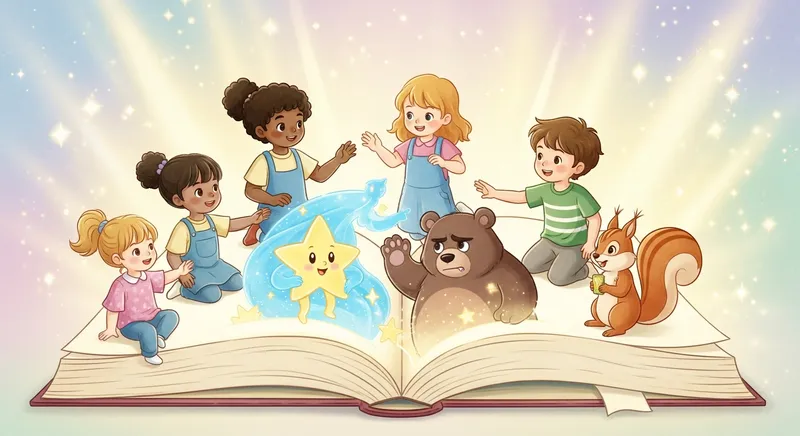
The Magic of Storytelling: How Reading Together Builds Emotional Awareness
So, how do we teach something as complex as empathy? We open a book. Or, even better, we tell a story.
Research highlighted by PBS KIDS for Parents shows that reading fiction is a powerful tool for promoting empathy. When children listen to a story, they are invited to step into a character's world. They experience a challenge, celebrate a victory, or feel the sting of a disappointment, all from the safety of a parent's lap.
Beyond the emotional benefits, the cognitive advantages are enormous. A groundbreaking study from The Ohio State University found that children who are read five books a day enter kindergarten having heard about 1.4 million more words than children who are never read to. This "million word gap" has a huge impact on literacy and development.
Stories provide a safe, shared space to explore big, complicated feelings. They give us the language to talk about sadness, anger, jealousy, and joy.
Actionable Tip: The next time you're reading, pause and ask a simple question: "How do you think that character feels right now?" This small act of reflection is a powerful exercise in building emotional awareness.
7 Heart-Warming Story Ideas to Nurture Empathy and Kindness
Ready to put this into practice? Here are seven flexible story prompts designed to tackle specific social-emotional concepts. You can use these as inspiration for your own telling, or as a starting point for creating a personalized story with your child.
1. The Toy That Learned to Share
- Prompt: A shiny red truck (or a favorite doll) loves being the most special toy on the shelf. But it feels lonely. One day, it discovers the incredible fun of being played with by two children at once, realizing that being shared multiplies the joy.
- Lesson: This story gently teaches that sharing isn't about loss; it's about creating more fun and connection for everyone.
- Actionable Tip: The organization ZERO TO THREE suggests focusing on the other person's feelings. After the story, if you see your child struggling to share, you can say, "Remember how happy the red truck was when everyone got to play? Your friend will be so happy if they get a turn." If your child is having trouble with this concept, a story like Courtney and the Whispering Shell can also help them explore their feelings.
2. The Grumpy Bear and the Patient Squirrel
- Prompt: A little, energetic squirrel wants to play with a big, sleepy bear who is feeling grumpy and just wants some quiet time. Instead of getting upset, the squirrel learns to understand the bear's feelings and finds a quiet way to be a friend, like leaving a tasty acorn near his den.
- Lesson: Empathy isn't just about sharing happiness; it's also about understanding and respecting when someone needs space or feels differently than you do.
- Actionable Tip: Use this story to start a conversation about different moods. Say, "It's okay to feel grumpy like the bear sometimes. What are some quiet things we can do when we feel that way?" For stories about navigating friendships, Leo and the Pet Pictures can offer more inspiration.
3. The Little Star Who Was Afraid to Shine
- Prompt: In a sky full of twinkling stars, one little star is too shy and scared to let its light shine brightly. With some gentle encouragement from the wise old moon, it learns that its unique sparkle is an important part of the night sky's beauty.
- Lesson: This story focuses on self-empathy and self-acceptance. It teaches children that it's okay to feel shy or scared, and that bravery is about trying, not about being fearless.
- Actionable Tip: Connect this story to your child's own experiences. "Remember when you felt a little shy before your first day of school? You were so brave, just like the little star!" A story like Raquel and the Shy Moonbeam can beautifully illustrate this theme.
4. The Magical Paintbrush of Forgiveness
- Prompt: A child character accidentally spills juice on a friend's beautiful drawing, ruining it. They find a "magical" paintbrush that can fix anything, but discover the real magic happens when they apologize sincerely and help their friend create something new and even better together.
- Lesson: This story tackles the difficult concepts of making mistakes, taking responsibility, the power of a heartfelt apology, and the warmth of forgiveness.
- Actionable Tip: Use puppets or toys to role-play a situation that requires an apology. Act out both sides so your child can practice saying "I'm sorry" and "I forgive you" in a low-pressure way. For another take on creative problem-solving, check out Justine and the Magical Paintbrush.
5. The Quest to Help a Friend in Need
- Prompt: A character's best friend, a little rabbit, is very sad because he lost his favorite fluffy carrot toy. The main character sees their friend's sadness and decides to go on a grand "quest" around the garden to find it, showing kindness through action.
- Lesson: This teaches active empathy-the crucial step of not just noticing someone is upset, but taking action to help them.
- Actionable Tip: Create a "Kindness Jar." Use slips of paper to write down any act of kindness or helping you or your child does during the day. Read them together at the end of the week to celebrate your family's empathy in action! For more stories about brave quests, see Pip's Gigantic Climb.
6. The Day the Colors Argued
- Prompt: The crayons in a coloring box start arguing. Red says it's the most important, Blue says it's the best, and Yellow says it's the brightest. They soon realize that only by working together can they create a beautiful, multi-colored rainbow.
- Lesson: As the Making Caring Common project from Harvard's Graduate School of Education suggests, stories are perfect for exploring different perspectives. This story teaches the value of diversity, teamwork, and seeing that every individual part contributes to a beautiful whole.
- Actionable Tip: After telling this story, get out the crayons! As your child draws, talk about how wonderful it is that we have so many different colors and how they make the picture more interesting together. For a story about finding your own voice, Lily's Happy Voice is a great choice.
7. The Animal Shelter Surprise
- Prompt: A child is so excited to finally get a pet. At the animal shelter, they see lots of loud, playful puppies but notice a small, quiet cat hiding in the corner. Instead of picking the most popular animal, the child sits patiently, showing kindness to the scared cat until it feels safe enough to come out and becomes their perfect pet.
- Lesson: This story teaches empathy for animals, patience, and the idea that caring for others (human or animal) is a deep responsibility.
- Actionable Tip: Talk about your own pets or animals you see in the neighborhood. Ask your child, "What do you think that dog is feeling when its tail is wagging? What do you think the cat needs when it's hiding?" Explore the theme of finding the perfect friend in Lily's Perfect Pet.
Your Magical Storytelling Assistant
These ideas are a wonderful starting point. And here's the exciting part: you don't need to be a creative genius or have endless energy to turn them into personalized adventures. That's where Dreamcraft Tale can help.
Our AI-powered app was created by a parent for parents, designed to turn these exact teachable moments into magical stories. It's as easy as Imagine, Create, and Read.
- Make your child the hero: Instead of a generic character, the story can be about them learning to be kind to the scared cat at the shelter. This makes the lesson personal and unforgettable.
- Tailor the lesson: Had a tough day with sharing? Create a story where your child's favorite toys learn to play together. You guide the plot, and our AI brings it to life.
- Get beautiful illustrations: Every personalized story is brought to life with vibrant, custom artwork, making it as engaging as any picture book in a safe, ad-free environment.
Dreamcraft Tale is your tool for putting all this wonderful theory into practice, effortlessly. It transforms you from a tired parent into a magical storyteller, ready to create the perfect story for the exact lesson your child needs to hear. And if you need instant inspiration, you can browse thousands of tales in our Shared Story Library, created by families just like yours.
Frequently Asked Questions
At what age can a child start learning empathy?
The building blocks of empathy start forming right from birth. Experts at ZERO TO THREE note that even infants show early forms of empathy, like crying when they hear another baby cry. However, the real magic happens between ages 3 and 5. This is when children begin to understand that other people have thoughts and feelings separate from their own, making it the perfect age to actively use stories to nurture this growing skill.
What's the difference between empathy and sympathy?
This is a great question, and the difference is key. Sympathy is feeling for someone from a distance. Empathy is feeling with them, putting yourself in their shoes.
Here's a simple way to think about it:
- Sympathy: "Oh no, you fell and scraped your knee. That's too bad."
- Empathy: "Ouch! I saw you fall, and that looks like it really hurts. Let's get a bandage. Do you need a hug?"
Empathy closes the distance and creates a connection. Stories are one of the best ways for kids to practice this, as they naturally encourage children to feel what the characters are feeling.
How can I teach my child about feelings they haven't experienced yet?
This is where stories become a kind of "flight simulator" for life, a concept discussed by researchers at Harvard's Making Caring Common project. Your child may not have experienced the deep sadness of losing a pet or the complexity of forgiving a friend, but they can explore those feelings safely through a character in a story. This builds an essential "emotional vocabulary" and a framework for understanding, so when they do face these situations in real life, they already have a reference point.
Are moral stories effective for teaching kindness?
Yes, but with an important catch: the most effective stories show kindness rather than just telling kids to be kind. Stories that are too preachy or end with a heavy-handed moral can make children tune out. The best approach is to use stories where characters make choices and experience the natural outcomes of their actions. That's why Dreamcraft Tale focuses on character-driven narratives where children see themselves making choices and experiencing outcomes. The goal isn't to deliver a lecture, but to spark a conversation. Asking, "Why do you think she shared her toy, even when she didn't want to at first?" is far more powerful than a story that simply ends with "And the moral is: always share."
My child gets upset when characters in a book are sad. What should I do?
First, take a moment to celebrate this as a parent. This is a beautiful, clear sign that your child is developing strong empathetic feelings! Don't shy away from the moment by closing the book or quickly turning the page. Instead, lean into it.
Pause the story and validate their feelings. Say something like, "It is really sad, isn't it? It makes my heart feel a little heavy, too." Then, gently guide them with curiosity: "Why do you think the little bear is so sad?" This transforms their emotional reaction from something overwhelming into a powerful, shared moment of connection and learning.