
Tired of Bedtime Battles? Spark Your Child's Imagination Tonight
It's 8:47 PM. You've read the same three books twice, your voice is getting hoarse, and your child is still pleading for "just one more story." You're running on empty, and the creative well has run dry. If this sounds familiar, you are not alone.
Every parent knows this feeling. You want to create those magical, bonding moments and watch your child's imagination soar, but the end-of-day exhaustion is real. Coming up with fresh, exciting ideas on the spot can feel like a monumental task, often leading to repetitive routines that feel more like a struggle than a special moment.
But what if you had a treasure chest of ideas ready to go? This post is your secret key. We've gathered over 50 imaginative story starters and fun prompts designed to turn that dreaded question into your favorite part of the day. Let's transform bedtime from a battle into a magical adventure you create together.
Why Creative Storytelling is More Than Just Fun and Games
Cuddling up for a story is a cherished ritual, but it's also one of the most powerful tools for your child's development. When you tell stories together, you're not just passing the time—you're building a foundation for lifelong learning and connection.
Experts agree that these early creative moments are critical. According to the NAEYC (National Association for the Education of Young Children), emergent writing skills, which blossom during storytelling and play, are significant predictors of a child's future reading and writing abilities. It's in these make-believe worlds that the building blocks of literacy are laid.
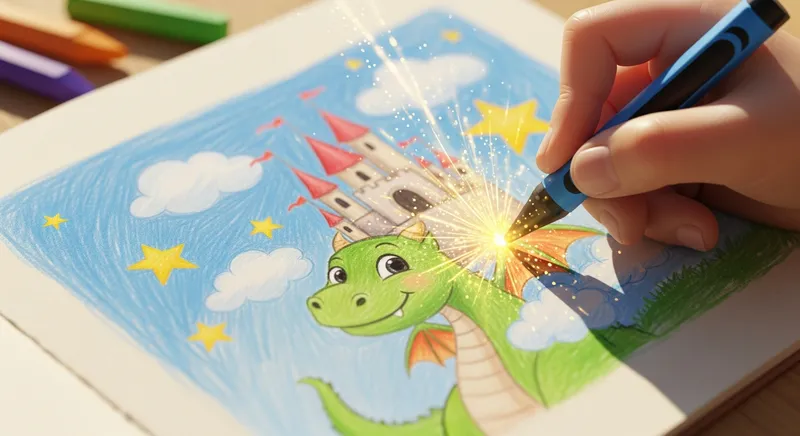
Furthermore, imaginative play is like a workout for your child's brain. Research highlighted by the Child Mind Institute shows that children who engage in pretend play often have stronger skills in flexible thinking, memory, and self-control. As they navigate their made-up scenarios, they're learning to solve problems and think creatively. And as the experts at ZERO TO THREE point out, sharing family stories and reminiscing helps build a crucial bond between you and your child, strengthening their sense of identity and belonging.
How to Use a Story Prompt: From a Spark to a Full Adventure
A story prompt is just the beginning. The real magic happens when you build on that first spark together. Don't worry, you don't need to be a professional author! Just follow this simple, three-step framework to guide your child from a single idea to a grand adventure.
The Spark: Ask Open-Ended Questions. Start by reading the prompt aloud. Then, become a curious listener. Instead of telling them what happens, ask them. Questions like, "Who is our hero?" "What do they look like?" or "Where are they right now?" invite your child into the creative process.
The Quest: Introduce a Simple Goal. Every great story has a mission. It could be finding a lost object, helping a friend, or solving a silly problem. Ask, "What do they need to do?" or "Who needs their help?" This gives the story direction and purpose.
The Grand Finale: Guide Them to a Resolution. Help your child think about how the adventure ends. How does the hero solve the problem? What do they learn along the way? Celebrate the ending by asking, "How does everyone feel now?" This provides a satisfying conclusion. The literacy experts at Read Write Think offer many tools that reinforce how this process helps children organize their thoughts and build narrative skills.
Want to turn these ideas into a real storybook?
Dreamcraft Tale makes it easy. Our simple 3-step process—Imagine, Create, and Read—helps you co-create a unique story in minutes. It's a completely ad-free and safe environment designed to celebrate your child's creativity.
Fantasy & Magic Story Starters
- You find a tiny, sparkling stone that whispers secrets. What does it say?
- A dragon with rainbow-colored scales has lost its fire. How do you help it get it back?
- In your backyard, you discover a tiny door in the trunk of an old tree. You open it and...
- You're given a potion that lets you talk to animals for one hour. Who do you talk to first?
- A shy moonbeam is afraid of the dark. How do you help it be brave?
- You wake up with a pair of small, shimmery wings. Where do you fly first?
- A grumpy gnome is guarding a bridge and won't let anyone pass. How do you cheer him up?
- You find a cookbook filled with recipes for magical treats (like cookies that make you float).
- A forest full of glowing, giggling creatures invites you to a secret party. What happens there?
- You plant a jellybean and it grows into a giant, magical beanstalk overnight.
- You find a mysterious map where all the words are pictures. What does it lead to?
- A friendly ghost is scared of the dark. How do you help it?
- You find a map that leads to a hidden waterfall that grants one wish.
- The stars in the sky have gotten all tangled up. Your mission is to untangle them.
- You meet a fairy who has lost her magic wand.
- A grumpy cloud refuses to rain. How do you convince it to help the thirsty flowers below?
- You find a key that can unlock any door, but only if you sing the right song.
Story Spotlight: "My 5-year-old, Leo, used the prompt about the tiny door in the tree (#3). He created a whole world of 'Button Bears' who trade buttons for berries. It's our new favorite bedtime ritual, and I'm amazed at what he comes up with!" – Sarah M.
Adventure & Mystery Story Starters
- A mysterious flower that only blooms in the moonlight has disappeared. Your mission is to find it before sunrise.
- You find a treasure map where 'X' marks the spot right in the middle of your living room.
- You have to rescue a friend's favorite toy from the top of something impossibly tall.
- You're a detective and your first case is to find out who stole the cookie from the cookie jar.
- You build a rocket ship out of a cardboard box and it actually blasts off to the moon!
- You discover a secret code written on the back of your cereal box.
- You and your friends are on a mission to clean up the planet, starting with your local park.
- You're exploring an island when you find footprints that don't belong to any human or animal you know.
- A message in a bottle washes up on shore. It's a plea for help from a tiny island kingdom.
- You're a spy whose mission is to sneak a healthy snack into a picky eater's lunch.
- You can shrink to the size of an ant. What does the world look like from down there?
- You find a compass that doesn't point North—it points to whatever you want most.
- An important package was delivered to the wrong house. You have to go on an adventure to find it.
- You're sailing a boat when a friendly dolphin asks for your help.
- You are exploring a cave and find ancient drawings that start to glow.
- You're the captain of a submarine exploring the deepest part of the ocean. What do you discover?
- A flock of birds has stolen the town's park swings. You have to negotiate to get them back.
Silly & Funny Story Starters
- Your pet suddenly starts talking. What's the first thing it says?
- You wake up to find that everything you touch turns to chocolate.
- All the animals in your town decide to have a talent show. Who has the most surprising talent?
- Your favorite stuffed animal suddenly grows to the size of a house for one day. What do you do?
- Imagine you burp, and colorful, sweet-smelling bubbles float out.
- Your nose starts to wiggle every time someone tells a fib.
- What would happen if you invented a machine that makes it rain spaghetti and meatballs?
- Your shadow comes to life and wants to play tag.
- Everyone in the world suddenly starts walking backward. How do you get to school?
- You find a pair of shoes that makes you dance uncontrollably every time you wear them.
- Your refrigerator tells you a joke every time you open the door.
- Imagine you switch places with your pet for a day.
- Your bathtub turns into a submarine whenever you add bubble bath.
- You build a pillow fort so amazing that the pillow king and queen come to visit.
- What happens when your crayons come to life and start drawing on their own?
- A squirrel in your yard is trying to tell you something very important. What is it?
Picture Writing Prompts: Telling a Story Without Words
Sometimes, the best story starter isn't a sentence—it's an image. A visual can ignite the imagination in a totally different way, especially for kids who are more visual thinkers.
- Actionable Tip: Find a picture of a funny-looking animal. Ask your child: "What's its name? Where does it live? What is it about to do?"
- Actionable Tip: Show them a photo of a quirky treehouse. Ask: "Who do you think lives here? What secrets does this place hold? Is that a slide or an escape route?"
- Actionable Tip: Use one of your child's own drawings! This is a powerful way to show them you value their art. Ask them to tell you the "story behind the picture." You'll be amazed at the worlds they've already created. As PBS KIDS for Parents notes, connecting play and art with literacy helps children express themselves and build confidence.
Storytelling for Pre-Writers (Ages 3-5): No Writing Required!
For the youngest storytellers, the pressure of writing can be a barrier. The good news is, storytelling doesn't need a pen and paper! The goal at this age is all about verbal creativity, play, and imagination.
- Puppet Show: Grab a few socks or their favorite stuffed animals. Give one to your child and keep one for yourself. Start a simple story ("Hello, Mr. Bear, are you going to the park today?") and let your child create the dialogue for their puppet. It's acting, play, and storytelling all in one.
- The Story Chain: This is a perfect family game for the dinner table or a car ride. One person starts the story with a single sentence (e.g., "Once upon a time, there was a purple squirrel who loved to sing"). Then, each person in the family adds the next sentence, building the story together one piece at a time.
Bring Your Story to Life: Create a Memory You Can Keep
Once you've co-created an amazing adventure, what if you could turn it into a professionally illustrated, personalized storybook?
That's what Dreamcraft Tale was built for.
In just three simple steps—Imagine, Create, and Read—our carefully designed AI helps you transform your child's idea into a complete, unique story where your child is the hero, complete with vibrant artwork. Our built-in content moderation ensures every story is wholesome and age-appropriate, so you can relax and enjoy the magic.
Ready to create your first story? Try Dreamcraft Tale today!
Frequently Asked Questions
What are good story starters for kids?
Good story starters are open-ended questions or intriguing situations that spark curiosity. Instead of having one right answer, they open up a world of possibilities. The best ones often start with "What if..." or "Imagine..." and are tailored to a child's interests, whether that's magic, adventure, or just plain silliness. A great prompt doesn't just give an idea; it asks a question your child is excited to answer.
How do I get my 7-year-old interested in writing?
The key is to make writing feel like play, not work. Focus on the fun of creating a story together and worry less about perfect spelling or handwriting. Start with their passions—if they love dinosaurs, make your story about a T-Rex who wants to be a baker. Try collaborative writing where you each write one sentence at a time. Using fun online tools, like the interactive story generators from Scholastic, can also make it feel like an exciting game. Above all, celebrate every finished story with enthusiasm!
How long should a child's story be?
There's no magic number. For a three or four-year-old, a complete story might just be three sentences told aloud. For an eight-year-old, it might be a few paragraphs they proudly write down. The goal is the act of creation and the joy of finishing a thought. Always focus on celebrating the completed story, no matter its length, to build their confidence as a storyteller.
What if my child says 'I don't know' to every prompt?
This is completely normal! It usually means they feel a little pressure. The best way to respond is to lower the stakes and make it silly. Try a different approach, like using a picture from a book or one of their own drawings as a prompt. You can also break the ice by starting the story yourself with a ridiculous first sentence, like "The giraffe packed his suitcase, but he forgot his socks." This shows them there are no wrong answers and that the goal is simply to have fun.
Can storytelling really help with school?
Absolutely. Creative storytelling is a powerhouse for developing skills that are crucial for academic success. According to guidance from the U.S. Department of Education, early literacy skills are foundational. When your child creates a story, they are practicing vocabulary, story structure (beginning, middle, end), and problem-solving—all of which are essential for reading comprehension and writing. Apps like Dreamcraft Tale make this even easier by handling the story structure while your child focuses on the creative ideas.