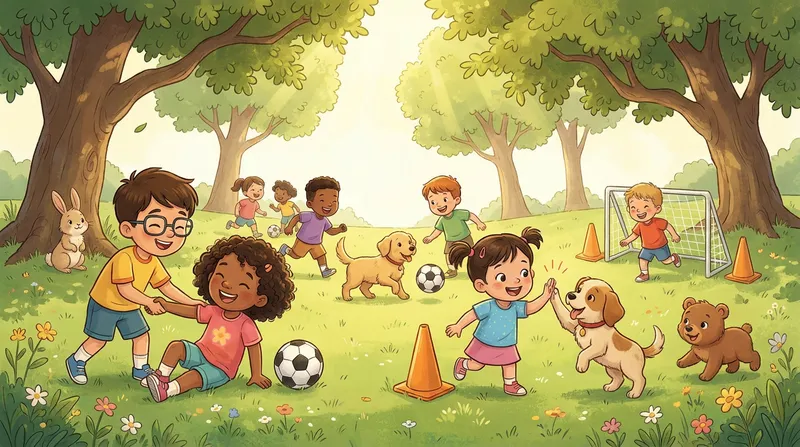
It is Saturday morning. The youth soccer game just ended. Instead of celebrating a fun time on the field, your five-year-old is in tears because their team lost. Or perhaps they threw a fit because they did not score the winning goal. If you are nodding your head right now, you are not alone. Parents everywhere struggle with their children throwing tantrums, crying, or wanting to quit when they lose a game.
Explaining complex emotions like frustration, fairness, and empathy to a young child is incredibly difficult. When emotions are running high, the last thing a preschooler wants is a boring lecture about playing fair. They need relatable, age-appropriate stories that help them process these big feelings in a safe and engaging way.
That is where the magic of storytelling comes in. Reading a short story about sports for kids is one of the most effective ways to introduce social-emotional learning. By reading about characters who face similar struggles, your child can learn how to handle winning and losing gracefully.
In this guide, we will share five original teamwork stories for kids, complete with parent discussion prompts to help you turn reading time into a valuable life lesson.
Why Teaching Sportsmanship Matters for Young Kids
Before we dive into the stories, it is important to understand why good sport books for kids are so vital for early development. Sportsmanship is about much more than just a game. It is a foundational social skill.
According to pediatric experts at Stanford Children's Health, the hallmarks of good sportsmanship include being able to win without gloating, respecting opponents, and losing gracefully. When children learn these principles early, they are better equipped to handle setbacks in the classroom, in friendships, and eventually in their careers.
Furthermore, participating in team activities has incredible mental health benefits. Research from the National Institutes of Health (NIH) shows that organized sports participation is linked to improved psychological well-being, self-esteem, emotional stability, stress resilience, and social integration. Teaching your child how to navigate the emotional ups and downs of sports ensures they reap all these incredible benefits.
Story 1: The Soccer Team That Learned to Share the Ball
Pip the puppy loved playing soccer. He was the fastest runner on the meadow team, and he had a very strong kick. But Pip had one small problem: he never wanted to pass the ball.
During the big game against the Forest Foxes, Pip got the ball and started running. "Pass it to me, Pip!" yelled his teammate, a little bunny named Barnaby. Barnaby was wide open near the goal.
"No way, I can score!" Pip barked. He tried to dribble past three foxes all by himself. But the foxes surrounded him, gently tapped the ball away, and scored a goal for their own team.
Pip sat on the grass and pouted. Coach Owl flew down and blew his whistle. "Pip, soccer is not a one-puppy game," Coach Owl explained kindly. "When we share the ball, we share the fun. A team works together like puzzle pieces."
In the second half, Pip got the ball again. He saw the foxes running toward him. He remembered Coach Owl's words. Instead of keeping the ball, Pip kicked it right to Barnaby. Barnaby kicked it to a squirrel named Nutty, and Nutty kicked it right into the net! Goal!
Pip realized that setting up his friends for a goal felt just as wonderful as scoring one himself. From that day on, Pip was known as the best passer in the meadow.
Parent Discussion Prompts
- Why did Pip lose the ball in the first half of the game?
- How do you think Barnaby felt when Pip refused to pass the ball?
- Can you think of a time when you shared something and it made the activity more fun?
- Actionable Tip: Next time you are playing a game at home, practice taking turns and loudly praising your child when they share.
For more adventures about overcoming big obstacles, check out Pip's Gigantic Climb.
Story 2: The Fastest Cheetah Who Finished Last
Charlie the Cheetah was the fastest animal in the savanna track club. Everyone knew Charlie was going to win the big Spring Sprint. Charlie knew it, too.
When the starting whistle blew, Charlie zoomed ahead of the zebras, the ostriches, and the gazelles. He was so far ahead that he started looking back to see how slow everyone else was. Because he was not looking where he was going, Charlie tripped over a large tree root and tumbled into the dusty grass.
His knee was scraped, and his pride was hurt. As he sat there, the ostriches ran past him. Then the zebras. Then the gazelles. Charlie wanted to cry and quit the race. "I am not going to win anymore," he sniffled.
Just then, a tiny tortoise named Timmy slowly walked by. Timmy was at the very back of the race. "Come on, Charlie," Timmy smiled. "The finish line does not care who gets there first. It just waits for us to cross it."
Charlie took a deep breath, stood up, and brushed off his knees. He jogged the rest of the way, matching Timmy's slow pace. When they crossed the finish line together, they were in last place. But the crowd cheered louder for Charlie's perseverance than they did for the winner. Charlie learned that finishing what you start is a victory all on its own.
Parent Discussion Prompts
- Why did Charlie fall down during the race?
- How did Timmy the Tortoise help Charlie feel better?
- What would you do if you fell down while playing a game?
- Actionable Tip: Teach your child a simple mantra for when they feel like giving up, such as, "I am brave, I am strong, I will keep going."
If your child loves animal stories, they will adore Rosie's Animal Show!.
Story 3: Basketball Bears and the Fair Play Rule
Benny the Bear loved playing basketball. He was tall, strong, and great at catching rebounds. But Benny was very competitive. Sometimes, when he was losing, he forgot the rules.
During a game of driveway basketball with his friends, Benny's team was losing by two points. Benny wanted to win so badly that when his friend Leo went up for a shot, Benny gave him a sneaky little push. Leo stumbled, missed the basket, and scraped his paw.
"Foul!" yelled the referee, a wise old badger.
Benny crossed his arms. "I barely touched him! I just want to win."
The badger shook his head. "Winning only feels good if you win fairly, Benny. A victory won by cheating is just a secret defeat."
Benny looked at Leo, who was rubbing his paw. Benny felt a heavy, sad feeling in his tummy. He realized that a plastic trophy was not worth hurting his friend. Benny walked over and helped Leo up. "I am sorry, Leo. That was not fair play."
They finished the game, and even though Benny's team lost, Benny felt proud. He had played the rest of the game with honesty and respect.
Parent Discussion Prompts
- Why did Benny push Leo?
- How did Benny feel after he realized he hurt his friend's feelings?
- What does it mean to play fair?
- Actionable Tip: If your child breaks a rule during a board game, gently pause the game. Ask them to explain the rule to you, reinforcing that rules keep the game fun for everyone.
Discover more stories about friendship and doing the right thing in Leo and the Pet Pictures.
Story 4: The Gymnastics Meet and the Gracious Winner
Mia the Monkey was a fantastic gymnast. She could flip, twirl, and swing on the uneven bars better than anyone in the jungle. At the annual Jungle Gymnastics Meet, Mia performed a flawless routine and won the first-place shiny gold medal.
Mia was so excited that she started jumping up and down, pointing her finger at the other animals. "I won! I am the best! You guys were so slow and clunky!" she cheered loudly.
Her friend, a little parrot named Penny, had worked very hard but came in fourth place. Hearing Mia brag made Penny feel terrible. Penny tucked her head under her wing and started to cry.
Mia's mother pulled Mia aside. "Mia, winning is wonderful, and you worked hard. But being a gracious winner is just as important as being a good loser. When you brag, you make your friends feel small."
Mia looked at Penny and felt her heart sink. She walked over to Penny, gave her a big hug, and said, "Penny, your floor routine was beautiful. You pointed your toes perfectly."
Penny smiled, and Mia learned that the best part of winning is getting to celebrate everyone's hard work together.
Parent Discussion Prompts
- How did Mia act when she got her gold medal?
- Why did Penny the Parrot start to cry?
- What is a nice thing you can say to someone after you win a game?
- Actionable Tip: Role-play winning with your child. Practice saying phrases like, "Good game!" or "You played really well!" instead of "I beat you!"
Read more about celebrating unique talents in Dania's Sparkly Adventure.
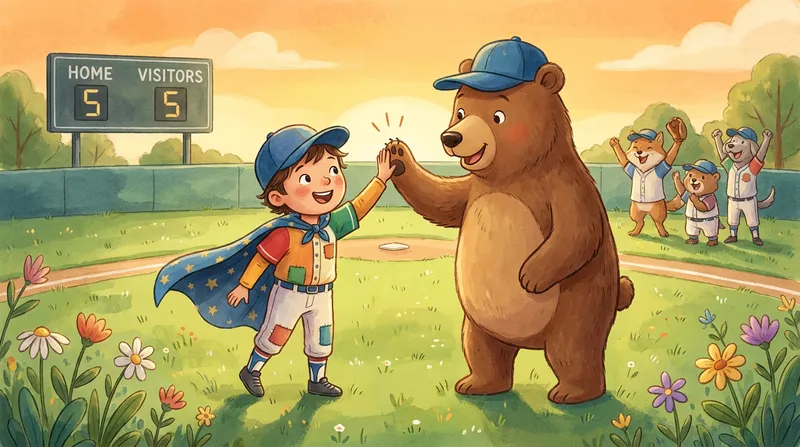
Story 5: The Baseball Bunnies Learn How to Lose
The Fluffy-Tail Bunnies were playing in the baseball championship. They had practiced hitting, catching, and running the bases all summer. It was the bottom of the last inning, and the Bunnies were down by one run.
Batter up! It was little Barnaby's turn. He swung the bat with all his might. Strike three! The game was over. The Fluffy-Tail Bunnies had lost.
Barnaby threw his bat on the ground. Several other bunnies started to cry and stomp their feet. "It is not fair!" they shouted. "We practiced so hard!"
Coach Kangaroo hopped over. "Team, listen to me. It is okay to feel sad and frustrated. You are allowed to be disappointed. But we must never forget our manners. The other team practiced hard, too."
He lined up the Fluffy-Tail Bunnies. Even though they had tears in their eyes, they walked past the winning team, gave them high-fives, and said, "Good game." On the way home, Barnaby realized that losing did not mean he was a bad player. It just meant he had something new to practice for next season.
Parent Discussion Prompts
- Why were the bunnies so upset at the end of the game?
- What did Coach Kangaroo tell them to do?
- According to experts at KidsHealth, being a good sport helps children learn respect for others and self-control. How can we show respect to the other team even when we are sad that we lost?
- Actionable Tip: Validate your child's feelings when they lose. Say, "I know it is frustrating to lose when you tried so hard." Once they calm down, guide them to shake hands or say good game.
How to Talk to Your Kids About Winning and Losing
These five stories are a wonderful starting point, but the real growth happens in the conversations that follow. Here are actionable ways to help your child develop strong social-emotional learning skills around winning and losing.
1. Praise the Effort, Not the Outcome
Instead of saying, "You are the best player on the field," try saying, "I loved watching how hard you ran after that ball today." When children tie their self-worth to their effort rather than the scoreboard, they become more resilient.
2. Model Good Sportsmanship
Children are always watching. If you yell at the referee through the television during a football game or complain when another driver cuts you off, your child is learning that frustration equals anger. Model deep breathing and calm reactions in your everyday life.
3. Acknowledge the Big Feelings
Do not tell your child "do not cry" or "it is just a game." To a five-year-old, the game is their entire world in that moment. Research published by Saybrook University indicates that children who play organized team sports show lower social problem scores and lower anxious and depressed scores compared to non-participants, largely because they learn to process these negative emotions in a group setting. Allow them to feel sad, but set a boundary on behavior: "You can be mad that you lost, but you cannot throw your toys."
What sportsmanship lesson is your child working on right now? Share in the comments below, we would love to hear your story!
Make Your Child the Hero with Dreamcraft Tale
Imagine your child as Pip, learning to pass the ball to their teammates in a story made just for them. With Dreamcraft Tale, you can create that exact adventure in minutes and watch their face light up when they see themselves as the hero.
Dreamcraft Tale is an AI-powered mobile app that transforms your child's ideas into beautifully illustrated, personalized stories. Every story comes to life with vibrant, professionally illustrated artwork, just like the images you have seen throughout this post.
Create magical stories in just three simple steps: Imagine, Create, Read. You can customize character names, traits, and roles, building confidence by putting your child at the center of the action. Because our app features a mobile-first design, you can create a story on the drive home from the game, and by bedtime, your child can read about their own journey to becoming a great teammate. Plus, enjoy peace of mind with our completely ad-free, COPPA-compliant, and content-moderated experience.
Too tired to create tonight? Explore thousands of magical stories in our shared Story Library, featuring tales like Courtney and the Whispering Shell or Lily's Perfect Pet.
Frequently Asked Questions
How do I teach my 5-year-old to be a good sport?
Start by playing simple, fast-paced board games at home. At age five, children are just beginning to understand that other people have feelings too. Model good behavior by saying "good game" when you lose to them. Praise them heavily when they follow the rules, and gently pause the game if they try to cheat or throw a tantrum.
What is a good story about teamwork for preschoolers?
Stories that feature animal characters working together are highly effective for preschoolers. Like Story 1 in this guide, where Pip the Puppy learns that passing the ball is more rewarding than going it alone, a great story teaches kids that everyone brings something special to the team.
How do you explain winning and losing to a child?
Keep it simple. Explain that winning means you scored the most points this time, and losing means the other person scored the most points this time. Emphasize that the main goal of playing is to have fun and exercise. Remind them that even professional athletes lose games and use losses as a chance to practice and get better.
Why does my child struggle to lose gracefully, and how can I help?
Struggling to lose is a very normal developmental phase. Young children have a hard time regulating their emotions and often view a loss as a personal failure. You can help by validating their disappointment, avoiding overly competitive games until they mature, and reading kids books about perseverance in sports to help them process their feelings in a healthy way.
What are the best social-emotional learning sports stories?
The best stories are those that address specific emotional pain points. Look for books about winning and losing for kids that do not just focus on the final score, but rather on themes like playing fair, overcoming a mistake, being a gracious winner, and helping an injured teammate. These narratives provide actionable lessons children can apply to their own lives.