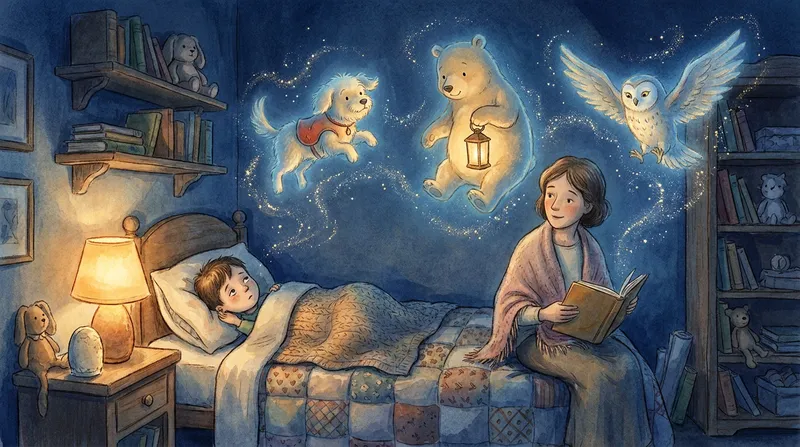
It is 8:00 PM. You have already read the same picture book twice, and your child is begging for an exciting hero story. They want loud sirens, epic adventures, and daring rescues. You, on the other hand, just want them to close their eyes and go to sleep.
Every parent knows this specific bedtime battle. Kids often demand action-packed tales right before bed, which hypes up their nervous systems and makes falling asleep incredibly difficult. Parents are desperately seeking a way to satisfy their child's desire for brave heroes while keeping the tone soothing enough to actually help them wind down.
What if you could give your child the exciting heroes they crave, but in a way that naturally calms their body and mind?
Welcome to the magic of gentle rescue stories. In this guide, we will share five wholesome animal stories designed perfectly for bedtime, along with actionable tips to make your nightly routine peaceful, engaging, and deeply comforting. Perfect for children ages 2 to 10, these tales are a wonderful way to build emotional intelligence.
Actionable Tip: Want to turn tonight's story into a personalized illustrated adventure? Dreamcraft Tale lets you create your child's version of these tales in minutes. Unlike passive video content, our app offers a mindful, ad-free alternative that turns screen time into a creative bonding experience.
Why Gentle Rescue Stories Are the Ultimate Bedtime Solution
Kids love heroes because heroes have power, agency, and the ability to solve big problems. During the day, high-stakes action stories are fantastic for their imagination. But at night, those same stories can cause adrenaline spikes.
This is where gentle bedtime stories for kids come in to save the day. The concept of a "gentle rescue" involves lowering the stakes, removing scary villains, and focusing entirely on helping rather than fighting. In a gentle rescue, the conflict is usually a simple environmental obstacle, like a lost toy or a fallen branch, and the resolution is cooperative and calm.
According to the American Academy of Pediatrics, establishing a predictable wind-down routine, such as their recommended "Brush, Book, Bed" program, is essential for easing bedtime stress. When you incorporate bedtime rescue stories into this routine, you bridge the gap between your child's daytime interests and their nighttime need for rest.
Actionable Tip: Create a predictable wind-down routine by pairing your story time with a physical comfort cue. For example, you can read The Warmest Hug: 5 Heartwarming Bedtime Stories About Family Love for Kids while giving your child a gentle back rub. The combination of a calm story and physical touch signals to their brain that it is safe to sleep.
How to Tell Action Stories Without Overstimulating Your Child
If your child is a die-hard fan of superheroes and fast-paced rescues, you might wonder how to transition them to these calmer stories. The key is understanding the psychological difference between daytime action and nighttime action.
Daytime stories rely on high stakes, fast pacing, and loud conflicts to hold attention. Bedtime stories need to do the exact opposite. Here are the golden rules for telling an action story at bedtime:
- No Bad Guys: Replace villains with environmental obstacles. A fallen log, a gentle snowstorm, or a lost map are perfect problems to solve. This removes the element of fear or anxiety.
- Slow the Pace: As the story progresses, consciously slow down your speaking speed. Let the hero take their time.
- Focus on Cooperation: Instead of the hero fighting their way to a solution, have them work together with others.
- The Easy Resolution: Make sure the problem is solved easily and peacefully, leaving plenty of time at the end of the story to describe the characters getting cozy and falling asleep.
Actionable Tip: If you are using a story generator to create your bedtime tales, specifically prompt it to make the rescue "calm, quiet, and cooperative." This ensures the AI avoids generating high-stress plots. To learn more about getting the most out of story platforms, read Yoto vs. Epic! vs. AI Story Creators: The Ultimate Parent's Guide for 2026.
The Magic of Wholesome Animal Stories for Teaching Empathy
Animals make the absolute perfect subjects for bedtime stories. Young children naturally relate to animals, often projecting their own feelings and vulnerabilities onto them. When a child hears about a small animal in need of help, it triggers their natural caregiving instincts.
Educational animal stories do more than just entertain. They are powerful tools for building emotional intelligence. Research from the Humane World for Animals shows that reading animal-friendly stories actively helps children develop empathy, especially when parents guide the conversation to focus on feelings.
By focusing on wholesome animal stories where characters look out for one another, you are teaching your child that true bravery is not about fighting bad guys. True bravery is about kindness, patience, and lending a helping hand.
Actionable Tip: To maximize the emotional benefits of these stories, pause during the reading to ask perspective-taking questions. You can ask, "How do you think the little bunny felt when he was lost?" or "How did the rescue dog feel when she helped her friend?" If you want to dive deeper into this practice, check out our guide on What is the Moral of a Story? A Parent's Guide to Teaching Life Lessons to Kids (Ages 3-9).
5 Gentle Bedtime Rescue Stories for Kids
Below are five ready-to-read animal rescue stories for kids. You can read these outlines directly to your child, expanding on the details as you go, or use them as inspiration for your own storytelling.
Actionable Tip: Give your child a sense of control over their bedtime routine by letting them choose the story. Ask them, "Which brave helper do you want to hear about tonight? The bear, the rescue dog, the fire truck, the owl, or the forest friends?"
Story 1: Barnaby Bear Finds the Lost Bunny
Barnaby was a very large, very gentle brown bear. He had soft, rumbly snores and walked with slow, heavy steps through the whispering forest. One evening, as the sun began to set and paint the sky in shades of purple and pink, Barnaby heard a tiny sniffle.
Behind a large oak tree sat a small, fluffy bunny who had wandered too far from her burrow. The forest was getting dark, and she did not know the way home. Barnaby did not roar or rush. He simply sat down next to the bunny, offered her a sweet blackberry from his paw, and said in his deep, warm voice, "Do not worry, little one. I know this forest perfectly."
Together, they walked slowly through the quiet woods. Barnaby used his big paws to gently move prickly bushes out of the way, making a safe path. Soon, they reached the bunny's burrow, where her family was waiting with warm hugs. Barnaby smiled, waved goodnight, and lumbered back to his own cozy cave for a long, peaceful sleep.
Actionable Tip: Use voice modulation to make these short rescue stories for preschoolers even more effective. When speaking as Barnaby Bear, use a deep, slow, rumbly whisper. This low frequency naturally helps slow your child's breathing and heart rate, preparing them for sleep.
Story 2: Penny the Rescue Dog Helps a Friend
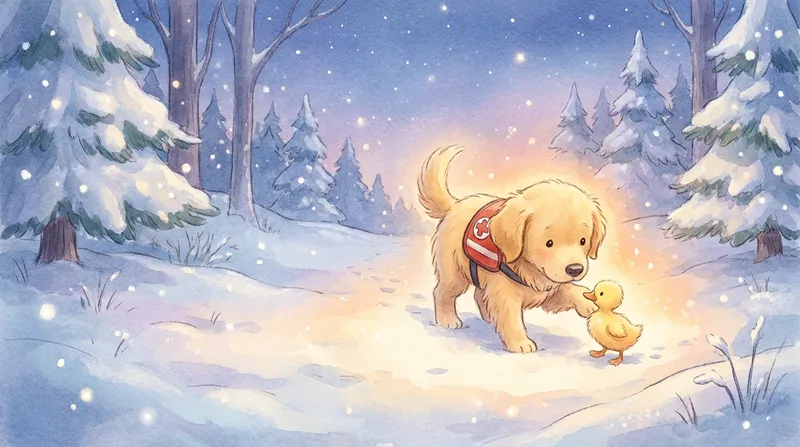
Penny was a brave golden retriever with a special orange vest. She was a trained rescue dog, which meant her favorite thing in the whole world was helping others. One winter evening, a gentle, quiet snow began to fall, covering the farm in a soft white blanket.
While Penny was resting on the porch, she noticed a family of ducks trying to waddle back to their barn. But the snow was getting too deep for their little webbed feet! Penny knew exactly what to do. She trotted out into the snow, keeping her body low. Using her strong paws and her warm nose, she began to dig a clear, safe path through the snowdrifts.
She worked calmly and steadily. The ducks followed closely behind her, quacking soft "thank yous" all the way. Once the ducks were safely tucked into the warm hay of the barn, Penny shook the snow from her golden fur and curled up by the fireplace, feeling proud and very, very sleepy.
Actionable Tip: Turn this into an interactive breathing exercise. Have your child mimic Penny's "calm, deep sniffs" as she works through the snow. Deep breathing is a proven way to relax the body. You can also use stories like this to smooth out daytime transitions, as we discuss in Toddler & Kids Morning Routine: How a Custom Story Can Stop the Rush.
Story 3: The Little Fire Truck That Saved the Kitten
In a quiet little town, there lived a small, shiny red fire truck named Buster. Unlike the big trucks that zoomed around with loud sirens, Buster liked to take things slow. His engine made a soft, humming purr.
One evening, the firefighters received a call. A tiny orange kitten had climbed too high up in a tall maple tree and was too scared to come down. Buster drove carefully down the street, his lights blinking in a slow, steady rhythm. When they arrived, Buster did not make any loud noises that might scare the kitten.
Instead, he slowly, gently extended his long silver ladder up, up, up into the branches. A friendly firefighter climbed up and scooped the kitten into his arms. Buster lowered the ladder just as smoothly. The kitten purred, the firefighters smiled, and Buster hummed his quiet tune all the way back to the station for a good night's rest.
Actionable Tip: When telling stories about community helpers, adjust your sound effects for bedtime. If you make a fire truck noise, make it a soft, sleepy "woo woo" instead of a loud, startling siren.
Story 4: The Brave Owl Guides the Way Home
High up in the branches of an ancient pine tree lived Oliver, a wise and watchful owl. Oliver loved the nighttime. He loved the quiet breeze, the silver moonlight, and the twinkling stars.
One night, Oliver looked down and saw a baby deer looking around in confusion. The little deer had lost sight of his mother in the tall ferns. Oliver spread his silent, soft wings and glided down to a low branch. "Follow me," Oliver hooted softly. "I will be your lantern in the dark."
Oliver flew gently from tree to tree, his white feathers catching the starlight to show the little deer the way. The forest was peaceful, filled only with the sound of crickets singing their lullabies. Finally, they reached a moonlit clearing where the mother deer was waiting. Oliver gave a happy hoot and flew back to his nest, closing his big yellow eyes as the forest went to sleep.
Actionable Tip: Enhance gentle bedtime stories for kids by dimming the lights in the bedroom to match the nighttime theme of the story. You can even project stars onto the ceiling. For more magical night sky ideas, read Written in the Stars: Magical Constellation Stories & Myths for Kids.
Story 5: The Forest Friends Work Together
Down by the whispering river, a problem had occurred. A heavy branch had fallen from a tree, blocking the water from flowing into the little pond where the frogs lived.
Benny the Beaver saw the branch, but it was too heavy for him to move alone. Sammy the Squirrel scampered down to help, but even together, they could not budge it. Finally, Daisy the Deer stepped out from the trees. "If we all work together, we are very strong," she said softly.
Benny used his strong teeth to grip the wood. Sammy pushed with his tiny paws, and Daisy used her sturdy antlers to lift. "One, two, three, push!" they whispered together. With a gentle splash, the branch rolled away, and the water flowed freely again. The frogs croaked a happy, sleepy song to say thank you, and the three friends curled up together on the soft moss to rest.
Actionable Tip: Experts at Bright Horizons emphasize that reading at bedtime builds emotional literacy. You can actively involve your child in this story about teamwork and empathy by asking them to "help" the animals push the branch. Have them take a long, deep exhale to "push" the wood, which acts as a physical relaxation technique.
How to Bring These Stories to Life in 3 Simple Steps
Tired of bedtime battles? A familiar story often works better than a stack of new ones, because a child who already knows how it ends can settle instead of staying alert for what comes next.
With Dreamcraft Tale, you can turn these gentle rescue prompts into fully illustrated, personalized books where your child becomes the brave helper. Here is our easy 3-step creation process:
- Imagine: Pick a gentle rescue prompt and cast your child as the hero.
- Create: Let our safe AI generate beautiful illustrations and soothing text.
- Read: Enjoy an ad-free, calming reading experience together.
Turn bedtime from a battle into a magical bonding experience tonight. Try Dreamcraft Tale for Free Today!
Frequently Asked Questions
Why do kids love rescue stories so much?
Young children crave agency and independence. Rescue stories allow them to explore themes of bravery, heroism, and problem-solving in a safe, controlled way. This helps them feel powerful in a world where they are usually the smallest.
How can I make an action story calming for bedtime?
Remove the villains and focus on environmental obstacles, like a fallen log or a lost toy. Speak in a low, slow voice, and ensure the characters use teamwork and patience to solve the problem peacefully.
Are animal rescue stories good for teaching empathy?
Yes, absolutely. Relating to a small animal in need helps children practice perspective-taking. When they imagine how a lost bunny or a stuck kitten feels, they are building the foundational skills for real-world empathy.
What age is best for short rescue stories?
These gentle, wholesome stories are ideal for children ages 2 to 10. This age range is the prime window for developing emotional literacy, enjoying imaginative play, and learning how to process complex feelings through storytelling.
How can I create my own gentle rescue story for my child?
You can use everyday objects, favorite stuffed animals, or family pets as inspiration. Keep the stakes low and the solutions cooperative. For an even easier solution, use a family-friendly AI tool like Dreamcraft Tale to generate perfectly paced, beautifully illustrated bedtime tales in just minutes.