15 Creative Storytelling Activities to Spark Joy and Imagination in Preschoolers
It's that time of day again. You've read the books, sung the songs, and you're fresh out of ideas. Meanwhile, your child is looking at you with those big, hopeful eyes, ready for the next adventure. If you're a parent or educator, you know this feeling well: the desire to provide enriching, screen-free activities, mixed with the exhaustion of constantly having to be the creative director.
We get it. You want to foster your child's imagination and connect with them in a meaningful way, but your creative well is running dry. The good news is, you don't need a cape or a magic wand to be a master storyteller. You just need a few simple ideas.
Storytelling is so much more than just reading from a book-it's a powerful tool for connection and development. We've gathered 15 creative, low-prep storytelling activities perfect for preschoolers and young children that will turn any moment into a magical memory.
Key Takeaways for Busy Parents
- Low-Prep Fun: Find 15 simple, screen-free activities using everyday items.
- Boost Key Skills: Help your child develop literacy, empathy, and problem-solving skills.
- Strengthen Your Bond: Each story is a chance for connection and shared laughter.
- Beat Creative Burnout: Use these prompts when you're tired but still want to create magical moments.
The Magic of Interactive Storytelling for Early Development
Before we jump into the activities, let's talk about why this is such a powerful way to spend time with your little ones. Interactive storytelling isn't just a way to pass the time; it's a developmental powerhouse that builds a foundation for learning, empathy, and creativity.
A Boost for Literacy
When children participate in storytelling, they are actively building crucial skills for reading and writing. According to the National Association for the Education of Young Children (NAEYC), telling stories helps preschoolers learn new words and understand how language is structured. Each story they hear and tell prepares them for future academic success.
Building Emotional Intelligence
Beyond literacy, storytelling is key to social-emotional growth. Experts at ZERO TO THREE explain that creating narratives is a primary way children learn about themselves, their families, and their culture. This "narrative thinking" helps them develop a sense of identity and understand other people's perspectives, which is the bedrock of empathy.
Strengthening Cognitive Skills
Each story a child tells is a workout for their brain. Research highlighted by Reading Rockets, a national literacy initiative, shows that having children retell stories significantly boosts their comprehension and language skills. This simple act strengthens memory, sequencing, and problem-solving abilities.
Part 1: Hands-On Fun with Storytelling Props
You don't need a trunk full of expensive toys to bring a story to life. The most magical props are often the simplest. These hands-on activities use everyday items to engage a child's senses and make stories tangible and unforgettable.
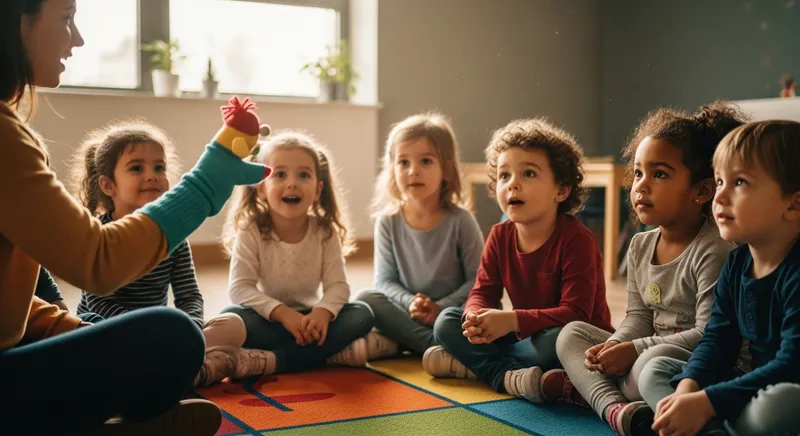
1. Puppet Storytelling Shows
How-to: Turn simple items into characters! A sock with button eyes, a paper bag with a drawn-on smile, or even just your fingers can become the stars of a show. Create a simple stage using a cardboard box or the space behind a sofa.
Actionable Tip: Let your child be the director. Ask them what the puppet's name is and what it wants to do. According to research published by the ERIC Institute of Education Sciences, puppetry is incredibly effective for boosting communication and emotional expression, especially for children who may be shy. For a fun twist, you could even put on your own version of Rosie's Animal Show!
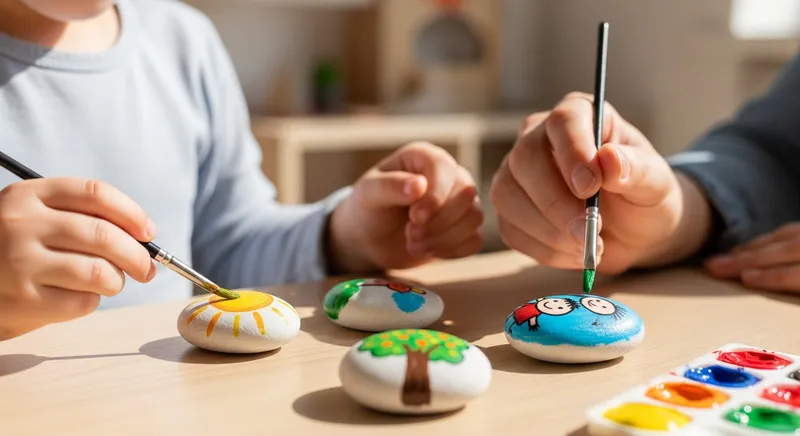
2. Magical Story Stones
How-to: Gather a handful of smooth, flat stones. On each one, draw or paint a simple, recognizable picture: a sun, a key, a boat, a flower, a house, a friendly monster. You don't have to be an artist; simple line drawings work perfectly!
Actionable Tip: Place all the stones in a small bag or box. Have your child pull one out to start the story (e.g., "Once upon a time, under a bright sun..."). Then, have them pull out the next stone to continue the tale ("...a boy found a mysterious key."). This game is fantastic for teaching sequencing and cause-and-effect.
3. Thematic Story Baskets
How-to: Choose a theme and fill a small basket or box with 4-5 related items. For a 'beach' theme, you might include a seashell, a small towel, sunglasses, and a toy fish. For a 'forest' theme, try a leaf, a twig, a pinecone, and a toy animal.
Actionable Tip: Sit with your child and pull out one item at a time, using it as a prompt to build a story together. For example, you could start a story about finding a magical shell, just like in Courtney and the Whispering Shell. This activity is wonderful for helping children make connections between objects and abstract ideas.
4. Sensory Story Adventures
How-to: Create a story that you can act out with sensory experiences. As you tell a story about a walk in the forest, have a bowl of dry leaves for them to crinkle. If the story involves rain, use a small water spray bottle to create a gentle mist. A story about baking could involve smelling cinnamon and vanilla.
Actionable Tip: This is especially powerful for toddlers and children with sensory processing needs, as it engages their whole body in the narrative. (Perfect for ages 2-4 and sensory seekers).
5. Storytelling with Art
How-to: Start with a big, blank piece of paper. Draw a single, simple shape (like a circle or a squiggly line) and ask your child, "What could this be?" A circle could become a sun, a ball, or the eye of a giant. Let their answer guide the next part of the drawing and the story.
Actionable Tip: Flip the roles! Ask your child to tell you a story, and you be the illustrator who brings it to life on paper. They will feel an incredible sense of pride seeing their ideas become art, just like Justine and the Magical Paintbrush.
Part 2: Active & Group Storytelling Games
Sometimes, little bodies need to move! These activities are perfect for getting the wiggles out, encouraging collaboration, and building social skills. They are ideal for playdates, classrooms, or just an active afternoon in the living room.
6. Collaborative Story Circle
How-to: This classic game requires no materials at all. Sit in a circle, and have one person start the story with a single sentence. For example, "Once upon a time, there was a tiny frog who loved to sing..." The next person in the circle adds the next sentence, and so on.
Actionable Tip: To keep things orderly, use a "talking stick" or a soft ball. Only the person holding the object can speak. The goal isn't to create a perfect plot, but to have fun building something together and listening to each other's ideas.
7. Role-Playing Adventures
How-to: Set a simple scene and invite your child to act it out with you. You could be brave explorers climbing a gigantic mountain (the sofa), sneaky spies on a secret mission, or vets taking care of stuffed animals.
Actionable Tip: You don't need elaborate costumes. Say, "Let's put on our invisible explorer hats!" or pretend to wade through a gooey, imaginary swamp. Acting out a story like Pip's Gigantic Climb helps children develop empathy by letting them walk in someone else's shoes.
8. 'What Happens Next?' Scenarios
How-to: This simple technique can be used anytime. When you're reading a familiar book, pause before a key moment and ask, "What do you think happens next?" You can also do this during everyday activities: "The toast just popped out of the toaster! What happens next?"
Actionable Tip: Celebrate every answer. There are no wrong responses! This simple question encourages critical thinking and prediction. As Scholastic points out, listening to stories gives children the tools they need to eventually tell their own.
9. Story Charades
How-to: This is a fun, non-verbal twist on storytelling. Write or draw simple characters or actions from familiar stories on slips of paper (e.g., a roaring lion, a fairy flying, building a house of bricks). Take turns drawing a slip and acting it out for everyone else to guess.
Actionable Tip: Start with easy concepts and get sillier as you go. (Best for ages 4+). It's a fantastic way for kids to express themselves without pressure and connect actions to characters and plots, like the animals in Leo and the Pet Pictures.
10. Outdoor Story Quest
How-to: Turn a simple walk around the neighborhood or a park into an epic adventure. Start with a prompt like, "We are on a quest to find a story." Then, create a narrative based on what you see. A shiny red leaf could be a message from a forest fairy.
Actionable Tip: Frame the walk with a goal, just like Luna's Moon Quest. For example, "Our mission is to find three magical objects before we get back home." This transforms a routine walk into a memorable, imaginative journey.
Running Low on Ideas? Too tired to create from scratch? Browse thousands of ready-to-read, beautifully illustrated stories in our Shared Story Library for instant inspiration. Explore the Library Now!
Part 3: No-Prep Oral Storytelling Prompts
Some of the best storytelling moments happen spontaneously: in the car, waiting in line, or during the quiet moments before bed. These activities require nothing but your voice and your child's imagination.
11. 'Tell Me About Your Day' Story
How-to: Instead of the classic (and often ineffective) question, "How was your day?" try a new approach: "Tell me the story of your day, from beginning to end."
Actionable Tip: Help them structure it like a real story. Ask, "What was the beginning of your story today?" and "What was the most exciting part in the middle?" According to Scholastic, encouraging children to recount events helps them develop long-term memory.
12. Two-Item Stories
How-to: Look around the room and pick two completely random objects. A sock and a banana. A book and a lamp. A pillow and a crayon.
Actionable Tip: Challenge your child (or yourself!) to create a short, silly story that connects both items. The story of the sock who went on an adventure to find his lost banana friend might just become a family legend. It's a hilarious way to spark creativity, much like the quest for Lily's Perfect Pet.
13. 'If You Were...' Stories
How-to: Use hypothetical prompts to unlock a world of imagination. Start with phrases like, "If you could have any superpower, what would it be?" or "If you discovered a hidden door in your room, where would it lead?"
Actionable Tip: Always follow up with, "And what adventure would you go on?" This encourages your child to think beyond the initial idea and build a narrative around it, creating a dazzling story like Dania's Sparkly Adventure.
14. Storytelling with Emotions
How-to: Build emotional intelligence by telling stories about feelings. Start by sharing one of your own: "Let me tell you about a time I felt really brave..." or "I remember a time I felt sad, and this is what happened."
Actionable Tip: After sharing, gently invite your child to do the same: "Can you think of a time you felt really brave?" This creates a safe space to discuss feelings and helps children develop the vocabulary to express their inner world, much like the shy character in Raquel and the Shy Moonbeam. One parent told us, "My son used to clam up, but now we tell 'brave stories' at bedtime, and he's opening up so much more."
15. The 'Never-Ending' Story
How-to: Instead of inventing a new story from scratch every night, create a recurring character or a magical world that you can revisit again and again.
Actionable Tip: This takes the pressure off you and gives your child a comforting sense of familiarity. Every night, you can simply ask, "I wonder what adventure Pip the Penguin went on today?" It becomes a shared world that you and your child can continue to build together over time.
Every Story You Create is a Memory in the Making
The most important thing to remember is that there's no right or wrong way to tell a story. The goal is not perfection; it's connection. Embrace the silly voices, the nonsensical plots, and the moments of shared laughter. Each of these activities is a chance to build your child's brain, boost their confidence, and strengthen your bond.
These 15 activities will fill your creative toolbox for weeks to come. And for those inevitable moments when you're running on empty but still want to provide a magical story experience, Dreamcraft Tale is your backup plan.
Ready to create a personalized, beautifully illustrated adventure in minutes? Try Dreamcraft Tale free and make your child the hero of their own story in just 3 simple steps: Imagine, Create, and Read.
Download Dreamcraft Tale today and start your adventure!
Frequently Asked Questions
At what age should I start storytelling with my child?
You can start from day one! For infants, storytelling is about the rhythm of your voice and the warmth of being close. As the experts at ZERO TO THREE explain, this builds connection and lays the groundwork for language. For toddlers, shift to simple narratives about their day. With preschoolers (ages 3-5), you can introduce more interactive elements like the ones on this list.
What if my child is too shy to participate?
That's perfectly normal. Create a safe, low-pressure environment. Start with non-verbal activities like drawing a story or using puppets to "talk" for them. Research shows puppets can be a wonderful tool for shy children. Always model the fun yourself and celebrate any participation, even just a smile. Never force it.
How can I make up stories if I'm not creative?
You're more creative than you think! The goal is connection, not perfection. Start with a simple prompt from this list, like Two-Item Stories or Story Stones. You can also narrate your own life: "The Story of Our Trip to the Grocery Store" can become an epic adventure. For extra help, you can browse thousands of tales in the Dreamcraft Tale Shared Story Library for instant inspiration.
How does storytelling help with reading skills?
Storytelling is a fundamental building block for literacy. When children tell stories, they learn about narrative structure (beginning, middle, end), expand their vocabulary, and understand how language works. Both the NAEYC and Reading Rockets confirm that strong oral language skills are directly linked to future reading success.
How do I keep my child engaged and focused during storytelling?
The secret is interaction and variety. Keep stories short, use an expressive voice, and be silly. The best way to keep them engaged is to involve them. Ask questions ("What color was the dragon?"), invite them to make sound effects ("Can you make a whooshing sound?"), and incorporate movement. If they start to wiggle, switch to an active game like Story Charades.