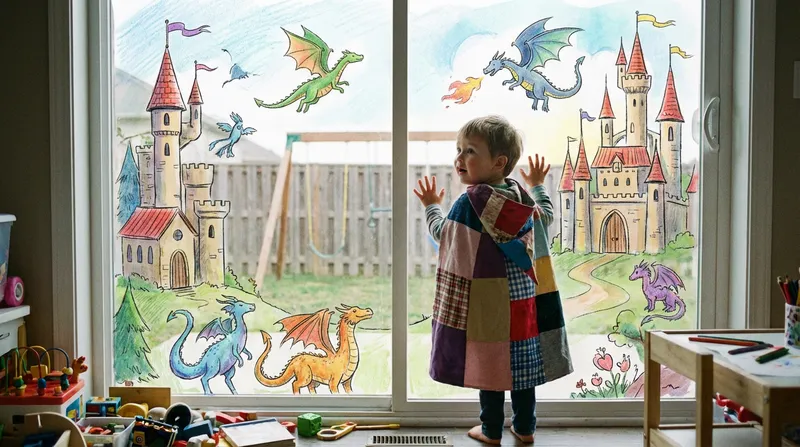
Introduction: The Magical Muscle You Can Help Your Child Build
A simple cardboard box becomes a rocket ship to Mars. A blanket draped over two chairs is a secret jungle fort. A twig found on a walk is a powerful magic wand. If you have a child between the ages of 3 and 9, you’ve witnessed these incredible moments of transformation. This is the magic of imagination.
Think of your child's imagination as a muscle. The more they use it, the stronger, more flexible, and more powerful it becomes. As parents, we have the wonderful opportunity to be their personal trainers in the gym of creativity. But don't worry—it doesn’t require any heavy lifting! It’s about creating small, joyful moments that encourage them to see the world not just for what it is, but for what it could be.
This guide offers 12 simple, fun, and expert-backed ways to help strengthen this magical muscle. From rainy day activities to bedtime routines, you’ll discover how to easily foster the creative thinking that will help your child for years to come. Welcome to the wonderful world where imagination comes to life!
Why Creative Play is More Than Just Fun: The Science-Backed Benefits
While it might look like just fun and games, imaginative play is one of the most important jobs of childhood. It’s so critical, in fact, that the American Academy of Pediatrics has officially called on doctors to prescribe play because it is essential for healthy development.
When children engage in creative play, they are building a powerful foundation for life. This type of play helps them develop:
- Cognitive Skills: By pretending a banana is a telephone, they are learning symbolic thinking, a skill crucial for later understanding letters and numbers.
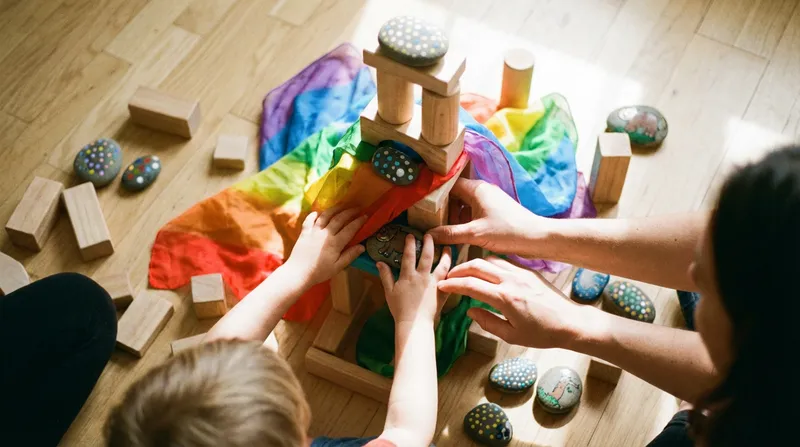
- Problem-Solving: Figuring out how to keep their block tower from falling or how to negotiate roles in a pretend game builds critical thinking. These foundational skills are why digital storytelling is also used in the classroom.
- Emotional & Social Skills: Play allows children to explore complex feelings, act out different social scenarios, and develop empathy for others.
Every make-believe adventure is a workout for your child’s brain, building essential skills for their future.
Part 1: The Art of Storytelling
The oldest form of magic is storytelling. It’s how we make sense of the world, share our dreams, and connect with each other. Here’s how to bring that magic into your daily life.
1. Create a 'Story Box' from Household Treasures
Turn a simple shoebox into a treasure chest of inspiration. Fill it with a collection of simple, open-ended items from around your house:
- An old, ornate key
- A scrap of velvet fabric
- A smooth, gray stone
- A single, shiny button
- A seashell
To start a story, have your child close their eyes and pick one object. That item must now be the star of a brand-new tale. A key doesn't just open a door—it opens a door to a hidden fairy world. A button isn't just from a shirt—it's a tiny shield for a brave mouse. As suggested by creative experts at PBS KIDS for Parents, using simple materials encourages children to see the extraordinary in the ordinary. This is the same magic we tap into with Dreamcraft Tale—turning simple ideas into complete, illustrated adventures.
2. Master Collaborative 'And Then...' Storytelling
This game requires zero props and can be played anywhere—in the car, at the dinner table, or while waiting in line.
Start a story with a single sentence, like, "Once upon a time, there was a little fox who loved to wear boots." Then, your child adds the next sentence, starting with the magic words, "And then..." You continue taking turns, building a wonderfully weird and unpredictable story together. This simple game teaches collaboration and narrative structure. Interestingly, a study published by the NIH National Library of Medicine found that listening to pure storytelling (without pictures) can activate the brain's prefrontal cortex more intensely, suggesting it gives the imagination a more powerful workout.
For more ideas on weaving narratives together, see our guide on how to create a custom bedtime story your kids will love.
3. Reimagine Classic Fairy Tales
Classic stories are a wonderful starting point, but they’re even more fun when you twist them. Encourage your child to ask "What if?" about their favorite tales.
- "What if the Big Bad Wolf was just misunderstood and had a terrible cold? (Ah-choo!)"
- "What if Cinderella’s glass slipper didn’t fit anyone, so she decided to invent comfortable shoes for the whole kingdom?"
This teaches children that stories are not set in stone and that they have the creative power to change the narrative. By doing this, you're helping them see the world from different perspectives. Dive deeper into this idea by exploring how you can create your own reimagined fairy tales.
Part 2: The World of Pretend Play
Pretend play is where imagination puts on a costume and takes center stage. It’s how children process their world, practice for the future, and become anyone they want to be.
4. Dive into Rich Pretend Play Scenarios
You don’t need fancy costumes or elaborate sets. A few simple props are all it takes to transform your living room into a new world. Try setting up:
- A Veterinarian's Office: Use stuffed animals as patients and a toy doctor's kit.
- A Restaurant: Create menus with crayons, use play food, and let your child be the chef or server.
- A Space Station: Use cardboard boxes for control panels and colanders for helmets.
According to the child development experts at ZERO TO THREE, this kind of pretend play is vital for helping children work through new or even scary situations, like a visit to the doctor, in a safe and controlled way.
5. Welcome Their Imaginary Friends
If your child has an imaginary companion, congratulations! It’s not a sign of loneliness, but rather a hallmark of a creative and socially intelligent mind. Research highlighted in Psychology Today shows that children with imaginary friends often have more advanced vocabularies and better perspective-taking skills.
Instead of questioning it, play along. Ask questions about their friend, set an extra (imaginary) plate at the table, or buckle them into their car seat. By validating their world, you are telling your child that their imagination is a wonderful and important place.
6. Let Your Child Be the Director
When you join in on pretend play, your most important job is to be a supporting actor. Let your child take the lead. If they hand you a block and say, "This is stinky cheese, and you have to eat it!" your job is to hold your nose and pretend to take a bite.
By letting them direct the play, you empower them and build their confidence. The experts at Harvard University's Center on the Developing Child emphasize that this kind of responsive, back-and-forth interaction is a core principle for building strong brain architecture.
Part 3: Hands-On Creativity & Exploration
Imagination isn't just in the mind; it's in the hands, too. These activities get children building, making, and exploring the physical world around them.
7. Champion Process Art over Product Art
Often, craft time is focused on creating a specific end product—a perfectly colored turkey or a flawless paper snowflake. This is product art. Process art, on the other hand, is all about the experience of creating.
Provide open-ended materials like paint, clay, recycled cardboard, and glue, and let your child explore without a specific goal. The joy is in mixing colors and feeling textures. The National Association for the Education of Young Children (NAEYC) champions this approach, as it frees children from the fear of "doing it wrong" and encourages true experimentation.
8. Choose Toys That Do Less to Inspire More
In a world of flashy electronic toys that talk and sing, sometimes the most powerful toys are the quietest ones. The best toys for imagination are often described as "90% child, 10% toy." This means the child has to do most of the work to bring them to life. Think of classics like:
- Wooden blocks
- LEGOs or magnetic tiles
- Animal or character figurines
- Play silks or scarves
These open-ended toys can become anything, from a castle to a car to a creature from another planet, providing endless opportunities for creative play.
9. Go on an 'Imagination Walk'
Turn a simple walk around the block into an epic adventure. As you stroll, ask open-ended, wonder-filled questions:
- "What do you think that puffy cloud looks like?"
- "If that twisty stick was a magic wand, what would be its first spell?"
- "That path looks a bit secret. Where do you think it leads?"
This simple habit teaches children to look closer and see the hidden magic in their everyday environment, turning a mundane walk into a quest.
Part 4: Bridging Traditional Play with Digital Magic
Now, let's address the elephant in the room: technology. Many parents worry about screen time, but what if we could harness technology to amplify creativity rather than just replace it? The secret is to use it as a tool for creation, not just consumption.
10. Redefine 'Screen Time' as 'Creative Time'
The debate around screen time often misses a key point: not all screen time is created equal. There’s a huge difference between passively watching videos and actively using a safe, creative digital tool to create something new. For a deeper dive, explore our thoughts on moving beyond screen time with interactive storytelling.
Think of certain apps and programs as a modern-day paintbrush or a digital set of building blocks. When technology is used to draw, compose music, code a simple game, or write a story, it becomes a powerful amplifier for your child's imagination.
11. Make Your Child the Hero of Their Own Digital Story
This is where technology can do something truly magical: it can take all the amazing ideas from your child's head and turn them into a finished, polished creation. Imagine taking the story you co-created about the fox with boots and instantly turning it into a beautifully illustrated digital book where your child is the hero.
With Dreamcraft Tale, you can customize your child's name, appearance, and personality—making them truly the protagonist of every adventure. When children see their ideas validated this way, it's incredibly empowering. It sends a clear message: your imagination is powerful, and your ideas are worth sharing. For more on this, check out our parent's guide to AI storytelling.
12. Create a 5-Minute Bedtime Story Together
Let’s be honest: some nights, you’re just too tired to invent another story from scratch. This is where creative technology can be a parent's best friend. You can co-create a completely unique, personalized story in just a few minutes, turning a stressful bedtime into a moment of connection.
With a tool like Dreamcraft Tale, you can ensure that even on busy days, you can share a high-quality, imaginative story that makes your child feel seen and celebrated. And when you're completely out of ideas? You can browse our Shared Story Library for instant inspiration from other families. It's the perfect solution for creating those 5-minute bedtime stories that feel both special and manageable, as research from Duke University's Center for Child & Family Policy shows the richness of language used during storytelling has long-lasting benefits for literacy skills.
Bringing It All Together: Your Imagination Toolkit
Fostering your child’s imagination isn't about scheduling elaborate activities or buying expensive toys. It’s about being present, asking “what if?”, celebrating their wonderfully weird ideas, and giving them the space and tools to explore.
By weaving these simple practices into your life, you are building a priceless toolkit for your child—one filled with creativity, confidence, and a lifelong love of stories. And when you want to add a touch of modern magic to that toolkit, we’re here to help.
Ready to turn your child's amazing ideas into a beautifully illustrated story you can treasure forever? Try Dreamcraft Tale free today and create your first personalized adventure in minutes!
Frequently Asked Questions
What are the first signs of a creative child?
Look for things like detailed pretend play, constantly asking "what if?" questions, having an imaginary friend, and finding unconventional uses for objects (a shoe becomes a boat!). But remember, all children are naturally creative; these are just signs their imagination muscle is getting a great workout!
Is screen time bad for my child's imagination?
It’s all about how it's used. Passively watching hours of videos can hinder imagination. However, active screen time, where a child uses a device as a tool to draw, build worlds, or create stories in a safe environment, can be a fantastic way to boost creativity and bring their ideas to life.
How can I encourage imagination in a child who says they're bored?
Try to see boredom as a good thing—it’s often the quiet space where the best ideas begin to grow! Instead of rushing to fill the void, you can offer a simple spark, like one item from a "Story Box" or asking, "I wonder what that cloud looks like?" Often, just giving them space will lead to the most inventive play.
At what age is imaginative play most important?
While imaginative play is at its peak during the preschool years (ages 3-5), it remains incredibly important throughout childhood. For older kids (ages 6-9), it evolves into more complex social role-playing and creating detailed stories. It’s a skill that grows with them, forming a foundation for innovation and problem-solving. It's why tools for digital storytelling in the classroom are also becoming popular.
What's the difference between imagination and creativity?
Here’s a simple way to think about it: Imagination is dreaming up the idea (a castle in the clouds with a friendly dragon). Creativity is doing something with that idea (drawing the castle, building it with blocks, or telling a story about it). Imagination is the spark, and creativity is the fire it builds.