Introduction
It's bedtime. You've read the classics, you've told the family favorites, but you're still met with the question: "Just one more story?" You want to give your child something meaningful, but you're tired of the same old fables. You want to talk about being kind online, caring for the planet, or handling big feelings, but it feels too much like a lecture.
We get it. As parents, we're looking for ways to gently guide our children through the complexities of the modern world. The good news is that the best stories have always been our greatest teachers. Reading together is more than just a routine; it's a powerful tool for connection and growth. In fact, the American Academy of Pediatrics (AAP) recommends reading aloud to build resiliency and strong parent-child bonds that support social-emotional health.
That's why we've created this collection of 10 complete, short moral stories for kids. These aren't the fables you grew up with. These are modern tales for today's children, filled with lessons on kindness, courage, and creating a greener world, ready for you to read aloud tonight.
Why Modern Moral Stories Matter for Today's Kids
The Tortoise and the Hare is timeless, but it won't teach your child about digital citizenship. Classic fables give us a wonderful foundation for core values, but they leave a gap when it comes to the unique challenges of modern life. Today's kids are navigating a world of social media, growing environmental concerns, and a greater emphasis on emotional intelligence.
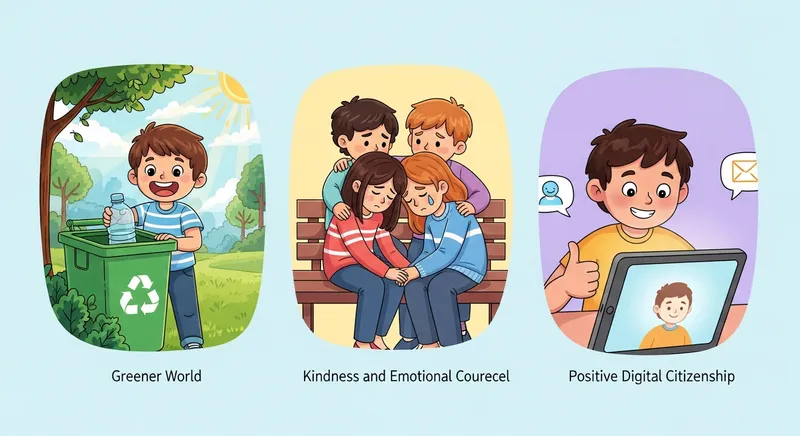
Modern moral stories bridge this gap. They provide a safe space for children to explore complex situations with relatable characters. According to Edutopia, using literary characters helps children learn strategies for navigating social and emotional challenges. By reading about characters who face similar dilemmas, kids can learn, grow, and, most importantly, start wonderful conversations with you.
Part 1: Tales of Kindness and Empathy
Kindness is a timeless virtue, but how it looks has changed. These stories explore compassion in the schoolyard and on the screen. As research shared by PBS KIDS for Parents shows, reading fiction is a powerful way to help children build empathy by letting them step into another person's shoes.
1. The Un-shared Selfie: A Story About Digital Kindness
Leo and his best friend Sam were making silly faces at the park. Leo snapped a picture of Sam mid-sneeze, with his eyes crossed and his mouth wide open. It was a hilarious photo, and Leo's first thought was to share it with their whole class group chat. He pulled up the chat, his thumb hovering over the 'send' button. But then, he paused. He imagined how he would feel if that picture was of him. He would be so embarrassed. It wouldn't feel funny at all. Sam trusted him. With a small smile, Leo moved his thumb to the 'delete' button instead. A funny moment was not worth hurting his friend's feelings.
Moral of the Story: True kindness means protecting our friends' feelings, both online and off. Much like in the story of Leo and the Pet Pictures, thinking before you act is a sign of a great friend.
2. Rosie's Welcome Wagon: A Story About Inclusion
There was a new girl, Maya, in Rosie's class. Maya was very quiet and at recess, she sat on the bench alone, watching the other kids play. Rosie felt a little flutter of nervousness in her tummy. It was scary to talk to someone new. But then she remembered how she felt on her first day. She took a deep breath, walked over to the bench, and said, "Hi, I'm Rosie. We're pretending to be animals from all over the world. Do you want to be a clever fox with us?" Maya's face broke into a huge, relieved smile. "I'd love to!" she said. And just like that, the playground felt a little bigger and a lot friendlier.
Moral of the Story: A small act of courage can make someone feel welcome and create a new friendship. Just like in Rosie's Animal Show!, including everyone makes every game more fun.
3. The Shared Sparkle: A Story About Digital Sharing
Dania's class was working on a giant digital mural of a magical kingdom using a collaborative art app. Dania had earned the most special tool of all: a one-time-use "rainbow shimmer" effect. It was the last one, and everyone wanted to use it for their part of the drawing. At first, Dania wanted to save it for her perfect unicorn. But then she looked at the big, plain castle and the dull-looking dragon. She realized that if she only used it on her unicorn, the rest of the kingdom would be less magical. So, she announced, "Sparkle break!" and let everyone add a little bit of rainbow shimmer to their part of the mural. The finished kingdom shimmered and shone, more beautiful than anything she could have made alone.
Moral of the Story: Sharing what you have, even in a digital space, can create more happiness and beauty for everyone, turning a simple project into a Dania's Sparkly Adventure.
Parent Tip: Sparking Conversation After reading, ask: "How do you think Maya felt before Rosie talked to her? Has anyone ever done something kind like that for you?" Connecting the story to their own life helps the lesson stick.
Part 2: Tales of Courage and Resilience
Courage isn't just about slaying dragons; it's about facing our fears, managing our big feelings, and trying again when we fail. A systematic review published in the Journal of Psychiatric and Mental Health Nursing found that storytelling is a powerful tool for enhancing psychological resilience in children. These tales are designed to help build that inner strength.
4. Pip's Gigantic Climb: A Story About Not Giving Up
Pip was the smallest squirrel in the oak grove, and he had his eyes on the biggest prize: the perfect, golden acorn at the very top of the tallest tree. On his first try, a gust of wind knocked him off. On his second, he slipped on a mossy branch. He felt frustrated and wanted to quit. But instead, he sat on a lower branch to rest. He watched how the older squirrels used their tails for balance and found sturdier paths. Taking a deep breath, Pip tried one more time, using a new route. It was hard, but slowly and surely, he made his way to the top. The acorn was just as perfect as he'd imagined.
Moral of the Story: Success doesn't always come on the first try. It's okay to fail, rest, and try again. Every big goal is just a series of small steps, like Pip's Gigantic Climb.
5. Leo's Roar: A Story About Managing Big Feelings
Leo had spent all morning building the tallest block tower ever. When his little sister toddled by and knocked it over with a giggle, a hot, prickly feeling bubbled up inside him. He felt a big ROAR in his chest and wanted to yell. Just then, his dad came in. "Wow, that's a big feeling," he said calmly. "It looks like you have a lion's roar inside. Let's let it out safely." He showed Leo how to cup his hands over his mouth and let out a soft, controlled "roar." They did it three times. The hot feeling started to fade. "Better?" his dad asked. Leo nodded. Together, they started to rebuild the tower.
Moral of the Story: Big feelings like anger are normal, and we can learn healthy ways to let them out without hurting anyone or anything. As experts at ZERO TO THREE explain, giving children words for their emotions, like finding their Lily's Happy Voice, helps them build compassion.
6. Luna's Night Light: A Story About Facing Fears
Luna was afraid of the dark. As soon as the lights went out, the shadows in her room turned into spooky monsters. One night, her mom suggested a new game. "The moonbeams are friendly guides," she whispered. "They are checking on you." Luna peeked out from under her covers. She saw a long, skinny shadow from her lamp and a lumpy one from her pile of stuffed animals. She took a deep breath and imagined the moonbeams were painting everything in a soft, sleepy light. The shadows weren't monsters after all; they were just her familiar things in their pajamas. The moonbeams were like shy friends, just like in the story of Raquel and the Shy Moonbeam.
Moral of the Story: Our imagination can make us feel scared, but it can also make us feel brave.
Parent Tip: Building Resilience When you finish a story, ask: "What do you think Pip will do next time he can't climb the tree?" This encourages problem-solving and a growth mindset, reinforcing the idea that it's okay to try a different way.
Part 3: Tales for a Greener World & Modern Honesty
Teaching kids to care for the environment and be honest can feel like a huge task, but it starts with small, empowering actions. These stories show children that their choices matter and that they can be powerful protectors of our planet and their own integrity.
7. The Little Recyclers' Club: A Story About Teamwork for the Planet
Asha, Tom, and Mia loved playing at Sunny Meadow Park, but lately, they kept finding plastic bottles and wrappers in the grass. "This makes the park sad," Asha said. So, they decided to form "The Little Recyclers' Club." They made a poster showing which things were trash and which could be recycled. During their next playdate, they walked around the park with two bags, sorting everything they found. Soon, the park was clean again, and the club had new members from all over the neighborhood.
Moral of the Story: Working together to care for our environment can make a big difference, and every helper counts, just like in The Great Green Quest.
8. Courtney and the Whispering Shell: A Story About Protecting Our Oceans
While walking on the beach, Courtney found the most beautiful, swirly shell. She picked it up and held it to her ear, expecting to hear the ocean. Instead, she imagined the shell was whispering a secret: "The turtles think the plastic bags are yummy jellyfish, and it makes them sick." Courtney looked at the ocean with new eyes. She saw a plastic bag floating near the shore. For the rest of the day, she and her family walked the beach with a bag, picking up any litter they found. The shell's whisper had made her an ocean guardian, just like in the tale of Courtney and the Whispering Shell.
Moral of the Story: We are all guardians of the ocean and its creatures, and we protect them with our actions.
9. Justine's Magical Garden: A Story About Nurturing Nature
Justine received a single, tiny seed from her grandmother. "It's magical," her grandma winked. Justine also had a magical paintbrush that could paint anything she imagined. She wanted to paint a giant sunflower, but then she looked at the little seed. She realized the real magic wasn't in her brush, but in the seed itself. So, she planted it in a small pot. Every day, she used her paintbrush to gently drip water onto the soil and to pretend to paint sunshine on its leaves. Slowly, a sprout appeared, until one day, a tall, bright sunflower stood in her garden, grown not by paint, but by her patience and care.
Moral of the Story: The magic of nature is in our hands when we care for it and help it grow, a lesson also found in Justine and the Magical Paintbrush.
10. Mark and the Mistaken Purchase: A Story About Honesty
While playing a game on his dad's tablet, Mark accidentally tapped a button that bought a pack of "Super Gems" for ten dollars. His heart pounded. He thought about hiding the app or pretending he didn't know what happened. But he remembered his dad once said, "I will always trust you more than I love any game or any money." He was scared, but he went to his dad. "I'm so sorry. I was playing a game and accidentally spent real money." His dad looked at the tablet and then at him. He gave him a hug. "I am not happy about the money," he said softly. "But I am so, so proud of you for telling the truth." Together, they figured out how to add a password for purchases.
Moral of the Story: Honesty is the foundation of trust, and it's more important than any mistake.
Parent Tip: Nurturing Honesty After this story, you can say: "The moral is that honesty builds trust. That's why I was so proud when you told me about the crayon mark on the wall." This reinforces that your love is unconditional, even when they make mistakes.
How to Use These Stories to Start Conversations
Reading these stories is just the beginning. The real magic happens in the conversation that follows. This is how a short story becomes a lasting lesson. As the National Association for the Education of Young Children (NAEYC) highlights, using narrative helps make a child's strengths and learning visible to them.
Here are a few tips:
- Ask Open-Ended Questions: Instead of "Was that a good choice?" try "What do you think Leo should do if his friend wants to post a silly picture of him?"
- Connect to Their World: Gently link the story to your child's own experiences. "That reminds me of when you shared your stickers with your cousin. That was so kind."
- Use the 'Moral' as a Guide: The "Moral of the Story" is a great summary to repeat and connect to your own family values.
And when you run out of our stories? You can create your own! With the Dreamcraft Tale app, you can turn any moral or situation into a personalized adventure, making your child the hero who learns the lesson. It's a wonderful way to keep the magic and the learning going.
Your Storytelling Adventure Awaits
Love these stories? With Dreamcraft Tale, you can create unlimited modern moral tales personalized to your child's world, making them the hero who learns about kindness, courage, and caring for our planet.
Start your first story together tonight!
Frequently Asked Questions
What makes a moral story 'modern'?
A modern moral story tackles themes relevant to today's world that classic fables might not cover. This includes topics like digital kindness and online etiquette, environmental responsibility, managing complex emotions, and celebrating diversity and inclusion. The goal is to provide children with relatable characters and situations that reflect their own lives and challenges, making the moral lessons more impactful and easier to discuss.
How do short stories actually teach morals to kids?
Stories are powerful teaching tools because they allow children to explore complex social and emotional situations from a safe distance. When a child reads about a character making a choice and seeing its consequences, they learn vicariously. This process helps develop empathy by encouraging them to step into the character's shoes. It provides a shared vocabulary for you and your child to talk about difficult concepts, turning a simple narrative into a lasting lesson in character.
What are the most important morals to teach a child?
While there are many valuable lessons, some of the most foundational morals for building strong character include: Honesty (building trust), Kindness (showing compassion to others), Empathy (understanding others' feelings), Resilience (the courage to persevere through challenges), Respect (valuing others and their differences), and Responsibility (for one's actions and for the community and environment).
At what age should I start reading moral stories to my child?
You can begin sharing stories with moral themes at a very early age. For toddlers (1-3), simple board books about sharing or being kind are perfect. As children enter preschool and early elementary school (4-9), you can introduce stories with more complex plots and moral dilemmas, like the ones in this article. The key is to match the complexity of the story and its lesson to your child's developmental stage to spark curiosity and conversation.
Are fables and moral stories the same thing?
They are closely related, but not identical. A fable is a specific type of moral story that traditionally uses anthropomorphic animals, plants, or forces of nature as characters to deliver a clear moral lesson (e.g., The Tortoise and the Hare). A moral story is a broader category that includes fables but also encompasses stories with human characters in realistic settings. All fables are moral stories, but not all moral stories are fables.